The mug in my hands shook the moment I recognized my daughter’s voice coming from the one room in the house she was never supposed to enter.
Vicente Castañeda’s office.
For a second, I could not move.
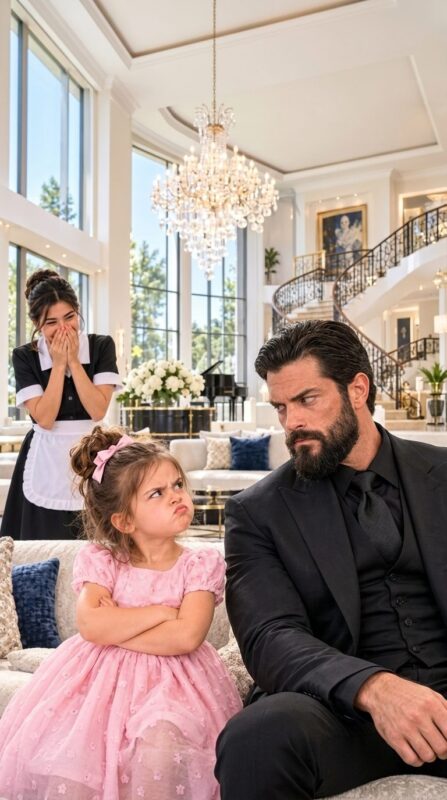
I was thirty-four years old, my name was Sofía Navarro, and for eight months I had been cleaning Vicente’s luxurious home in Zapopan. His staff followed many rules, but one stood above the rest: nobody crossed the threshold of his private office without permission.
That morning, I had already taken a risk by bringing Mía with me.
She was only three.
Her babysitter had canceled before dawn, and staying home would have meant losing money I desperately needed. So I brought her to work, arranged some crayons and snacks near the laundry room, handed her favorite stuffed rabbit to her, and promised ice cream if she stayed put.
When I checked on her at 9:10, she was gone.
I called her name.
Nothing.
I searched the laundry area, kitchen, side hall, and every nearby room.
Then I heard her.
Her tiny voice was coming from Vicente’s office.
The door was open just enough for me to see inside.
Mía stood in front of Vicente’s massive desk in her yellow dress, clutching her rabbit against her chest. Vicente sat behind the desk while his assistant and two security guards watched in complete silence.
Then my daughter did something that made my blood run cold.
She narrowed her eyes.
Pursed her lips.
Folded her arms.
Raised her chin.
She was imitating Vicente’s serious expression perfectly.
I wanted the floor to open beneath me.
Vicente looked at her.
Then he noticed me in the doorway.
I hurried inside.
“Mr. Castañeda, I’m terribly sorry. My babysitter canceled, and I had no one else. I’ll take her out immediately. It will never happen again.”
He lifted a hand.
I stopped.
Then he rose from his chair.
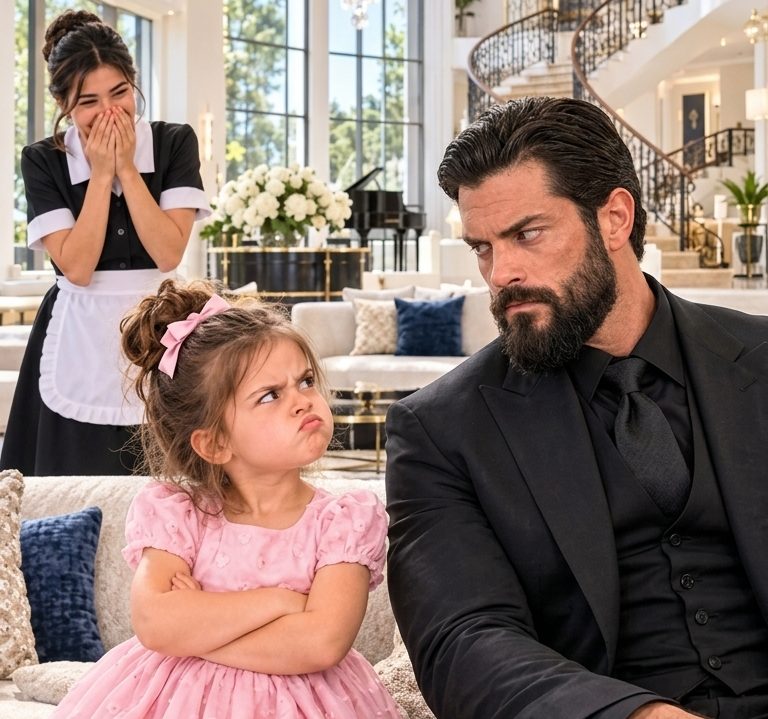
Instead of getting angry, he walked around the desk, lowered himself in front of Mía, folded his arms, tightened his mouth, and raised his chin exactly as she had.
Mía stared at him.
Then she laughed so loudly that everyone in the room froze.
A second later, Vicente laughed too.
It was the first time I had ever heard that sound from him.
“Leave her,” he said. “She can stay.”
From then on, Mía became an unexpected part of the house.
Whenever childcare failed, I brought her with me. Not long afterward, a child-sized table appeared in Vicente’s office. Then came picture books, crayons, puzzles, and toys.
Vicente claimed he had no idea how any of them had gotten there.
I never challenged the lie.
Several months later, I was dusting a cabinet behind his desk when I found an old photograph tucked between some papers.
The moment I saw it, I stopped breathing.
In the picture, a younger Vicente stood at a construction site beside a man wearing a blue safety helmet.
The man beside him was Diego.
My husband.
The man I had buried two years earlier.
When Vicente entered the office and saw the photograph in my hands, all the warmth disappeared from his face.
“You knew my husband?” I asked.
He closed the door before answering.
Diego, he explained, had worked for one of his construction companies.
The official story said Diego had died when scaffolding collapsed unexpectedly.
Vicente had never believed the story was that simple.
He had been standing close to Diego moments before the collapse. Without warning, Diego had shoved him aside.
Seconds later, the structure came crashing down.
For two years, Vicente had believed the accident had been meant to kill him and that Diego had died saving his life.
But then he told me something even worse.
Before his death, Diego had been quietly documenting serious problems at several construction sites.
Unsafe materials.
Altered inspection records.
Substituted products.
Missing paperwork.
And one name seemed to appear again and again.
Arturo Beltrán.
A powerful businessman with connections to several suppliers.
I was still trying to understand what it all meant when the office door burst open.
Vicente’s assistant hurried inside.
“Mía is missing.”
Everything inside me stopped.
We rushed outside.
The garden gate stood open.
Security footage from that section of the property had disappeared for seven minutes.
Near the fence, a guard found a small yellow shoe.
Mía’s shoe.
A gas station camera several blocks away captured a gray SUV leaving the area during those missing minutes.
The vehicle was eventually traced to an old warehouse.
By the time we arrived, police had surrounded the building.
I barely remember entering.
All I remember is hearing someone shout that a child had been found.
I ran toward the voice.
Mía was sitting inside a small back office.
Alive.
Frightened.
But unharmed.
I dropped to the floor and wrapped my arms around her.
“Mamá,” she complained softly, “you’re squeezing me.”
I laughed through my tears.
Then a man appeared from deeper inside the building.
Arturo Beltrán.
It quickly became clear that money was not what he wanted.
He wanted something Diego had hidden before his death.
A metal box.
Arturo believed I knew where it was.
As the confrontation continued, his anger made him careless.
He started talking about Diego’s notes.
The photographs.
The material lot numbers.
The records Diego had been collecting.
He accused Diego of preparing to expose what had been happening inside the construction projects.
Vicente’s expression changed.
At that moment, he finally understood the truth.
The scaffolding collapse had never been intended for him.
It had been intended for Diego.
Arturo had wanted my husband dead because Diego knew too much.
Then Arturo said the one thing he should never have said.
He admitted that he had authorized the substitution of a defective batch of construction materials and helped conceal the paperwork.
He did not realize that Vicente’s assistant had been recording everything.
Minutes later, the police moved in.
Three days after Mía came home, we found Diego’s metal box.
Inside was a notebook filled with dates, invoices, photographs, signatures, batch numbers, and handwritten observations.
There were seventeen separate reports concerning hazardous materials used on active construction projects.
One of the authorization records bore Arturo Beltrán’s signature.
But it was not the documents that broke me.
It was a sentence Diego had written eight days before he died.
“If something happens to me, this does not end with me.”
I sat there reading the line again and again.
He had known something might happen.
And still, he had kept gathering evidence.
The contents of the box opened the door to multiple audits and investigations.
Workers who had stayed silent for years began speaking.
Some admitted seeing paperwork altered.
Others had been ordered to ignore dangerous conditions.
A number of employees said they had been too afraid to come forward.
Arturo Beltrán eventually faced charges connected to Mía’s abduction, fraudulent records, and corruption involving the construction businesses.
Seven months later, I attended an official hearing.
Investigators read aloud the names of people whose information had helped expose the scheme.
I was listening quietly when I heard one name that made my chest tighten.
“Diego Navarro.”
For two years, official documents had reduced my husband to a single word:
Deceased.
But that day, a different word appeared next to his name.
Whistleblower.
I cried when I saw it.
Not because justice could return him to me.
It could not.
I cried because the truth about Diego had finally survived him.
He had not simply died in a workplace accident.
He had discovered a dangerous scheme.
He had tried to stop it.
And he had paid for that choice with his life.
A few months later, I left my cleaning job.
With Vicente’s support, I began working in administration for a foundation that helped families who had lost loved ones in workplace accidents.
It was never a future I had imagined for myself.
But every day, it felt as though I was continuing a small part of Diego’s unfinished work.
Mía, meanwhile, never stopped treating Vicente’s office as her second playroom.
Her crayons lived beside his expensive books.
Her toys appeared under his chairs.
Her stuffed rabbit occasionally occupied the corner of his desk.
Vicente continued pretending to disapprove.
One afternoon, I finally asked him something I had wondered about since that first morning.
“Why did you let her stay?”
He looked across the office at Mía, who was drawing quietly at her little table.
Then he smiled.
“Everyone who walked into this room either feared me or wanted something from me,” he said. “She was the first person who looked at me and decided I was funny.”
At that exact moment, Mía glanced up.
She narrowed her eyes.
Pressed her lips together.
Folded her arms.
Lifted her chin.
Vicente immediately copied her.
Mía burst into laughter.
And this time, I laughed too.