The 78-year-old woman had been inside the prison for less than a day when three inmates cornered her in the yard and demanded everything she owned.
When she refused, they knocked her down.
They expected tears.
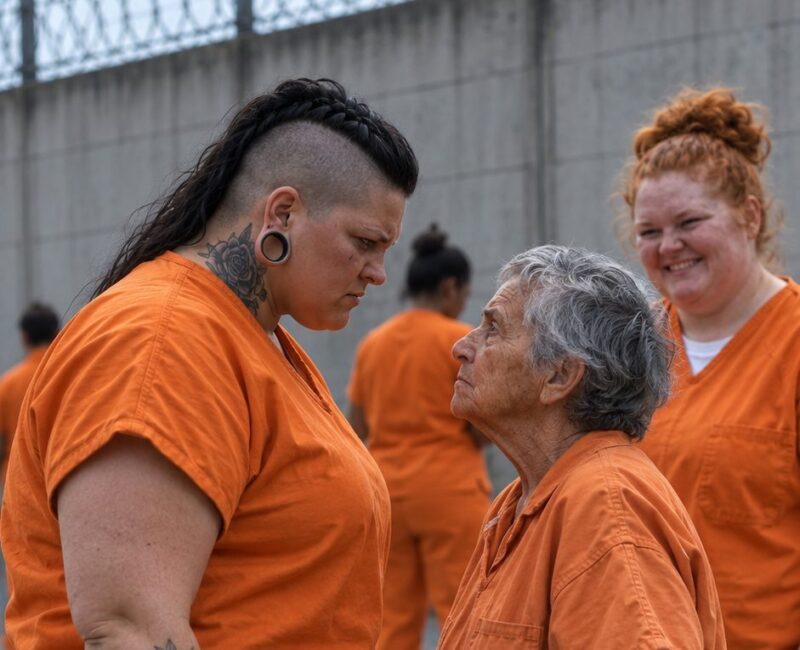
They expected fear.
What they did not expect was that, only minutes later, every voice in the yard would disappear.
The woman had arrived early that morning with a small fabric bag pressed tightly against her chest.
She spoke very little.
Her steps were slow, her hearing seemed poor, and she looked so physically frail that several inmates stopped to watch as a guard led her down the corridor.
“You’ll be taken to the yard shortly,” the guard told her.
She gave a small nod.
By then, however, someone else had already noticed her.
Her name among the inmates was Razor.
She was broad-shouldered, feared, and almost never seen without the same two women at her side. Prisoners learned quickly not to challenge her.
When Razor spotted the elderly newcomer entering the yard, she smirked.
“Look at this.”
Her two companions followed her gaze and laughed.
The old woman tried to continue walking.
Razor stepped in front of her.
“Going somewhere?”
“I’d like to sit down.”
Razor’s eyes dropped to the bag in her hands.
“What’s in there?”
“Nothing important.”
“Then hand it over.”
The woman hugged it closer.
“They’re personal belongings.”
One of Razor’s friends reached toward it.
The old woman stepped back.
“Please leave it alone.”
That only amused them.
Razor grabbed the bag and tore it away.
Its contents fell across the concrete.
A comb.
A faded handkerchief.
A few photographs.
And a small metal case.
Razor stared at the pile.
“That’s all you’ve got?”
The elderly woman lowered herself carefully and started collecting her belongings.
One of the women slid a photograph away with the toe of her shoe.
“That one too.”
The old woman moved toward it.
Around them, prisoners watched.
Nobody intervened.
Razor had built her reputation on making examples of people who resisted her.
As the woman reached down, Razor shoved her from behind.
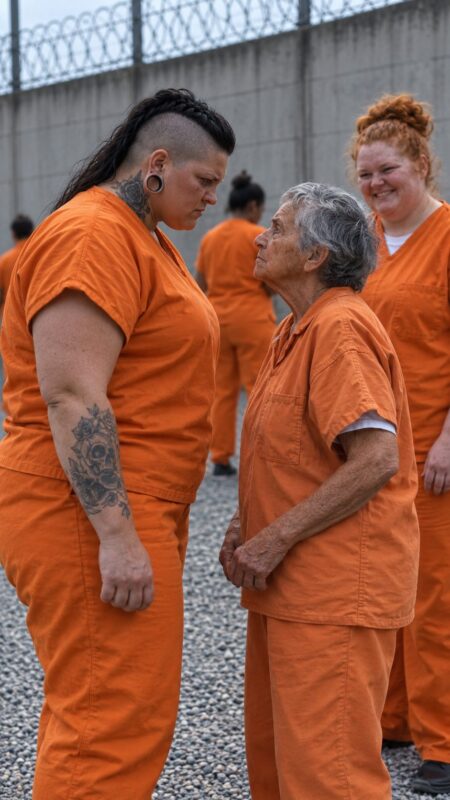
She landed hard on her knees.
A few inmates laughed nervously.
Razor looked down at her.
“This place is too much for you, Grandma.”
The woman tried to stand.
Razor pushed her down again.
“That’s enough,” the old woman said softly.
No one listened.
Then her expression changed.
The tears stopped.
She straightened as much as she could and looked directly at Razor.
There was something different in her eyes now.
Not anger.
Not panic.
Control.
Razor noticed it too.
“What?”
The woman did not answer.
She reached for the small metal case instead.
Razor pointed toward it.
“Open that.”
The old woman held it against her chest.
“No.”
“Why not?”
“Because you don’t understand what you’re asking for.”
Razor took another step forward.
“Give it to me.”
She reached toward the case.
The old woman moved suddenly.
Her fingers closed around Razor’s wrist.
The yard went quiet.
Razor tried to pull away.
She could not.
For someone who looked weak, the woman’s grip was startlingly firm.
She raised her eyes to Razor.
“Pay attention.”
Razor’s expression tightened.
The woman continued.
“You decided what I was the moment you saw me.”
Razor forced a laugh.
“And what are you supposed to be?”
The woman let go.
Then she opened the metal case.
Inside was an old badge made of dark metal.
Razor stared at it.
Nothing about it seemed familiar to her.
But one of the women beside her immediately stepped backward.
Her face lost its color.
“Wait.”
Razor looked at her.
“What?”
“I know that mark.”
“From where?”
The woman shook her head.
She suddenly seemed unwilling to explain.
A guard approached after noticing the gathering.
The elderly woman removed the badge from the case and handed it to him.
The guard barely glanced at it before stopping.
Then he looked again.
His entire posture changed.
“Where did you get this?”
The old woman answered calmly.
“I was instructed to place it directly in the hands of the prison director.”
The guard studied her.
“You know what this is?”
“Yes.”
“And you understand what it means?”
“I do.”
She paused.
“That is why I was brought here.”
Razor’s confidence vanished.
“What does that mean?”
The guard ignored her completely.
Instead, he turned toward the inmates crowding around them.
“Move away from her.”
No one reacted.
His voice hardened.
“Now.”
The group stepped back.
Even Razor.
The elderly woman bent down and collected the rest of her belongings one by one.
She picked up the photographs.
The handkerchief.
The comb.
Then she returned the metal case to her bag.
When she finished, she looked at Razor.
“You wanted to know why I’m here.”
Razor said nothing.
For once, there was no joke waiting on her lips.
No threat.
No smile.
The old woman gave her a long look.
“You’ll have your answer tomorrow.”
Then she walked away with the guard.
No one in the yard spoke until the doors closed behind them.
Razor remained where she was.
For years, she had survived by making other people afraid.
Now, for the first time in a long while, fear had found its way back to her.
Because one thing was suddenly obvious.
That elderly woman had not entered the prison as an ordinary inmate.