My father vanished when I was three years old.
For fourteen years, he was nothing more than a face in old photographs and a name that rarely came up.
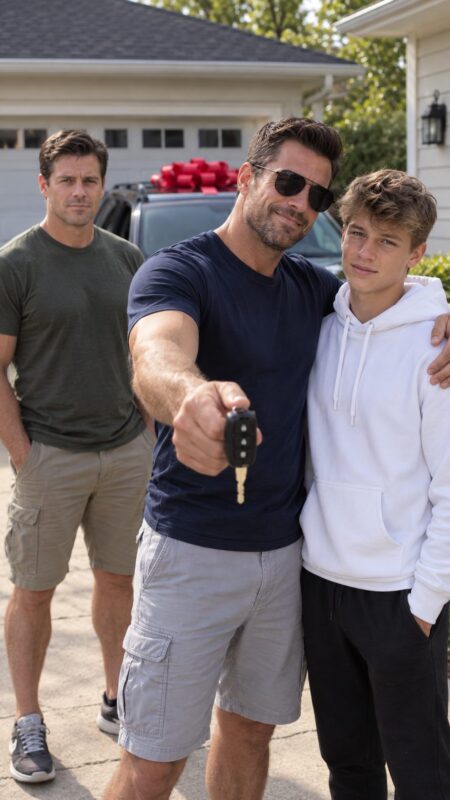
Then, on my seventeenth birthday, he appeared at our front door holding the keys to a brand-new black car.
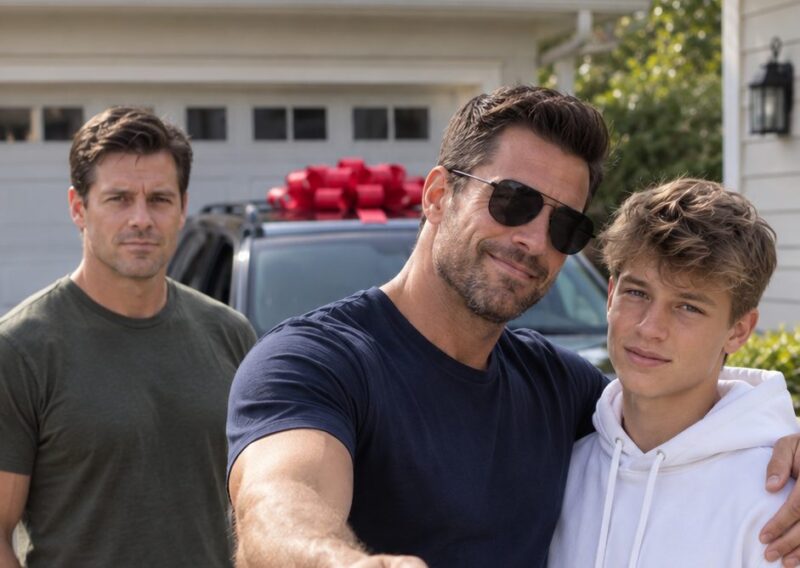
He smiled like he had been gone for fourteen days instead of fourteen years.
“Come on, son,” he said, glancing toward Ray. “Let’s be honest. He was never going to give you something like this.”
I stared at the keys for a moment.
Then I walked back into the house.
When I returned, I was carrying a small wooden box.
That was when his expression changed.
For most of my childhood, my family had been simple.
Mom and me.
Then, when I was fifteen, Ray entered our lives.
He already had two kids of his own. He could have treated me like someone else’s responsibility.
He never did.
Ray never made speeches about being there for me.
He just was.
Every football game, I could find him in the stands.
Even when I barely touched the field.
One night, after sitting through an entire game in freezing weather, I asked him why he had bothered coming when I had only played a few minutes.
He looked confused by the question.
“Because you were playing.”
That answer stayed with me.
So did the nights he sat beside me at the kitchen table while I fought my way through chemistry homework.
I hated chemistry.
Ray hated chemistry too.
But he stayed.
One night, close to midnight, I told him he could go to bed.
He shook his head.
“Parents don’t walk away before their kids are finished.”
Parents.
Kids.
He said it without thinking.
I pretended not to notice.
But I did.
After Ray married Mom, the two of them opened a college account in my name.
I knew they deposited money whenever they could.
What I did not understand was how much those deposits actually cost them.
That changed on my seventeenth birthday.
Ray handed me a wooden box he had made himself.
My initials were burned into the lid.
Inside were bank statements from the college account.
Next to each deposit, Ray had written a small note.
“New boots next month — $40.”
“Packed sandwiches all week — $25.”
“Truck repair can wait — $60.”
Some months had almost nothing.
One note read:
“Danny needed glasses. No deposit this month.”
The following month said:
“Catching up — $80.”
At the very bottom was a folded piece of paper.
Kid,
We’re not there yet.
But we’ll get there.
Ray.
I sat there longer than I expected.
It was not flashy.
It probably cost less than most of my other birthday gifts.
But those pages told me something a bigger gift never could.
Ray had been giving things up for me.
Not once.
Again and again.
Three hours later, the doorbell rang.
A man stood outside in a fitted coat and an expensive watch.
I knew him immediately.
My biological father.
No calls for fourteen years.
No cards.
No visits.
No Christmas messages.
Nothing.
And now he was standing there saying, “I came to see my son.”
He walked me toward the curb.
A brand-new black car sat outside with a massive red bow stretched across the hood.
“Paid in full,” he said.
For one second, I forgot everything else.
I had wanted a car forever.
Then he looked past me toward Ray.
A smug smile appeared on his face.
“Your stepfather can’t compete with this.”
That sentence ruined the gift.
Until then, I had wanted to believe he was trying to reconnect.
Maybe he was sorry.
Maybe this was his awkward way of beginning again.
But suddenly I understood.
The car was not about me.
It was about Ray.
He wanted to win.
So I asked him a question.
“What position do I play?”
He frowned.
“What?”
“Football. What position do I play?”
He hesitated.
“You play football.”
“What position?”
Nothing.
I nodded.
“What schools am I applying to?”
Silence.
“What class almost ruined my GPA last year?”
His face tightened.
“How am I supposed to know all that?”
I looked at him.
“Exactly.”
He held the keys toward me.
“I’m trying to make up for the years I missed.”
“With a car?”
“It’s a beginning.”
Then he added, “It’s more than he gave you.”
I went back inside.
A minute later, I returned with Ray’s wooden box.
My father looked at it and actually laughed.
“That little thing?”
I opened it.
Then I showed him the statements.
The deposits.
The notes.
The months when Ray had postponed buying things he needed.
The lunches he packed instead of buying food.
The truck repairs he delayed.
The boots he kept wearing long after they should have been replaced.
I pointed at the car.
“You bought that with money you could afford to spend.”
Then I looked back at Ray.
“He saved for me with money he really needed.”
My father’s smile disappeared.
“So you think he cares about you more than your real father?”
I stared at him.
“You still don’t know what position I play.”
That was when he started blaming Mom.
He said she had made things difficult.
He said she had pushed him away.
He said I did not know the whole story.
So I asked him something simpler.
“You knew where we lived, didn’t you?”
He said nothing.
“You knew when my birthday was.”
Nothing.
“You found this house today.”
Still nothing.
“You could have called once. Sent one card. Written one letter. You had fourteen years.”
He held the keys toward me again.
For a second, I nearly took them.
I had dreamed about having my own car.
I imagined driving to school, giving friends rides, not having to ask Mom for the keys.
Then I remembered Ray’s old boots.
The brown-paper lunches.
The delayed repairs.
The handwritten notes.
I reached forward.
My biological father relaxed as I took the keys.
Then I closed his hand around them again.
“I’ve wanted a car for two years,” I said.
He stared at me.
“But I wanted a father for fourteen.”
His face went hard.
“So you’re picking him over me?”
I shook my head.
“No.”
Then I glanced toward Ray.
“He already picked me.”
My biological father left a few minutes later.
I watched the black car turn the corner and disappear.
Later that night, I found Ray at the sink washing dishes.
He acted like nothing had happened.
“Thanks,” I said.
He looked over.
“For what?”
“The box. The savings. All of it.”
He shrugged.
I asked why he had done so much when he had never been obligated to do any of it.
Ray dried his hands and looked at me.
“Because you’re my son too.”
That was it.
A month later, Ray finally replaced his old work boots.
The college account kept growing.
So did the notes.
“Survived chemistry — $50.”
“First touchdown — $30.”
Then one I kept long after the others stopped mattering.
“Proud of you — $100.”
My biological father eventually reached out again.
The next time, there was no expensive car waiting outside.
No insults.
No competition.
Just an attempt at a conversation.
Maybe that mattered.
But by then, I had already learned the difference between someone trying to impress you and someone choosing you every day.
One man returned after fourteen years carrying something expensive.
The other had spent nearly two years giving me things with no price tag.
His evenings.
His patience.
His sacrifices.
His presence.
The car disappeared that afternoon.
The wooden box never did.