For twelve years, Shawn Miller had found a reason not to spend Christmas at home.
Work was too demanding. Flights were inconvenient. Deadlines came at the wrong time. There was always another excuse.
This year, he decided not to make one.
He drove to Pinewood Ridge without telling anyone, imagining the look on his parents’ faces when he walked through the door of the farmhouse where he had grown up.
Instead, his sister Brenda answered.
The instant she saw him, her expression changed.
“Shawn?”
He smiled. “Merry Christmas.”
“What are you doing here?”
“Surprising Mom and Dad.”
Brenda remained in the doorway.
Shawn’s smile faded.
“Where are they?”
“They went away for Christmas.”
That made no sense. His parents had barely traveled in recent years.
“Who did they go with?”
Brenda hesitated.
“Uncle Thomas.”
Shawn stared at her.
“Thomas has been dead for four years.”
A flash of panic crossed her face.
“I meant Thomas Junior.”
“You said Uncle Thomas.”
“I misspoke.”
Maybe she had.
But Brenda still hadn’t invited him inside.
Shawn stepped past her.
The farmhouse looked nothing like the place he remembered.
The scratched wooden floors had been refinished. Designer furniture occupied the living room. The kitchen was filled with gleaming new appliances, and expensive decorations covered walls that had once held family photographs.
Shawn slowly looked around.
For years, he had sent his parents $2,000 every month.
Whenever guilt surfaced about how rarely he visited, he reminded himself of those transfers.
The money paid for Dad’s repairs.
Mom’s prescriptions.
Taxes.
Food.
Heating.
At least that was what he had believed.
Twenty-four thousand dollars a year had become Shawn’s way of convincing himself that distance didn’t mean absence.
But standing there now, he wondered how much he actually knew about his parents’ lives.
He walked into the kitchen and opened the refrigerator.
A prescription bottle sat on the shelf.
He recognized his mother’s name.
Maria Miller.
Heart medication.
The pharmacy label showed that the prescription had been filled six days earlier.
“Brenda.”
She appeared in the doorway.
“You said Mom left yesterday.”
“Yes.”
Shawn held up the bottle.
“Without this?”
“She has another bottle.”
“Where?”
Brenda folded her arms.
“I don’t know. In her purse, probably.”
Shawn put the medication back.
Something was wrong.
He could feel it now.
He went outside.
Cold air swept across the property as he walked around the farmhouse.
Near the side of the building, he noticed a gray bundle lying in the dirt.
He bent down.
It was his father’s sweater.
Shawn knew it immediately.
Don Joseph wore that old gray sweater almost every winter, refusing to replace it no matter how many times Maria complained.
Why would he leave it outside if he had gone away for Christmas?
Shawn carried it back into the house.
He had barely closed the door when a faint sound stopped him.
Scrape.
He listened.
Another metallic scrape came from somewhere below.
“What was that?” he asked.
Brenda answered too quickly.
“The furnace.”
Shawn looked toward the floor.
Then he heard a cough.
Weak.
Muffled.
Human.
His eyes moved to the cellar door.
Brenda stepped between him and it.
“Shawn, don’t.”
His stomach tightened.
“Get out of my way.”
“You’re making this into something it isn’t.”
“Then move.”
She didn’t.
Shawn reached around her and pulled the cellar door open.
“Shawn!”
He was already descending the stone steps.
The cellar was freezing.
At first, he saw nothing beyond shelves and storage boxes.
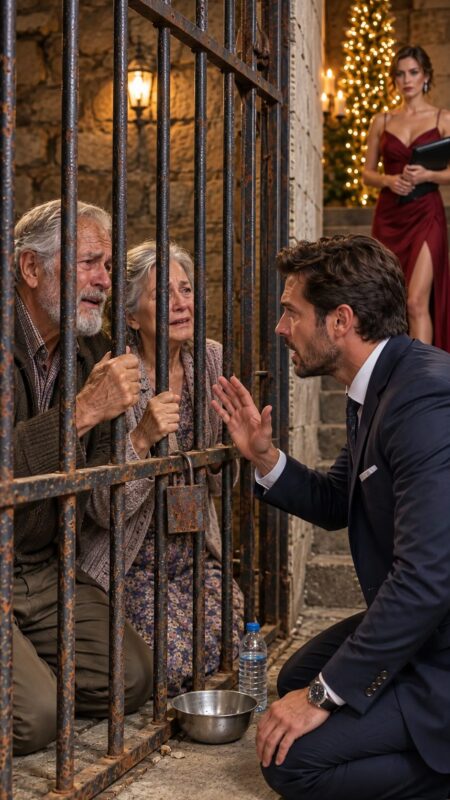
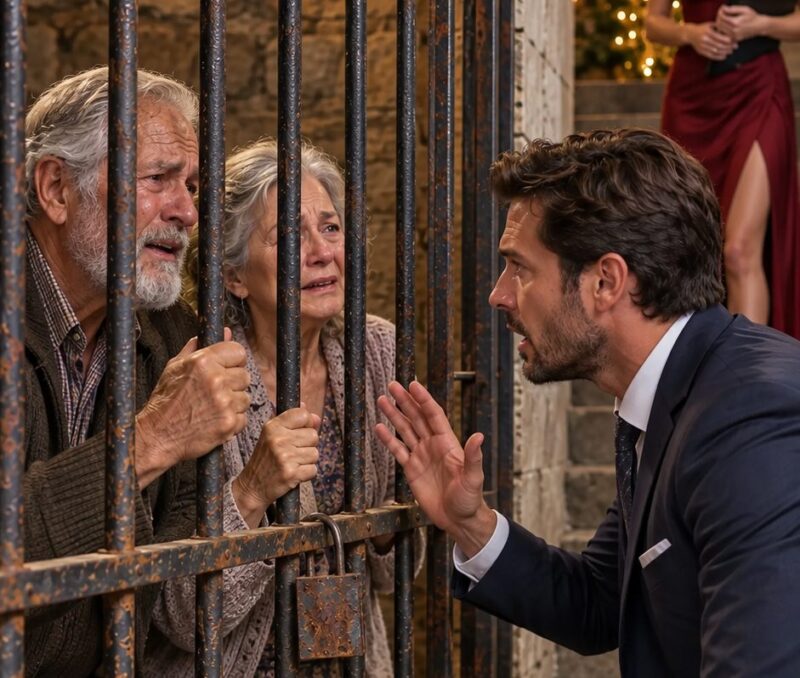
Then he noticed the iron gate at the far end.
A padlock hung from it.
Behind the bars sat two people.
Shawn stopped breathing.
“Mom?”
Maria lifted her head.
His father stirred beside her.
“Shawn?” Don whispered.
Shawn ran toward them.
Maria struggled to stand and reached through the gate.
He caught her hand.
It was ice-cold.
“I’m here,” he said. “Mom, I’m here.”
Footsteps sounded behind him.
Brenda had followed him downstairs.
Shawn turned.
“You locked them in here?”
“Listen to me—”
“You told me they were visiting relatives.”
“It wasn’t supposed to happen like this.”
Don moved closer to the bars.
“Shawn.”
His son turned back.
“The money you send every month,” Don said. “Your mother and I haven’t received it for almost three years.”
Shawn stared at him.
Three years.
Two thousand dollars every month.
Before he could process the number, a car pulled into the driveway.
Brenda went pale.
Eric.
Her husband.
The rest of the truth surfaced quickly.
For almost three years, Brenda and Eric had controlled the account receiving Shawn’s transfers.
At first, they took relatively small amounts and convinced themselves they would replace the money.
Then they stopped pretending.
The money paid for renovations.
Furniture.
Trips.
Debt.
Their lifestyle had quietly been financed by Shawn while his parents received almost nothing.
Eventually, Don discovered the missing funds.
He threatened to tell Shawn.
Brenda and Eric knew that once he did, everything would collapse.
So they locked Don and Maria in the cellar and told neighbors the couple had left town to visit family for Christmas.
Shawn didn’t scream.
He didn’t threaten Brenda.
He simply took out his phone and called the police.
Then he found the tools he needed to open the gate.
The moment it gave way, Maria collapsed against him.
Shawn removed his coat and wrapped it around her.
When officers arrived, Brenda and Eric were taken away.
As Brenda was being led toward the patrol car, she turned around.
“You think you’re better than me?”
Shawn said nothing.
“You left them too,” she shouted. “You just did it from farther away.”
The words followed him long after the police car disappeared.
Brenda’s actions were indefensible.
She and Eric had stolen from two vulnerable people and then imprisoned them to protect their secret.
Nothing Shawn had done made that acceptable.
But her accusation still found its mark.
Because for twelve years, Shawn had confused financial support with being a son.
He had remembered to send money.
He had forgotten to show up.
Christmas morning found him sitting beside his parents in the hospital.
Maria was resting beneath a blanket when Shawn finally spoke.
“I thought I was helping.”
His mother looked at him.
“I kept telling myself that as long as I sent money, you had everything you needed.”
Maria reached for his hand.
“We had enough money.”
Shawn looked toward Don.
“Then what were you waiting for?”
His father gave him a tired smile.
“For our son to come home.”
Three months later, Shawn did exactly that.
He reorganized his logistics company and opened a small office in Pinewood Ridge, allowing him to stay near his parents without abandoning the business he had spent years building.
The farmhouse changed again.
This time, the changes made it more familiar.
Maria replaced the stylish kitchen curtains with the cheerful yellow ones she loved.
Shawn repaired Don’s workshop and helped organize the tools.
Family photographs returned to the walls.
Above the fireplace, they placed a new picture of the three of them.
It was their first together in twelve years.
By the following Christmas, Shawn no longer needed an invitation.
He arrived early with bags of groceries and an embarrassingly ugly sweater that Maria criticized before he had even taken off his coat.
He laughed.
He had missed that too.
Later that evening, Don found him repairing a loose porch railing.
His father watched him work for a moment.
“Do you remember what I told you when you first left Pinewood Ridge?”
Shawn nodded.
“You told me to become a man you could live with.”
Don smiled.
“That’s not what I said.”
Shawn stopped working.
“I said, ‘Become a man you can live with.’”
The distinction stayed with him.
Through the window, Shawn could see Maria beside the Christmas tree, laughing as she rearranged decorations she had already moved three times.
He had spent years chasing the kind of success that could be measured.
Revenue.
Growth.
Contracts.
Money.
But none of those things could measure what he had lost by staying away.
Twelve Christmases were gone.
So were countless birthdays, dinners, conversations, and ordinary days he had once assumed would always be available later.
They weren’t coming back.
Shawn finally understood that regret could become another form of absence if he allowed himself to live inside it.
He couldn’t recover the years he had missed.
He could only be present for the years that remained.
So he put down his tools and followed his father inside.
Maria immediately handed him a box of Christmas ornaments.
Shawn smiled and took it.
For twelve years, he had sent money home.
Now he finally understood what his parents had actually been asking for.
Not his checks.
Not his success.
Not an apology for every year he had missed.
They had simply wanted him.
And this Christmas, he was there.