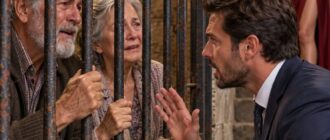
“People are trying to enjoy this flight. Either stop talking or find somewhere else to sit.”
The man across the aisle said it loudly enough for several passengers to turn toward us.
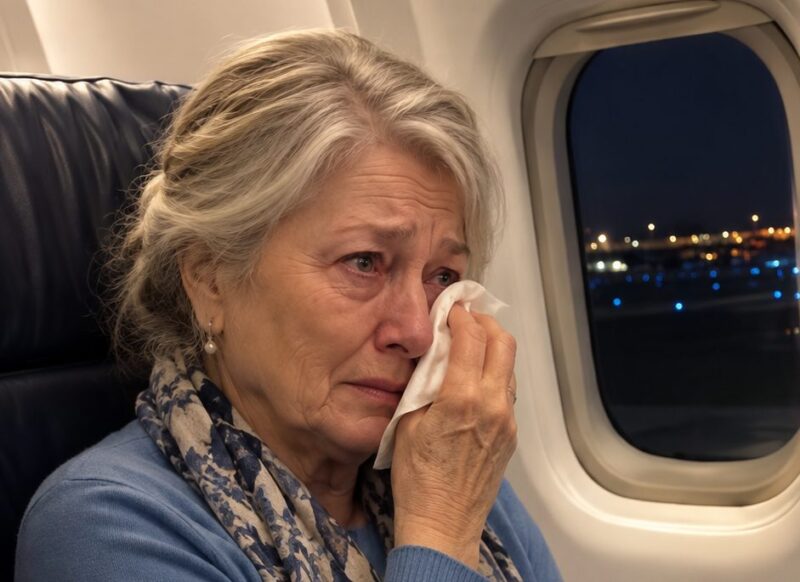
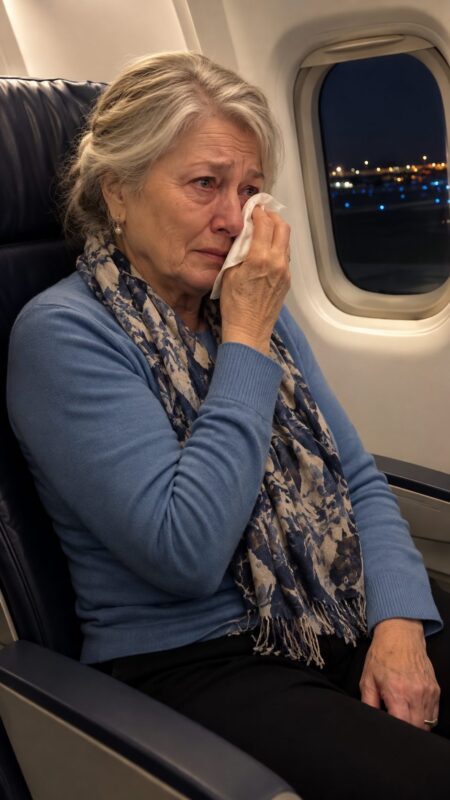
My mother immediately lowered her eyes.
I had no idea that, less than fifteen minutes later, the captain would leave the cockpit because of her.
And when he saw Mom, he stopped in the middle of the aisle.
“Margaret Ellis?”
My mother stared back at him.
She hadn’t heard that voice in thirty-one years.
That morning, I had deliberately given Mom the window seat.
She had always loved looking down at the clouds, and after six difficult months of cancer treatment, I wanted this trip to feel like something normal again.
It was her first time traveling since her diagnosis.
She was nervous, so I kept her distracted with quiet conversation.
About an hour after takeoff, the passenger sitting across from us abruptly closed his magazine.
“Do you mind?” he said.
I looked over.
“Excuse me?”
“Some of us paid for a quiet flight.”
I almost laughed because Mom and I had barely been speaking above a whisper.
Instead, I apologized.
Mom touched my arm.
“Forget about it,” she said softly.
A flight attendant appeared moments later.
Her name was Claire.
Before she could ask if everything was all right, the passenger began complaining.
“They’ve been talking constantly. Can you move them or at least ask them to stop?”
Claire glanced at us, but rather than scolding anyone, she focused on Mom.
“May I see your boarding pass, ma’am?”
Mom handed it to her.
Claire checked the information, then noticed a passenger-care note connected to Mom’s reservation.
She read it carefully.
Her demeanor changed.
Without explaining why, she reached for the intercom.
“Captain, could you please come into the cabin?”
The complaining passenger leaned back as though he had won.
Then the cockpit door opened.
The captain stepped out.
His eyes moved across the cabin until they reached my mother.
He froze.
“Margaret?”
Mom’s mouth fell open.
“David?”
Suddenly, the irritated passenger didn’t matter anymore.
Thirty-one years earlier, David had been a nineteen-year-old student when a motorcycle accident sent him to the emergency department at St. Anne’s.
Mom had been working there as a nurse.
At first, David appeared stable.
But Mom noticed his blood pressure was continuing to fall.
Something wasn’t right.
She raised her concerns, but the initial assessment had already been made. When others suggested monitoring him, Mom kept pushing.
She insisted that someone examine him again.
Eventually, the doctors did.
David had serious internal bleeding.
His condition had been far more dangerous than anyone initially realized.
David never forgot the nurse who refused to accept the first explanation.
Mom, however, barely remembered doing anything extraordinary.
“I was doing what I was supposed to do,” she told him.
David smiled.
“That may be how you remember it. I remember that you gave me another thirty-one years.”
Then we discovered that their reunion wasn’t entirely accidental.
A young physician named Elena had also been working the night David was injured. She was one of the people Mom had challenged when she insisted his condition was worsening.
Elena later became an oncologist.
She also became David’s wife.
While Mom’s travel clearance was being reviewed, Elena had recognized her name. Knowing Margaret was undergoing cancer treatment, she quietly arranged for the airline to be aware that she might require assistance.
The passenger across the aisle had heard everything.
His name was Richard.
Eventually, he stood and walked toward us.
“I’m sorry,” he said. “I didn’t know you had cancer.”
Mom studied him for a moment.
“You’re apologizing for the wrong reason.”
Richard looked confused.
“You didn’t need to know I was sick,” she continued. “You could have chosen not to embarrass a stranger anyway.”
He lowered his head.
“You’re right.”
Then, just as the tension in the cabin began to fade, Mom gripped my arm.
“I don’t feel right.”
Her face had suddenly gone pale.
A doctor traveling on the flight came over and checked her. Mom’s blood pressure was too low, and her oxygen reading was concerning enough that nobody wanted to take unnecessary chances.
David immediately arranged a diversion.
We landed in Omaha.
At the hospital, tests revealed severe dehydration, anemia, and an electrolyte imbalance.
None of those problems alone was catastrophic.
Together, however, they could have become dangerous if Mom had remained in the air for several more hours.
That evening, Elena called.
She wanted to tell Mom something she had carried with her for decades.
The night of David’s accident had changed the way Elena practiced medicine.
Mom’s refusal to accept the first diagnosis had taught her a lesson:
Being right mattered less than remaining willing to discover that you might be wrong.
Years later, Elena was caring for a leukemia patient whose test results appeared straightforward.
But something bothered her.
She remembered Margaret.
She ordered another test.
The new results revealed something the first evaluation had missed, allowing the woman to receive the treatment she needed.
When Elena finished telling the story, Mom began to cry.
She had spent decades caring for patients without ever considering how many lives might have been affected by decisions she barely remembered making.
To her, she had simply been a nurse doing her job.
To other people, those moments had changed everything.
David and Elena came to the hospital the following day.
Before leaving, David gave me an envelope.
Inside were two first-class tickets.
Across the accompanying card, he had written:
NEXT TIME, NO WHISPERING REQUIRED.
Mom laughed harder than I had seen her laugh in months.
Three weeks later, her doctors gave her permission to travel again.
I asked whether she wanted to postpone the trip longer.
She shook her head.
“Fear doesn’t get to make my schedule.”
So we boarded another plane and completed the journey we had started.
A year passed.
Then David and Elena invited us to a ceremony at St. Anne’s.
They had created a nursing scholarship in Mom’s honor.
The Margaret Ellis Speak Up Award would support nurses who demonstrated the courage to question assumptions and advocate for patients whose concerns might otherwise be overlooked.
Even Richard came.
He had contacted David afterward and contributed to the scholarship.
On the drive home, I mentioned how strange it was that everything had begun because one impatient passenger had complained.
Mom immediately corrected me.
“No.”
I looked at her.
“Don’t make his unkindness responsible for everyone else’s kindness.”
She was right.
Richard had created an unpleasant moment.
But he hadn’t created what followed.
Claire chose to pay attention.
David chose to remember.
Elena chose to carry a lesson forward.
And Mom had spent an entire career choosing not to ignore the quiet signs that told her someone needed help.
For months, I had believed cancer was the greatest test of my mother’s courage.
Eventually, I understood that her courage had been there long before the diagnosis.
It was there thirty-one years earlier when a nineteen-year-old patient’s numbers didn’t make sense and she refused to stop asking questions.
It was there every time she advocated for someone who couldn’t advocate for themselves.
And it was there when she looked at Richard and reminded him that compassion should never depend on knowing another person’s private suffering.
Our first flight had started with someone demanding that Margaret Ellis stop talking.
One year later, I watched an entire auditorium rise to applaud her because she had built a life around refusing to stay silent when silence could hurt someone.
She spoke when patients needed to be heard.
She spoke when assumptions needed to be challenged.
She spoke even when doing so made the room uncomfortable.
And after a lifetime of speaking for everyone else, she finally understood that her own voice deserved to be heard too.