I Abandoned My Stepson After His Mother’s Funeral—Ten Years Later, a Stranger Revealed His Secret
I threw my sixteen-year-old stepson out of the house just weeks after his mother died. He wasn’t my biological son, and in my grief, I convinced myself that I owed him nothing.
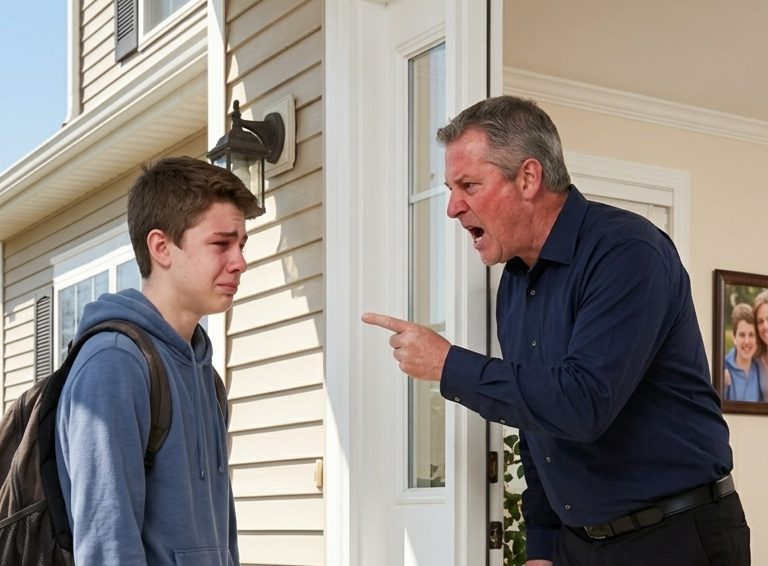
He left with a worn backpack and never contacted me again.
Ten years later, a woman called with an invitation to a prestigious art exhibition. Before hanging up, she asked one question that made my blood run cold.
“Would you like to know what became of the boy you abandoned?”
I had no idea that walking into that gallery would force me to face a truth I’d spent a decade avoiding.
My wife’s death came without warning.
One morning, she was making coffee in our kitchen, reminding me to pick up bread and milk on my way home. We discussed our plans for the weekend and said goodbye as we always did.
By the following evening, she was gone.
The sudden loss shattered everything familiar about my life.
After the funeral, I wandered through our house like a stranger. Her slippers remained beside the bed. Her favorite mug sat on the kitchen shelf. Her perfume still lingered on the clothes hanging in our wardrobe.
Every corner reminded me of her.
But I wasn’t the only person grieving.
Her sixteen-year-old son was grieving too.
When I met my wife, she was a single mother raising a six-year-old boy. His biological father had disappeared years earlier, leaving her to manage everything alone.
After we married, I became responsible for the child’s everyday needs.
I bought his school uniforms, paid his medical bills, attended parent-teacher meetings, and made sure he never went without food or clothing.
Everyone thought I was a devoted stepfather.
The truth was less admirable.
Although I’d provided for him, I never truly opened my heart to him.
I saw him as my wife’s responsibility rather than a son of my own.
While she was alive, I concealed those feelings. I knew how deeply she loved her child, and I never wanted to hurt her.
But after her death, I became bitter and withdrawn.
The boy reminded me of the woman I’d lost, and instead of finding comfort in our shared memories, I began resenting his presence.
He rarely spoke.
Most afternoons, he stayed in his bedroom, sketching in an old notebook or looking out the window.
Sometimes I passed his room and saw him sitting on the floor, holding a photograph of his mother.
I should have sat beside him.
I should have asked how he was coping.
Instead, I complained that he was becoming lazy and ungrateful.
I was so consumed by my own sadness that I failed to recognize his.
Then came the evening that changed both our lives.
We argued over something trivial. I can’t even remember what it was.
Perhaps he’d forgotten to take out the rubbish or left his schoolbooks on the dining table.
Whatever started it, I allowed my frustration to turn into cruelty.
“Do you think you can live here forever?” I shouted.
He looked at me, confused.
“What do you mean?”
“I mean this isn’t your home anymore.”
His face went pale.
“But Mom—”
“Your mother is gone,” I interrupted. “And you’re not my son.”
He stood completely still.
I continued saying things no child should ever hear.
“Pack your belongings. I want you out tonight.”
He stared at me for several seconds.
“Where am I supposed to go?”
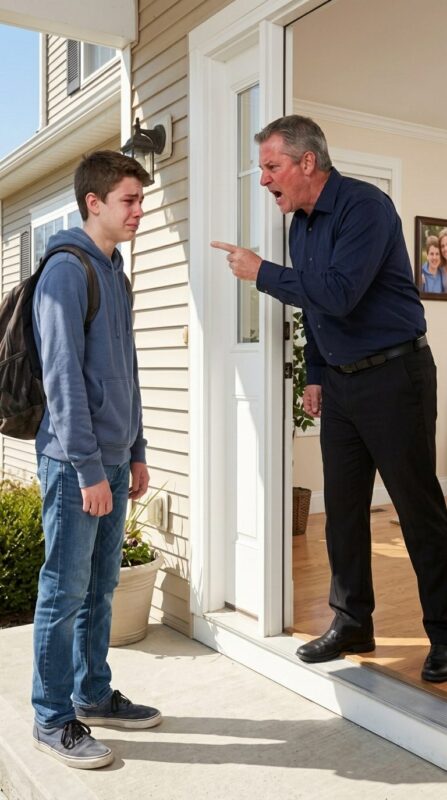
“I don’t know. That’s your problem.”
His eyes filled with tears, but he didn’t argue.
He simply nodded and walked upstairs.
Twenty minutes later, he came down carrying a faded blue backpack.
It contained a few clothes, his drawing notebook, and a photograph of his mother.
He stopped near the front door.
For a moment, I thought he might ask me to reconsider.
Instead, he whispered, “Goodbye.”
I remained silent.
The door closed.
And I let him disappear into the night.
Months later, I sold the house.
I moved across town, invested my savings in a small business, and slowly rebuilt my life.
The business prospered. I bought a comfortable apartment, traveled occasionally, and surrounded myself with new acquaintances.
From the outside, I appeared successful.
But every so often, I remembered the boy standing in my doorway.
I wondered whether he’d finished school, found a job, or managed to build a stable life.
Sometimes I considered searching for him.
Yet I always found an excuse not to.
Deep down, I knew that contacting him would mean acknowledging what I’d done.
Then, exactly ten years after he left, my phone rang.
“Good afternoon,” a woman said. “I’m calling from the Harrington Gallery. We’d be honored if you attended a private exhibition this Saturday.”
I nearly laughed.
“There must be some mistake. I’m not an art collector.”
“Your presence has been specifically requested.”
“By whom?”
She mentioned the name of a celebrated painter whose exhibitions attracted international attention.
I recognized the name immediately.
“But why would he want me there?”
The woman paused.
“Because the exhibition concerns someone you once knew.”
“Who?”
Her next words made me grip the phone.
“The teenage boy who left your house ten years ago.”
I couldn’t speak.
“Please come,” she continued. “There’s something he wants you to understand.”
The call ended before I could ask another question.
For the rest of the week, I barely slept.
On Saturday, I arrived at the gallery wearing my best suit.
The exhibition hall was spacious and beautifully illuminated.
Soft music played in the background, and well-dressed visitors moved quietly between the displays.
But instead of the colorful paintings I’d expected, the walls were covered with photographs.
The first image showed a railway station late at night.
A thin teenage boy was curled up on a wooden bench, using an old backpack as a pillow.
I stopped breathing for a moment.
I knew that backpack.
And I knew the boy.
It was my stepson.
I moved closer.
Beneath the photograph was a date.
It had been taken just days after I’d ordered him out of my house.
The next photograph showed him sitting behind a grocery store, drawing on a piece of discarded cardboard.
Another showed him waiting outside a shelter with several other people.
Farther along the wall were images of a cramped room, a building site, and a small neighborhood art studio.
Each photograph captured another stage of his life.
I began to understand what had happened after he left.
For weeks, he’d struggled to find somewhere safe to sleep.
Eventually, a shelter volunteer helped him obtain temporary accommodation.
The volunteer noticed that the boy carried a notebook everywhere.
He filled its pages with drawings of strangers, buildings, and scenes from his childhood.
Some sketches depicted a woman smiling in a kitchen.
Others showed a lonely figure standing outside a house.
The volunteer gave him paper, pencils, and a few secondhand paints.
Later, the teenager found work cleaning a small art workshop.
He swept the floors, washed brushes, and organized supplies.
The owner soon discovered his talent and allowed him to paint there after working hours.
He continued studying while taking evening jobs to pay his expenses.
Nothing came easily.
But he refused to abandon his passion.
Over time, his drawings became increasingly sophisticated.
A local exhibition featured several of his paintings.
One caught the attention of a renowned artist, who offered to mentor him.
That opportunity transformed his career.
The next photographs showed the boy growing into a young man.
I saw him standing beside his first exhibition.
Then accepting an award.
Then smiling beside collectors and respected artists.
He had become successful.
Not because I’d pushed him away, but because kind people had offered the support I refused to give.
I continued walking until I reached the final display.
There, an enormous portrait showed a handsome young man standing beside a painting of a small house.
The front door was open.
A blue backpack rested on the doorstep.
Beneath the portrait was a simple inscription:
“For the boy who lost his home at sixteen and spent the next ten years creating a place where he belonged.”
My eyes filled with tears.
I stood staring at the painting when someone approached from behind.
“You’re the man he wanted us to invite.”
I turned.
It was the famous artist who had helped launch my stepson’s career.
“Where is he?” I asked.
The man studied me for a moment.
“He’s doing well. He has a home, friends, and a career he’s worked very hard to build.”
I swallowed.
“Does he want to see me?”
The artist didn’t answer directly.
Instead, he held out an old blue backpack.
I recognized it instantly.
The fabric was faded, the zipper had been replaced, and one strap had been stitched back together.
“This belongs to him,” the artist said. “He asked me to show you what he carried when he left.”
I opened the bag with trembling fingers.
Inside were a worn sketchbook, a few personal belongings, and a small photograph.
It showed my late wife smiling beside her son.
I remembered taking that picture years earlier during a family holiday.
On the back, someone had written a message.
I recognized the handwriting immediately.
“You sent me away when I had nowhere to go. For a long time, I believed that meant I wasn’t worth loving. But other people helped me discover that I was. I built a life I’m proud of—not because you abandoned me, but despite it.”
I read those words several times.
The artist spoke quietly.
“He wanted you to see how far he’s come. Not to make you feel guilty, but because he no longer wants that night to define his life.”
I closed my eyes.
For ten years, I’d comforted myself with the idea that the boy had probably forgotten me.
But the photographs proved otherwise.
He remembered everything.
The night at the railway station.
The days without a permanent home.
The strangers who offered him food, shelter, and encouragement.
And the man who had refused to be his father when he needed one most.
I looked around the gallery.
Visitors admired his work and spoke enthusiastically about his future.
They saw a gifted artist whose determination had carried him through extraordinary difficulties.
I saw something else.
A frightened teenager standing in my hallway, waiting for one kind word that never came.
I turned to the artist.
“Could you tell him I’m sorry?”
The man nodded.
“I can pass along your message. Whether he wants to respond will be his decision.”
I understood.
An apology couldn’t return the years I’d missed.
It couldn’t undo the loneliness I’d caused.
And it couldn’t give him back the security he deserved after losing his mother.
Before leaving, I looked once more at the painting of the open doorway.
For the first time, I noticed a small detail.
Beyond the door, warm light spilled across the floor.
The house wasn’t empty.
Someone was waiting inside.
I realized then that my stepson had finally found what I’d denied him.
A place where he was welcome.
Ten years earlier, I’d told a grieving boy he was no longer part of my family.
Now I stood surrounded by evidence of the remarkable man he’d become, knowing that the greatest loss hadn’t been his.
It was mine.