My Mother Treated My Adopted Daughter Like a Servant on Christmas—Until One Letter Exposed Everything
On Christmas Day, I discovered my six-year-old daughter standing alone in my parents’ kitchen, washing the dirty dishes left behind by our entire family.
Meanwhile, her cousins were laughing beside the Christmas tree, unwrapping expensive gifts.
When I demanded an explanation, my father said something unforgivable.
“Those girls are our real grandchildren, Mauricio. Renata needs to understand she doesn’t have the same place in this family.”
I was furious.
But what happened next was even more disturbing.
When I reached for a sealed envelope from an attorney, my mother screamed for me to leave it alone.
And the fear on her face told me she’d been hiding something far more serious than her dislike of my adopted child.
My name is Mauricio DeLuca.
I’ve negotiated contracts worth millions and faced men who thought they could intimidate me. Yet nothing prepared me for what I witnessed that Christmas afternoon.
I’d stepped away to answer a business call.
When I returned, I noticed that Renata was missing from the living room.
My nieces, Sofia and Emma, were sitting on the carpet, surrounded by colorful wrapping paper and expensive toys.
But my daughter was nowhere to be seen.
Then I heard my mother’s voice coming from the kitchen.
“Renata, stop moving so slowly! There are still plenty of plates left.”
I followed the sound.
And what I saw made me freeze.
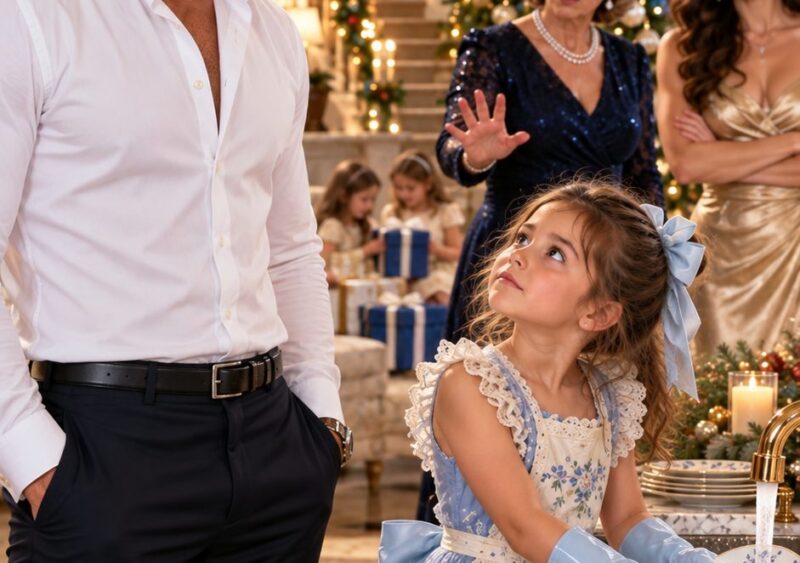
My little girl stood on a wooden stool in front of the sink. Her holiday dress was damp, her sleeves were rolled up, and she was struggling to clean a stack of greasy dishes.
She was so small that she could barely reach the faucet.
“Renata?”
She turned immediately.
“Daddy!”
Her face lit up with relief.
I crossed the room and lifted her off the stool.
“Sweetheart, why are you doing this?”
She lowered her eyes.
“Grandma said I have to help because I’m not like Sofia and Emma.”
I slowly turned toward my mother.
Carmen was standing beside the counter, calmly drying an expensive wineglass.
“Explain yourself,” I said.
She barely looked at me.
“There’s nothing to explain. The child needs discipline.”
“She’s six years old.”
“And six is old enough to learn that privileges must be earned.”
I pointed toward the living room.
“Then why aren’t the other girls earning theirs?”
My father appeared in the doorway.
“Mauricio, lower your voice. It’s Christmas.”
“Exactly. It’s Christmas. So why is my daughter washing everyone’s dishes while her cousins open presents?”
He sighed impatiently.
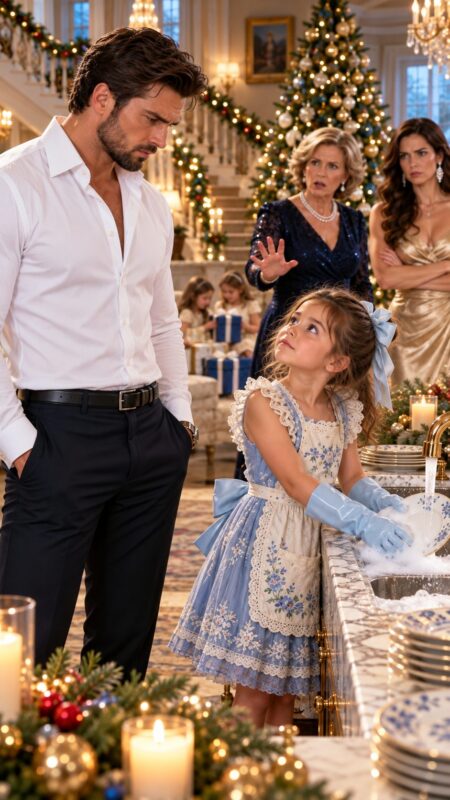
“Because Sofia and Emma are Paola’s daughters. They’re our flesh and blood.”
I stared at him.
“And Renata?”
He shrugged.
“You adopted her. That doesn’t make her our biological granddaughter.”
For several seconds, I couldn’t speak.
I’d brought Renata into my life when she was only two.
She was a quiet little girl who clung to my hand during our first meeting and barely spoke above a whisper.
Over time, she’d grown into a cheerful, affectionate child.
I was there for her first day of school, her birthdays, her scraped knees, and her bedtime stories.
I had never thought of her as anything other than my daughter.
My parents, however, had always been obsessed with ancestry, family names, and inherited wealth.
They spoke constantly about preserving the DeLuca legacy.
I’d dismissed those comments as old-fashioned thinking.
Now I saw what their beliefs had done to my little girl.
Renata touched my face.
“Daddy, are you angry with me?”
I kissed her forehead.
“Never, sweetheart. You haven’t done anything wrong.”
She hesitated.
“Grandma said I shouldn’t expect the same presents because I wasn’t born in this family.”
My chest tightened.
Suddenly, I remembered a drawing Renata had made a few days earlier.
It showed our family gathered around a Christmas tree.
Everyone stood together, smiling.
But she’d drawn herself in a corner, separated from the others by a large empty space.
When I’d asked why, she’d simply said, “That’s where Grandma puts me.”
At the time, I hadn’t understood.
Now I did.
I looked directly at my parents.
“We’re leaving.”
My mother scoffed.
“Don’t be dramatic. It’s only a few dishes.”
“No, Mom. This isn’t about dishes. It’s about how you’ve made my daughter feel.”
I carried Renata into the hallway and reached for our coats.
That’s when I noticed the door to my father’s study, which I’d been using during our visit.
A large envelope was sitting on the desk inside.
It had arrived that morning from a law office.
The accompanying notice referred to Renata’s adoption and requested that I contact the attorney immediately.
I’d planned to read it after dinner.
But now something felt wrong.
I stepped toward the study.
Behind me, my mother suddenly shouted.
“Mauricio! Don’t touch that letter!”
I turned around.
Her expression had changed completely.
The woman who’d been calmly criticizing my daughter moments earlier now looked terrified.
My father hurried toward us.
“Son, there’s no reason to get involved in that paperwork today.”
I narrowed my eyes.
“Why would you care about a letter addressed to me?”
Neither answered.
Then Renata whispered into my ear.
“Daddy, Grandma already read it.”
I looked at her.
“What do you mean?”
“This morning, she took it into Grandpa’s room. They were talking loudly.”
I turned back toward Carmen.
“Did you open my mail?”
She looked away.
That was all the confirmation I needed.
I entered the study, placed Renata gently on the sofa, and picked up the envelope.
The seal had been broken and carefully pressed back into place.
Inside were several legal documents, a handwritten letter, and an old photograph.
I unfolded the first page.
A familiar name caught my attention.
Isabella DeLuca.
My younger sister.
I hadn’t seen her in seven years.
My parents had told me she’d left after a bitter disagreement and wanted no further contact with the family.
A year later, they’d informed me that she’d died abroad.
I’d mourned her for years, believing there was nothing I could have done.
But the photograph inside the envelope showed Isabella holding a newborn baby.
She looked tired but happy.
I turned the picture over.
A date and a name were written on the back.
Renata.
My hands began trembling.
I quickly read the attorney’s letter.
Then I read it again, unable to believe what I was seeing.
Renata was Isabella’s biological daughter.
The little girl I’d adopted four years earlier was my own niece.
I looked toward my parents.
“How long have you known?”
My mother covered her mouth.
My father stared at the floor.
“Answer me!” I demanded.
Carmen began crying.
“We didn’t know how to tell you.”
“Didn’t know how? You watched me adopt my own sister’s child without saying a word!”
My father finally spoke.
“Things were complicated.”
I continued reading.
The attorney’s documents revealed that Isabella had established an inheritance for her daughter.
It included a substantial sum of money intended to provide Renata with financial security as she grew older.
But my parents had concealed the connection between Isabella and Renata.
The documents also described attempts to obtain control over the inheritance.
I looked at them in disbelief.
“You knew she was your granddaughter.”
Carmen said nothing.
“You knew she was Isabella’s daughter, yet you treated her like an outsider!”
My mother wiped her face.
“We were trying to keep the family together.”
I shook my head.
“No. You were trying to protect your control over Isabella’s money.”
My father stepped forward.
“Mauricio, listen. We can settle this privately.”
“Privately?” I repeated. “You lied about my sister, concealed her child, and tried to interfere with what she left behind. And today you made that child believe she wasn’t worthy of being loved.”
My mother began sobbing.
“We never intended for things to go this far.”
I looked at Renata.
She was sitting quietly on the sofa, clutching the little stuffed rabbit she’d brought from home.
She didn’t understand the documents.
She didn’t know anything about the inheritance.
All she knew was that the adults around her were arguing.
Then she looked up at me.
“Daddy?”
I knelt beside her.
“Yes, sweetheart?”
“Does this mean I have a different family?”
I took her hands.
“You have people you’re related to, Renata. But that doesn’t change who we are.”
Her eyes filled with uncertainty.
“Are you still my daddy?”
I pulled her into my arms.
“Of course I am. I was your daddy yesterday, I’m your daddy today, and I’ll be your daddy for the rest of my life.”
She hugged me tightly.
“Even if Grandma doesn’t want me?”
I felt tears gathering in my eyes.
“Sweetheart, you never have to earn a place in my family. You already belong.”
Then I stood and faced my parents.
“From this moment on, you will have no part in deciding Renata’s future.”
The following morning, I contacted the attorney.
Over the next several weeks, we reviewed Isabella’s documents and arranged for Renata’s inheritance to be safeguarded in a legally protected trust.
An investigation was also opened into my parents’ attempts to control the funds.
The attorney shared more details about Isabella’s life and the arrangements she’d made for her daughter.
I learned that my sister’s greatest wish had been for Renata to grow up in a secure, loving home.
I wished I could tell Isabella that her daughter was safe.
That she was loved.
And that I would do everything in my power to protect her.
We never celebrated another Christmas at my parents’ house.
The following December, I decided to create a completely different holiday for Renata.
We decorated our home together.
She chose the ornaments, helped hang the lights, and insisted on placing a handmade golden star at the top of the tree.
On Christmas morning, she hurried downstairs in her red pajamas.
Presents filled the space beneath the branches.
But instead of opening them, she climbed onto the sofa beside me.
“Daddy, can I tell you a secret?”
I smiled.
“Of course.”
She leaned close.
“I asked Santa for something special.”
“What did you ask for?”
She wrapped her arms around my neck.
“I asked him to make sure I could stay with you forever.”
I held her close.
“Renata, you don’t need Santa for that. You’re my daughter, and this will always be your home.”
She smiled.
“Then I already got the best Christmas present.”
I looked toward the tree, its lights glowing softly in the morning sunshine.
For years, my parents had insisted that family was defined by bloodlines, surnames, and inheritance.
But they’d forgotten the one thing that mattered most.
They had rejected their own biological granddaughter while claiming that blood was everything.
And I had loved her as my daughter long before I knew we shared the same family history.
That Christmas, Renata didn’t need to prove she belonged.
She already knew.
And as she rested her head against my shoulder, I realized that the most precious thing in our home wasn’t the inheritance, the decorations, or the presents beneath the tree.
It was the trust of a little girl who finally understood that she would never be unwanted again.