The honeymoon suite looked almost exactly as I remembered it: cedar walls, a stone fireplace, mountains beyond the windows, and one enormous bed in the center of the room.
Jeffrey stared at the bed as though the hotel had made a terrible mistake.
“Where’s the other one?”
“There isn’t another one,” I said. “This is the same suite we had twenty years ago.”
His face tightened.
“I can’t stay here.”
That was not how I had imagined our anniversary beginning.
Five months had passed since my final chemotherapy treatment, and I had planned the weekend because I wanted us to feel married again. For nearly a year, Jeffrey had organized my medication, accompanied me to appointments, sat beside me during treatments, and stayed awake whenever pain kept me from sleeping.
He had been everything I needed.
But somewhere along the way, I had stopped feeling like his wife and started feeling like his responsibility.
Cancer had taken more from me than my health. My hair had only begun growing back, scars crossed the places where surgeons had operated, and the body in the mirror no longer felt like mine.
Jeffrey continued to call me beautiful.
I continued to wonder whether he meant it.
Sometimes I imagined that love had turned into duty—that he remained because honorable men did not leave their wives during cancer treatment.
I had noticed changes in him too. He wore shirts several sizes too large and disappeared into the bathroom whenever he changed. Even at home, he kept the door locked.
I never asked why. I was too busy hiding from my own reflection to notice that Jeffrey might be hiding from his.
Now he lifted his suitcase from the luggage rack.
“I’m going downstairs to ask for another room.”
The words struck harder than I expected.
“You would rather sleep alone than beside me?”
“That isn’t what I want.”
“It certainly looks that way.”
He closed his eyes briefly.
“I need you to trust me tonight.”
Then he left before I could demand an explanation.
I stood alone in the room I had chosen to remind us of who we used to be.
Instead, it reminded me of everything I believed I had lost.
On our honeymoon, my hair had fallen halfway down my back. I had worn a silk nightgown without worrying about scars, swelling, or surgical tape. Jeffrey had looked at me as though I were the only woman in the world.
Perhaps he could no longer look at me that way.
We met for dinner, but the conversation felt painfully artificial. We discussed the drive, the weather, and the hotel renovations. Whenever I mentioned the separate room, Jeffrey avoided my eyes and changed the subject.
After dinner, I returned upstairs alone.
By 11:30, I was sitting on the edge of the bed, crying, when someone knocked.
Jeffrey stood in the hallway.
“I owe you the truth,” he said.
I wiped my face.
“Have you finally decided to admit that you don’t want me anymore?”
He stared at me in disbelief.
“You think I left because of you?”
“What else am I supposed to think? You saw one bed and practically ran.”
Jeffrey entered the room and closed the door.
“I wasn’t running from your body,” he said. “I was trying to hide mine.”
Before I could respond, he began unbuttoning his oversized shirt.
Deep red lines crossed his ribs and stomach, as though something had been pressing painfully into his skin.
I stepped toward him.
“What caused those marks?”
He reached into his suitcase and handed me a black elastic garment.
I unfolded it.
“What is this?”
“Compression shapewear.”
I looked from the garment to him.
“Why are you wearing shapewear?”
Jeffrey sat down and covered his face with both hands.
“Because I gained nearly sixty pounds while you were sick.”
During my treatment, he had barely slept. He stopped going to the gym, ate at irregular hours, and relied on food whenever fear or exhaustion became overwhelming.
He had watched my health deteriorate while pretending he was strong enough to handle everything.
Food became the only comfort he allowed himself.
“I didn’t care what happened to me,” he said. “The only thing that mattered was keeping you alive.”
His clothes gradually stopped fitting, so he replaced them with larger ones and kept the size labels hidden. He began changing in locked rooms because he did not want me to see him without a shirt.
Then I surprised him with the anniversary trip.
“The moment you mentioned this hotel, I remembered our honeymoon pictures,” he said. “I remembered the way I looked when we were here before. I panicked and ordered that thing online.”
He pointed at the compression garment.
“It hurts so much that I can barely sit in it. There was no way I could sleep while wearing it. But if I took it off beside you, you would see how much weight I had gained.”
“So you booked another room?”
He nodded.
“You genuinely believed I would stop wanting you because you had gained weight?”
Jeffrey’s eyes dropped to the floor.
“Yes.”
I should have been angry.
Instead, I suddenly understood how ridiculous—and heartbreaking—the situation was.
We had both arrived at the hotel carrying the same secret.
Each of us believed the other was still lovable.
Neither of us believed it about ourselves.
I sat beside him.
“You aren’t the only one who has been hiding.”
Then I told him everything.
I told him how often I avoided mirrors and how carefully I positioned myself when changing clothes. I admitted that I hated my scars and barely recognized my own face without the hair I used to have.
Most painfully, I confessed that I believed he had stayed because he pitied me.
Jeffrey looked devastated.
“You thought I cared for you out of obligation?”
“Sometimes.”
“I was terrified every day that I would lose you.”
“And I was terrified that surviving would leave me with a husband who no longer desired me.”
He reached for my hand.
“There is nothing cancer could do to your body that would make me stop loving you.”
I squeezed his fingers.
“And there is no number on a scale that could make me stop loving you.”
We looked at each other for a moment.
Then I began to laugh.
Jeffrey stared at me before starting to laugh too.
“Twenty years of marriage,” I said, wiping tears from my cheeks, “and neither of us thought to have this conversation.”
“We’re not nearly as wise as we pretend to be.”
“No,” I agreed. “Apparently, we’re idiots.”
He removed the compression garment and dropped it into his suitcase.
I changed into my nightclothes without turning off the lights or hiding my scars.
When we climbed into bed, Jeffrey hesitated.
I moved closer and rested my head against his chest.
“No more separate rooms,” I said.
“No more locked bathroom doors,” he replied.
“And no more pretending we’re fine when we’re frightened.”
He kissed the top of my head.
“Agreed.”
That weekend did not make us look twenty years younger.
My hair remained short. My scars were still there. Jeffrey returned home carrying the same extra weight he had brought with him.
Nothing about our bodies changed.
What changed was our willingness to be seen.
I had spent the previous year believing that cancer was a battle I had fought alone. Only then did I understand that Jeffrey had been fighting beside me in a different way. He had lived with fear, exhaustion, and helplessness while convincing himself that he had no right to struggle because I was the one who was ill.
I had mistaken his silence for rejection.
He had mistaken mine for judgment.
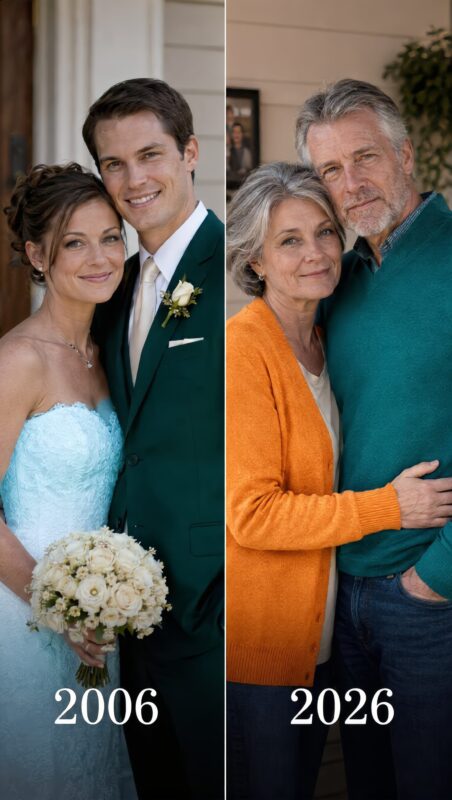
The young couple in our honeymoon photographs had disappeared long ago. Life had altered us through age, illness, responsibility, and loss.
But love had not asked us to remain unchanged.
It had only asked us to remain honest.
Twenty years after our first night in that hotel, we lay in the same room with bodies neither of us had expected and a marriage that had survived more than either of us knew.
We were older.
We were scarred.
We were imperfect.
And we were still choosing each other.
This time, neither of us was afraid to be seen.