“Mom, look up!”
I followed Ethan’s finger toward the enormous screen hanging above the stadium.
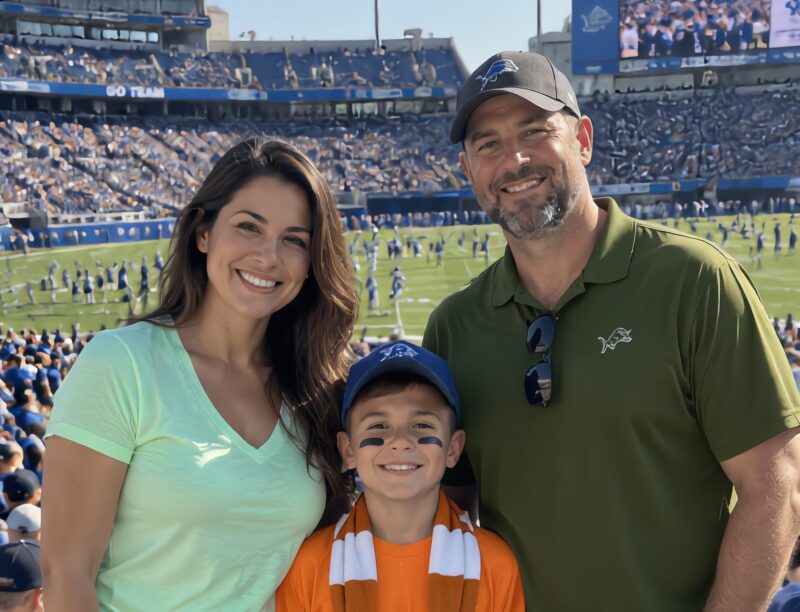
There we were.
Chris on one side, me on the other, and our ten-year-old son squeezed between us in his blue football jersey. Ethan was laughing so hard that his drink tilted dangerously in his hand.
For that brief moment, he wasn’t a patient.
He was simply a boy at a football game with his parents.
Then a voice thundered through the speakers.
“Ethan, we heard this is your first game with us. We also heard someone has been keeping a surprise from you. You and your parents need to look behind you.”
Ethan spun around first.
Chris and I followed.
Coming down the stadium steps was Ray, carrying something we recognized immediately: Ethan’s old tabletop football set. The plastic field was scratched, several players were faded, and one corner had been repaired more than once.
Behind Ray came familiar faces from the hospital—one of Ethan’s nurses, a boy named Cody with his mother, and Leo, a dad Chris had befriended during countless hours in waiting rooms.
Ethan froze.
“How did you guys get here?”
His expression made everyone around us laugh.
Only a few months earlier, football Sundays in our house had been loud, ridiculous, and wonderfully predictable.
Chris argued with coaches who obviously couldn’t hear him through the television.
Ethan argued with Chris.
And I blamed the officials whenever our team was losing.
Then came the appointment that divided our lives into before and after.
Ethan’s treatment was no longer working.
The doctors could not tell us exactly how much time remained, only that there might be far less of it than we wanted.
I reacted by trying to preserve everything.
I photographed breakfast.
I recorded jokes.
I filmed Ethan asleep on the couch and captured pointless debates between him and Chris about quarterbacks and statistics.
Every ordinary second suddenly felt too valuable to lose.
When a wish organization later asked Ethan to choose something special, we expected a complicated answer.
Instead, he said, “Take me to a real football game with my parents.”
That was all he wanted.
On game day, the boy we remembered seemed to return.
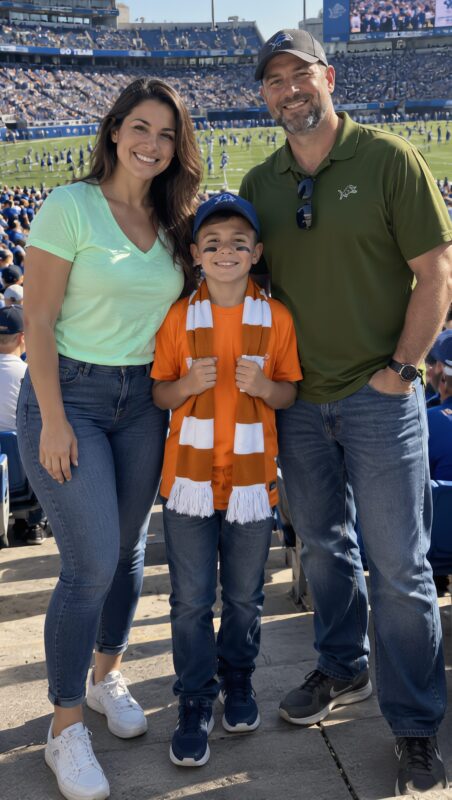
Ethan cheered until his voice became hoarse. He ate some of my pretzel, stole half of Chris’s hot dog, and laughed at strangers screaming instructions toward professional athletes.
But Chris couldn’t stop checking him.
“You warm enough?”
“Yes.”
“Need water?”
“No.”
“Want to sit back?”
“Dad.”
“What?”
“Watch football.”
Chris pointed toward the field. “I am.”
Ethan shook his head.
“You’re watching me.”
That sentence stayed with me.
At halftime, we finally understood the surprise.
Ethan had secretly asked for several members of what he called his “hospital football league” to attend.
The league had started beside his hospital bed with that battered plastic game.
Ethan had only one membership requirement.
Walk into his room, and sooner or later you had to play.
Nurses played.
Visitors played.
Other patients played.
Parents played.
Even people who claimed they didn’t understand the rules were handed a plastic player.
“Everybody plays,” Ethan always said.
Thousands of people applauded when the announcer shared the story.
Later, stadium employees gave us access to a quiet room so Ethan could recover from the excitement.
Eventually our guests returned to their seats, leaving the three of us alone.
I was still holding my phone.
“Why did you want everyone from the hospital here?” I asked.
Ethan glanced at the screen in my hand before answering.
“Because they don’t stare at me all the time.”
I felt my stomach tighten.
Chris leaned forward.
“What do you mean?”
“They know I’m sick, but they still joke with me. They still argue with me. They still make me play.”
“We do that,” Chris said.
Ethan gave him a look.
“Dad, you can’t even watch one play without asking if I need something.”
Chris opened his mouth, then closed it.
Ethan turned toward me.
“And Mom records everything now.”
My phone suddenly felt much heavier.
“You filmed me eating toast yesterday.”
“I wanted to remember it.”
“I know.”
His voice wasn’t angry.
That somehow made it harder.
He looked between us.
“Before I got really sick, Dad would scream at the TV and forget I was even sitting there. Mom would get mad at the referees for ten minutes.”
“They deserve it,” I muttered.
Ethan laughed.
Then he grew serious.
“That’s what I miss.”
Chris stared at him.
“The yelling?”
“Normal stuff.”
The room went quiet.
Ethan rubbed one thumb across the edge of his football game.
“I didn’t ask for today because I wanted everyone making a big deal about me.”
“Then why?” I asked.
“Because I wanted us to have fun together.”
He paused.
“I know everybody thinks every minute has to be perfect now.”
Neither Chris nor I interrupted him.
“But when people try to make every second important, it feels like they’re already saying goodbye.”
I turned my phone off.
Ethan looked at it.
“Sometimes I just want a hot dog to be a hot dog,” he said. “And a football game to just be football.”
Chris reached for his hand.
“I think I understand.”
Ethan raised an eyebrow.
“You think?”
“I’ve spent so much time worrying about losing moments with you that I stopped being inside them.”
Ethan considered this.
“So I was right.”
Chris immediately shook his head.
“Let’s not get carried away.”
That familiar grin returned.
A little later, I asked whether he had enough energy to stay.
Ethan listened to the roar coming from outside.
“Ten more minutes.”
We returned to our seats.
And those ten minutes became exactly what he had asked for.
Nothing special happened.
Nobody mentioned Ethan’s name.
The camera never returned.
Chris complained about the offensive line.
Ethan told him his football opinions were embarrassing.
Then a flag flew onto the field.
I jumped up.
“You have GOT to be kidding me!”
Ethan stared at me.
“Mom, you don’t even know what they called!”
“Doesn’t matter. It was clearly wrong.”
He laughed so loudly that Chris started laughing too.
My hand instinctively moved toward my phone.
I stopped halfway.
Ethan caught me.
“No video?”
“Not this time.”
“Seriously?”
I nodded toward the field.
“I’m busy watching the game.”
His smile was small, but I saw it.
Near the end of the fourth quarter, our team reached the end zone.
The entire stadium seemed to rise at once.
Chris jumped up shouting.
I shouted with him.
Ethan grabbed both of us, laughing in the middle of the noise.
His battered tabletop game slipped sideways, sending one tiny plastic player beneath my seat.
I saw it fall.
I left it there.
There would be time to pick it up.
Right then, Ethan was laughing with his father.
The scoreboard was glowing.
Thousands of strangers were cheering.
And for those few seconds, none of us were measuring time.
Eventually the stadium settled.
Ethan looked at his game.
“Wait—where’s my player?”
I bent down, found the little figure, and handed it to him.
He pushed it back onto the plastic field.
Then he smiled.
“Everybody plays.”
Chris looked toward the real field.
So did I.
And Ethan did too.
No one checked the clock.
No one reached for a camera.
For the rest of the game, we stopped trying to preserve the moment.
We simply lived it.