I had spent nearly six years building a life in Singapore when I booked a flight to Seattle and told no one I was coming.
It was supposed to be a surprise.
During the long trip home, I kept imagining my mother’s reaction. She would open the front door of the soft-blue house I’d purchased after my father’s death, stare at me for two seconds, and then probably start crying.
Instead, Vanessa opened the door.
My younger sister didn’t hug me.
She didn’t even smile.
What caught my attention first wasn’t her expression, though.
It was the jewelry.
Mom’s pearls were in Vanessa’s ears, and the anniversary bracelet Dad had given Mom years ago circled her wrist.
“Clara,” she said flatly. “What are you doing here?”
“Nice to see you too.”
Behind her, the house looked different.
Three unfamiliar vehicles occupied the driveway. Men’s shoes sat beside the stairs. From the second floor came footsteps and the sound of a door closing.
“Who’s upstairs?”
“Tenants.”
My confusion deepened.
“Where’s Mom?”
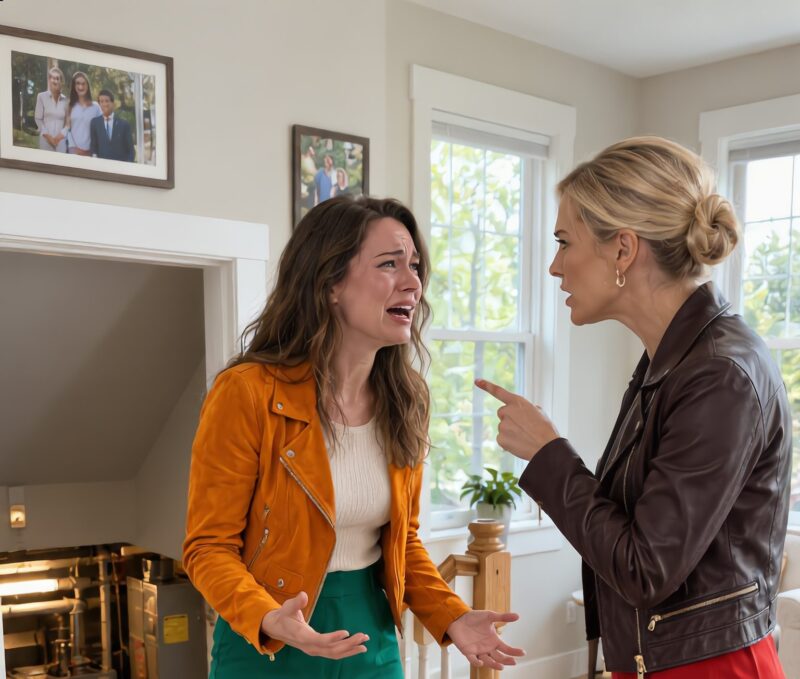
Vanessa pointed toward the basement door.
“Down there.”
I stared at her.
“Seriously?”
She folded her arms.
I didn’t wait for an explanation.
I opened the basement door and rushed down the steps.
What I saw at the bottom erased every question from my mind.
Mom was sleeping beside the furnace on a cheap folding bed.
She still had her coat on.
In June.
Her medications were crowded onto a plastic table beside a half-empty glass of water. Boxes had been piled around her belongings, and a small electric heater was connected to an extension cord that looked dangerously overloaded.
Suddenly, the strange video calls of the previous months made sense.
Mom had always kept the camera close to her face.
Whenever I asked to see the garden, kitchen, or living room, Vanessa would interrupt.
“She’s exhausted.”
“Another day.”
“Don’t bother her.”
I’d believed her.
That mistake burned.
Vanessa came downstairs behind me.
“Before you start accusing me of something, she agreed to this.”
“Mom agreed to live beside a furnace?”
“I needed the bedrooms upstairs. Renting them helps cover the house.”
I turned.
“I cover the house.”
She rolled her eyes.
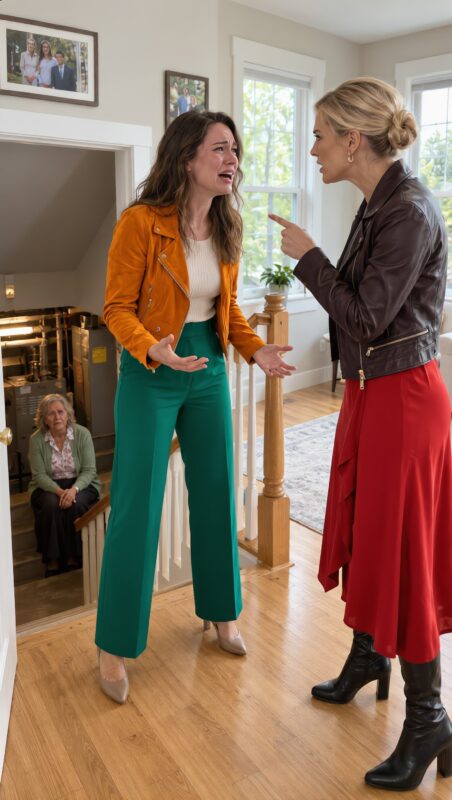
“You don’t know what things cost here anymore.”
Then I noticed a cardboard box tucked behind some old paint supplies.
Inside were letters.
Mine.
Birthday cards. Bank notices. Documents.
None had been opened.
I felt my anger disappear.
Not because I’d forgiven Vanessa.
Because anger wasn’t useful anymore.
Evidence was.
I pulled out my phone.
I photographed the basement from every angle. The unsafe wiring. Mom’s sleeping space. The unopened mail. Then I went upstairs and documented the locked bedrooms and signs that other people were living there.
Vanessa followed me around, complaining the entire time.
I barely listened.
My next call was to Rachel Kim, the lawyer who had helped me purchase the property.
By nine that evening, Vanessa’s confidence was gone.
A knock sounded at the front door.
When she opened it, a city inspector and a police officer were standing outside.
Vanessa immediately blocked the entrance.
“You can’t just walk into somebody’s house.”
I stepped into the hallway.
“They’re not standing outside your house.”
She looked at me.
“What?”
“The property belongs to me.”
For years, I’d paid every mortgage installment, tax bill, insurance premium, and major repair.
Mom had the right to live there for the rest of her life.
Vanessa had no ownership interest whatsoever.
Apparently, she’d convinced herself that six thousand miles of distance meant I had stopped paying attention.
The inspection quickly revealed that three upstairs bedrooms had been rented out.
Vanessa was collecting more than $5,000 every month.
That wasn’t all.
For nearly a year, she’d been messaging me about Mom’s supposed financial problems.
Medicine was getting expensive.
Groceries had gone up.
Mom needed new clothes.
I’d trusted her and sent an additional $800 every month.
Most of it had never reached Mom.
While the inspector was upstairs, Mom quietly touched my arm.
“There’s a blue folder in the bottom drawer,” she whispered. “Take it.”
I found it exactly where she said.
Inside were copies of checks, account statements, handwritten figures, and a document authorizing Vanessa to manage the property.
Mom’s name appeared at the bottom.
I carried it downstairs.
“Did you sign this?”
Mom studied the page.
Then she shook her head.
“No.”
Vanessa stopped talking.
Rachel began searching public records.
Twenty minutes later, she called me back.
Her first words were simple.
“Clara, we have a much bigger problem.”
Four months earlier, someone had filed paperwork claiming I’d transferred the house to Vanessa.
My signature was on it.
So was a notarization supposedly completed in Washington State.
There was just one detail Vanessa hadn’t considered.
On the date printed beside my forged signature, I wasn’t anywhere near Seattle.
I was giving a presentation in Singapore.
There were security records, travel records, emails, and dozens of witnesses to prove it.
The false deed opened another door.
Using it, Vanessa had obtained a $120,000 credit line against the property.
Investigators followed the money.
What they found wasn’t complicated.
Luxury shopping.
Credit-card balances.
Trips.
A leased SUV.
Thousands poured into a boutique that collapsed almost immediately.
Gambling transactions.
Cash withdrawals.
Even Mom’s jewelry had been sold or pawned.
We managed to recover Dad’s watch and Mom’s emerald ring.
My grandmother’s silver tea set was never found.
I thought that would be the hardest thing to hear.
I was wrong.
Late that night, after Vanessa had gone upstairs, Mom finally told me why she’d stayed silent.
Vanessa had convinced her that one phone call to me would have consequences.
She threatened to place Mom in a nursing facility.
Worse, she said she’d tell relatives and doctors that Mom was confused and could no longer make decisions for herself.
Mom had been frightened that no one would believe her.
That explanation hurt more than every missing dollar combined.
Vanessa eventually came downstairs carrying a suitcase.
She stopped near the front door.
For once, she wasn’t looking at me.
She looked at Mom.
“So that’s it? You’re picking Clara?”
Mom slowly stood.
“No.”
Vanessa frowned.
Mom’s answer was calm.
“I’m finally picking me.”
The months that followed were exhausting rather than dramatic.
Investigators traced transactions.
Attorneys filed motions.
Financial records were reviewed.
Signatures were examined.
Statements were taken.
Eventually, Vanessa admitted her role in falsifying documents and obtaining money against property she didn’t own.
There were legal penalties, repayment requirements, and strict limits on her contact with Mom.
Nobody applauded.
There was no spectacular courtroom showdown.
Real consequences rarely look cinematic.
They arrive one document at a time.
Most importantly, the fraudulent transfer was undone.
The house remained ours.
I’d originally requested four weeks away from my job.
By the end of the second week, I’d made another decision.
I asked my company for a permanent transfer to Seattle.
They approved it.
I didn’t stay because Mom needed another person telling her what to do.
She’d already had enough of that.
I stayed because I’d finally understood the flaw in my arrangement.
For six years, I’d believed that as long as the mortgage was paid, the insurance was current, and money appeared whenever Mom needed it, I was taking care of her.
I had protected the building perfectly.
I hadn’t noticed what was happening inside it.
A year later, Mom and I were sitting on the porch after dinner.
The house looked completely different.
The upstairs rooms belonged to her again.
Her flowers filled the windows.
Dad’s recovered watch rested loosely around her wrist.
Mom studied the pale-blue siding for a while before asking me a question.
“If you knew all this would happen, would you still have bought this place?”
I didn’t need time to answer.
“Absolutely.”
She gave me a skeptical look.
“Even knowing what it would cost us?”
“Especially knowing.”
She glanced toward the house.
“Technically, it still belongs to you.”
I smiled.
“Only on paper.”
Mom looked at me.
Then she understood.
Her hand reached across the porch table and closed around mine.
The county records could say whatever they wanted.
The mortgage could carry my name.
The deed could sit in my file.
None of that was why I’d bought the house.
I bought it so that after losing Dad, Mom would always have one place where nobody could make her feel unwanted.
It had taken six years, one betrayal, and a basement full of secrets to understand the difference between owning a house and having a home.
My name was still on the deed.
But the home was finally hers.