Nobody knew I was flying back to Texas.
After six years of working overseas, I wanted my return to be a surprise—especially for my mother, Martha.
Two years earlier, I had bought her a $600,000 home in Austin outright. No mortgage. No rent. No fear that retirement would leave her struggling to keep a roof over her head.
I also sent $3,000 every month so she could live comfortably.
As far as I knew, she was doing exactly that.
Then I rang her doorbell.
A man answered.
It took me a moment to recognize Julian, my sister Khloe’s husband. We’d barely spent time together before I moved abroad.
He clearly didn’t recognize me at all.
He looked at my suitcase and travel-worn clothes.
“What do you need?”
“I’m here for Martha.”
His expression turned impatient.
“Cleaning staff use the back entrance.”
I stared at him.
“Excuse me?”
“The maid’s outside. Go around.”
Then he shut the door.
I stood there for several seconds trying to understand what had just happened.
Something felt deeply wrong.
Instead of ringing again, I walked around the side of the property.
Halfway across the backyard, I stopped.
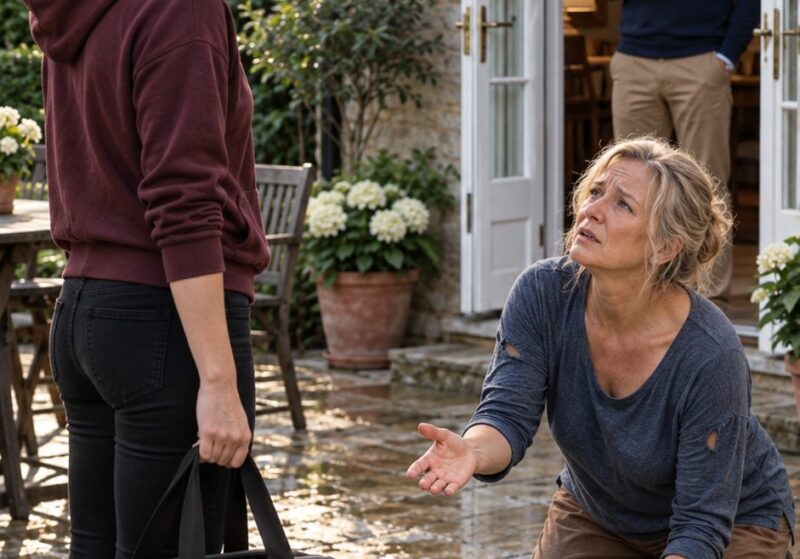
A woman was kneeling beside a bucket, scrubbing the patio.
It was my mother.
At sixty-two, Martha was on her hands and knees cleaning concrete while the people I’d allowed to stay in her house relaxed inside.
Her hands looked painfully red.
“Mom?”
She froze.
Slowly, she turned around.
Her face went blank with disbelief.
“Natalie?”
I crossed the patio and pulled her to her feet.
“When did you get here?”
“Just now.”
She immediately tried to smile.
“You should have told me you were coming.”
I looked at the bucket.
Then at her hands.
“Why?”
“Why what?”
“Why are you scrubbing the patio?”
She said nothing.
“And why did Julian just refer to you as the maid?”
Her smile disappeared.
That was when I realized my mother had been hiding something from me.
We sat down, and piece by piece, the truth emerged.
Khloe and Julian had moved in two years earlier.
It was supposed to last only a few weeks while they sorted out their finances.
Weeks became months.
Months became years.
They took the master bedroom.

Then they began handling Mom’s bank cards “to make things easier.”
Eventually, they controlled nearly every part of her daily life.
Mom cooked.
Mom cleaned.
Mom did their laundry.
And somehow, inside the home I’d purchased specifically for her comfort, she’d been made to feel like a guest who could be thrown out at any moment.
“But I called you constantly,” I said. “You always told me you were happy.”
Her eyes filled with tears.
“Julian said if I complained, you’d get tired of all the family problems and sell the house.”
I couldn’t believe what I was hearing.
“You thought I would make you homeless?”
“He made it sound possible.”
I reached for her hand.
“This house exists because I never wanted you worrying about that again.”
I looked at the cleaning supplies beside us.
“You’re finished working for them.”
We entered the house together.
Khloe was on the couch.
Julian stood behind the bar pouring himself a drink.
When they saw Mom beside me, the room went silent.
Julian finally recognized who I was.
“You’re Natalie?”
“Yes.”
“The one working in Dubai?”
“The one whose name is on the deed.”
His confidence slipped for half a second.
Then he recovered.
“You can’t just come back after six years and order us out. We’ve lived here long enough to have legal protections.”
I pulled out my phone.
“Maybe.”
I checked the time.
“By tonight, we’ll know exactly what those protections are.”
I didn’t argue with him.
Instead, I took Mom to a hotel.
Then I called Harrison Vance, my attorney.
He met us at the property later that evening with a police officer and a locksmith.
Julian’s attitude changed immediately.
Harrison asked for their lease.
There wasn’t one.
Then he requested proof that they’d ever paid rent.
There wasn’t any.
But by then, housing rights were becoming the smallest part of the problem.
Harrison began reviewing the accounts connected to Mom’s monthly allowance.
I had transferred $3,000 every month for her needs.
The money had certainly been spent.
Just not primarily on her.
There were expensive restaurant bills, resort charges, golf expenses, luxury purchases, and payments connected to Julian’s car.
Mom looked horrified.
“I’ve never even been to that resort.”
Harrison continued examining the records.
Then we found a cabinet filled with documents.
Copies of my passport were inside.
So were Mom’s personal records.
There were employment documents bearing my name and pages containing financial information I’d never knowingly provided to Julian.
At the bottom of the stack was an unfinished loan application.
Amount requested:
$180,000.
My name appeared on it.
So did a signature resembling mine.
I hadn’t signed anything.
Harrison stopped everyone from touching the remaining papers.
“We document everything from this point forward.”
Then Mom called from the hotel.
Her voice was barely above a whisper.
“I remembered something.”
“What?”
“The garage.”
She told me about a locked cabinet Julian had forbidden her from opening.
We found it against the rear wall.
Inside were three carefully organized files.
One for Martha.
One for Natalie.
One for Khloe.
Mom’s folder contained financial and medical information.
Mine held passport copies and employment records.
Khloe’s contained something she clearly hadn’t expected us to find.
A record of a $22,000 transfer.
The money had come from an inheritance our father left her.
Khloe stared at the page.
Then at Julian.
“What did you do with my money?”
“I invested it.”
“Where?”
Julian started talking quickly, but he never gave her a clear answer.
Then Mom remembered another incident.
Four months earlier, someone from a bank had come to the house looking for me.
Julian told him I was still abroad.
Then he claimed he had authority to conduct financial business in my name.
“What kind of authority?” Harrison asked.
“Power of attorney,” Mom answered.
Harrison looked directly at me.
“Did you ever give him one?”
“Never.”
At that point, nobody was talking about an unpleasant family living arrangement anymore.
Several hours later, Harrison received a call from a title company.
An attempt had been made to borrow $275,000 against the Austin property.
Documents bearing my information had been submitted.
The transaction failed only when the identity-verification process couldn’t be completed.
That was when Julian stopped pretending.
“You disappear overseas for years and think money solves everything!” he shouted. “You buy a house with cash and act like you’re some hero. I’ve been the one living here. I created this life!”
I stared at him.
“No, Julian.”
I pointed toward my mother.
“You took hers.”
The officer detained him while authorities investigated the suspected financial fraud.
Khloe broke down afterward.
She admitted she’d signed paperwork Julian brought to her.
She had also given him access to some of Mom’s identification documents because he’d convinced her they were needed to “protect” the property.
Maybe she hadn’t understood his entire plan.
But she’d understood enough to know how our mother was being treated.
That mattered too.
Khloe agreed to move out.
The locksmith replaced every exterior lock before the night was over.
Mom’s bank access was secured.
Her cards were replaced.
Her documents were returned.
Three days later, I brought her home.
This time, she entered through the front door without asking anyone’s permission.
We moved her furniture back.
Her photographs returned to the walls.
Her novels went back onto the shelves.
I found her favorite quilt packed away in a closet and spread it across the bed in the master bedroom.
Her bedroom.
I arranged for a housekeeper to visit regularly and hired a physical therapist to help with the pain and stiffness she’d developed.
Mom objected immediately.
“I don’t need someone cleaning after me. I’m capable of doing it myself.”
“I know you are.”
“Then why pay someone?”
I smiled.
“Because this time, cleaning is optional.”
Months later, the investigation expanded.
Evidence suggested Julian had previously pursued money or property belonging to other relatives and older people.
Mom hadn’t been the first person he’d tried to exploit.
But she was no longer someone he could control.
By Christmas, the house felt completely different.
There was music in the kitchen.
Mom’s photographs covered the hallway again.
Her books were everywhere.
On Christmas Eve, she sat beside me and placed something in my palm.
It was the old front-door key.
“I used to think this key meant the house was mine,” she said.
I closed my fingers around it.
“It is yours.”
She shook her head.
“That’s not what I mean.”
She looked around the room.
“You bought these walls for me two years ago. But I stopped feeling like I belonged inside them.”
Then she took my hand.
“When you came home, you didn’t give me back a building.”
Her voice trembled.
“You gave me back my home.”
I hugged her.
Julian had apparently believed that six thousand miles of distance would protect whatever he was doing.
He forgot that property creates records.
Money leaves trails.
Documents preserve signatures.
And lies eventually collide with evidence.
Most importantly, he underestimated the woman he’d ordered to scrub his patio.
She wasn’t his maid.
She was my mother.
And her daughter came home before he expected her to.
That evening, I made one final change.
I opened Mom’s emergency information.
For years, Khloe had been listed as her first contact.
I replaced it.
Natalie Carter — Daughter — Primary Emergency Contact
Then I added a note beneath my name:
Call anytime. For anything. Never worry about bothering me.
Mom read it silently.
Then she read it again.
Finally, she looked up.
“You really want me to call, even if it’s something small?”
I squeezed her hand.
“Especially then.”
She smiled.
And for the first time since I’d found her kneeling beside that bucket, my mother wasn’t worrying about someone else’s demands.
There were no floors waiting to be scrubbed.
No orders waiting to be followed.
No reason to earn the right to stay in her own home.
There was only tomorrow.
And finally, it belonged to her.