They Treated the Rain-Soaked Young Woman Like She Was Invisible—Until the Hotel Owner’s Son Heard Her Mother’s Name
By the time Lucía Serrano reached the Gran Hotel Castilla, the rain had soaked through her jacket.
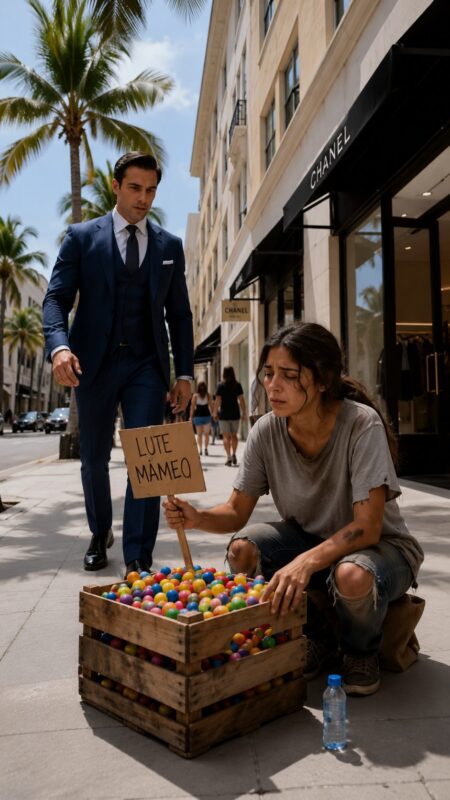
At twenty-two, she owned little worth carrying. Her shoes were cracked, her clothes offered almost no protection from the cold, and everything important to her fit inside a faded blue folder wrapped carefully in plastic.
Around her, luxury cars stopped beneath the hotel’s glowing entrance. Men in tailored suits and women in elegant evening gowns stepped onto the pavement before disappearing into the warmth.
None of them noticed Lucía.
Or perhaps they simply chose not to.
She approached the entrance.
“Excuse me. I need to speak with Ernesto Valcárcel.”
The security guard barely looked at her.
“Invitation?”
“I don’t have one.”
“Then you can’t go inside.”
Lucía tightened her grip on the folder.
“Please. My mother knew him. Her name was Carmen Serrano. I promised her I would give this to him.”
The guard shook his head.
“Move away from the entrance.”
Two guests passing nearby glanced at Lucía and laughed quietly. One whispered that she was probably hoping for a free meal.
Lucía heard them.
She said nothing.
Three days earlier, she had sat beside her dying mother and received a request she still did not fully understand.
“Find Ernesto Valcárcel,” Carmen had whispered. “Give him the blue folder.”
Then, after struggling for breath, she had added:
“Tell him I forgave him. But he deserves to know the truth.”
Now Lucía had come to keep that promise.
Inside the hotel, hundreds of people were celebrating Ernesto Valcárcel’s seventieth birthday. The Valcárcel name was known throughout Spain. The family controlled prestigious hotels, vineyards, and properties worth millions.
Lucía knew nothing about that world.
All she knew was what the folder contained.
Old photographs.
A handwritten letter.
Half of a silver medallion.
And her birth certificate.
For twenty-two years, she had been Lucía Serrano.
But another surname appeared on that document.
Valcárcel.
She was preparing to plead with the guard one final time when someone behind her spoke.
“What name did you just say?”
Lucía turned.
A tall, elegantly dressed man had stopped several steps away.
“Carmen Serrano,” she replied.
His expression changed instantly.
Several hotel employees recognized him and became visibly attentive.
Lucía did not know who he was.
“My name is Alejandro Valcárcel,” he said.
Ernesto’s son.
His gaze fell on the blue folder.
“Why are you looking for my father?”
“My mother asked me to find him before she died.”
Alejandro stared at her.
“Your mother was Carmen?”
Lucía nodded.
Something in his face softened.
“Come inside.”
The guard immediately intervened.
“Mr. Valcárcel, she isn’t on the guest list.”
Alejandro didn’t even turn toward him.
“Add her.”
Then he held the door open.
For the first time that evening, Lucía stepped into the warmth.
The ballroom seemed to belong to another universe. Crystal chandeliers illuminated tables covered with white linen. Music drifted through the room as waiters carried champagne between hundreds of guests.
Then people began noticing her.
Conversations stopped one by one.
Lucía crossed the ballroom beside Alejandro, leaving faint marks from her wet shoes on the polished floor.
At the center of the celebration sat Ernesto Valcárcel.
His wife, Beatriz, was beside him.
Alejandro stopped in front of their table.
“Father, this young woman says her mother was Carmen Serrano.”
Ernesto looked up.
Then he saw the folder.
The smile disappeared from his face.
“Where did you get that?”
“My mother gave it to me.”
Ernesto slowly stood.
“Where is Carmen?”
Lucía swallowed.
“She died three days ago.”
The old man seemed to lose his balance for a moment.
“That’s impossible,” Beatriz said sharply. “Carmen Serrano died years ago.”
Lucía turned toward her.
“No. She didn’t.”
Beatriz’s expression hardened.
“This is obviously some kind of scheme.”
“I haven’t asked you for anything,” Lucía replied.
“Not yet.”
Lucía ignored the insult.
“I came here to fulfill my mother’s final wish. That’s all.”
She placed the blue folder on the table and opened it.
The first photograph had been taken decades earlier beside the sea. Ernesto was young, smiling, with one arm around Carmen.
The second showed Carmen several months pregnant.
In the third, she held a newborn against her chest.
Ernesto picked up the photograph with trembling fingers.
On the back were five words and a date:
“Our daughter, Lucía. Summer 2004.”
The room fell completely silent.
Lucía reached into the folder again.
This time, she removed half of a small silver medallion.
Ernesto stared at it.
Then, without explanation, he reached beneath his shirt.
A chain hung around his neck.
Attached to it was the missing half.
He placed the piece beside Lucía’s.
They joined perfectly.
A murmur swept through the ballroom.
Beatriz stood abruptly.
“This proves nothing!”
Lucía looked at Alejandro.
“There is a letter.”
He unfolded the pages.
As Alejandro read, a secret buried for more than two decades began to emerge.
Carmen had loved Ernesto.
She had also been carrying his child.
But before she could tell him everything, Beatriz discovered the pregnancy. According to Carmen’s letter, Beatriz threatened her, warning that powerful people could make sure she never saw her baby again.
Terrified, Carmen disappeared.
Only one person had helped her.
Dolores, the family’s former cook.
Beatriz laughed bitterly.
“So now we’re supposed to believe a dead woman’s story?”
A voice answered from the back of the room.
“You should.”
Heads turned.
An elderly woman emerged from among the guests.
Ernesto recognized her immediately.
“Dolores?”
She nodded.
“I’ve carried this secret long enough.”
Dolores faced Ernesto.
“Carmen didn’t leave because she stopped loving you. She left because she was afraid.”
Then she looked directly at Beatriz.
“I heard the threats. I helped Carmen escape Madrid. I thought I was protecting her and the baby.”
Alejandro’s face went pale.
He turned toward Beatriz.
“You knew about Lucía?”
Beatriz looked away.
“Answer me.”
She remained silent.
That was enough.
Alejandro looked across the table at Lucía.
“My sister,” he whispered.
Ernesto had not moved.
For decades, he had apparently believed Carmen had vanished without explanation. Now he was staring at the daughter who had grown up without him.
Slowly, he approached her.
“I don’t know if I have the right to ask this,” he said, his voice breaking. “But may I hug you?”
Lucía hesitated.
Then she nodded.
Ernesto embraced her.
And beneath the chandeliers of Madrid’s most glamorous birthday celebration, a powerful businessman wept in the arms of the daughter he had discovered twenty-two years too late.
Around them, the people who had judged Lucía only minutes earlier avoided her eyes.
The women who had laughed outside were silent.
The security guard stood near the entrance, unable to move.
The young woman they had dismissed as someone who did not belong had just become the most important person in the room.
The truth was officially confirmed in the weeks that followed.
Family records supported Carmen’s story, and DNA testing removed any remaining doubt.
Lucía Serrano was Ernesto Valcárcel’s daughter.
She could have demanded a mansion.
She could have asked for cars, jewelry, or a share of everything the Valcárcel family owned.
She could even have devoted herself to revenge.
Instead, Lucía surprised everyone.
She asked Ernesto to help her create something in Carmen’s memory.
Together, they established the Carmen Serrano Foundation, an organization dedicated to providing shelter, education, and opportunities for young people living without stable homes.
Months later, Lucía returned to the Gran Hotel Castilla.
This time, no guard blocked her path.
The main doors opened before she reached them.
Near the entrance stood a new plaque bearing a simple message:
“Never judge what someone carries by the clothes they wear. Sometimes, the quietest stranger at your door is holding a truth powerful enough to change your world.”
Lucía paused to read it.
Then she smiled and walked inside.
The blue folder was no longer in her hands.
It had already delivered everything her mother had entrusted to it.
A hidden truth.
A lost family.
And one final lesson no one at the Gran Hotel Castilla would ever forget:
Sometimes, changing a person’s life begins with something remarkably simple.
You stop.
You look at them.
And you listen.