June was barely four months old when the thermometer showed 104 degrees.
As a nurse practitioner who had spent years working around emergency medicine, I understood immediately how dangerous a fever that high could be for an infant. I called June’s pediatrician, and the answer was immediate: take her to the emergency room.
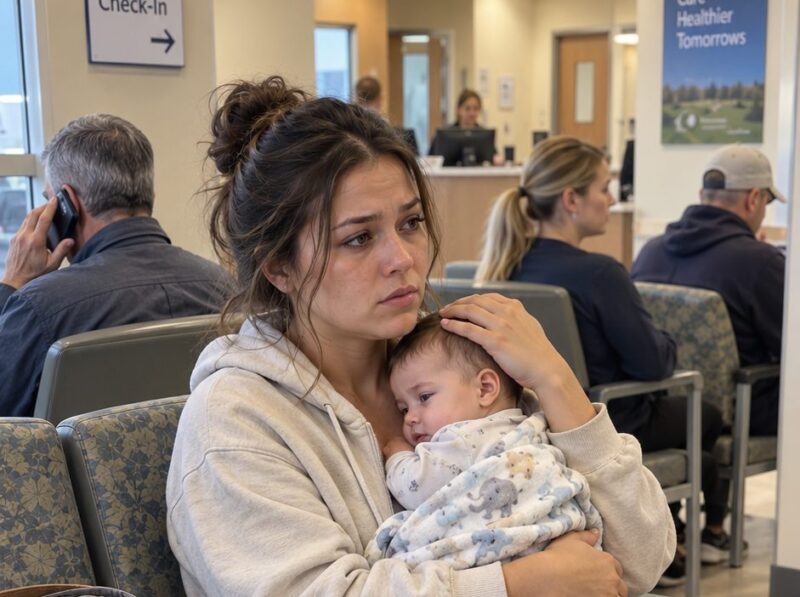
I woke my husband, Ethan, and within minutes, we were on our way.
By 2:00 a.m., I was sitting in the ER waiting area with our crying daughter pressed against my chest. The fluorescent lights made everything feel even more exhausting. Ethan kept walking back and forth nearby, repeatedly checking the time.
Finally, he sighed.
“I can’t believe we’re still here. I have a major presentation at nine.”
I looked up at him.
“Ethan, June’s temperature is 104.”
“I know. I’m just completely wiped out.”
I understood exhaustion better than he realized.
For months, I had been working, caring for our baby, and helping my mother manage Parkinson’s. Most days, I felt as though I was running on whatever energy I had left.
But exhaustion didn’t erase responsibility.
A few minutes later, Ethan took out his phone and walked down the hallway.
I assumed he was calling work.
I was wrong.
Roughly twenty minutes later, the hospital doors slid open, and Sylvia—Ethan’s mother—hurried inside.
She had crossed town in the middle of the night, but her concern wasn’t focused on her sick granddaughter.
She had come for Ethan.
“Get your coat,” she told him. “Come home with me and get some rest before your meeting.”
I stared at her in disbelief.
“June hasn’t even seen the doctor yet.”
Sylvia shrugged.
“Ethan can’t spend the entire night sitting here.”
“And I can?”
She gave me a cold look.
“You’re June’s mother.”
Then came the sentence that exposed everything she had been suggesting for years.
“My son shouldn’t have to deal with this much pressure. You’re the mother. You need to handle it.”
For a few seconds, no one around us seemed to move.
I turned toward Ethan.
He was standing beside his mother with his coat in his hands.
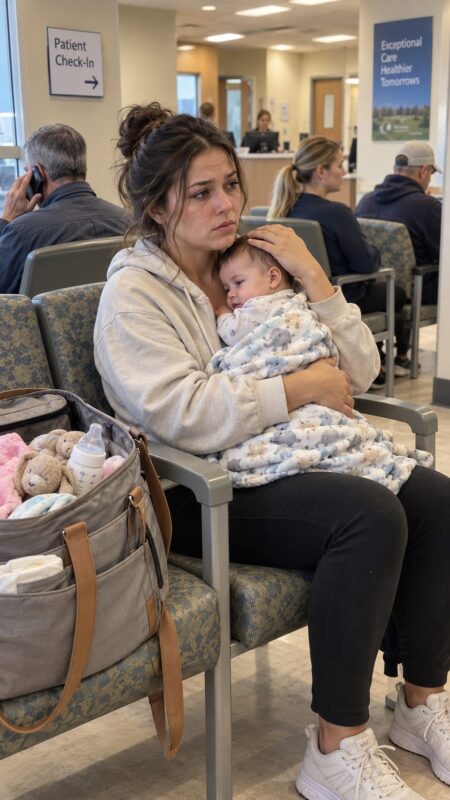
And suddenly, the problem wasn’t just about that night.
I could see the pattern clearly.
Every time Ethan encountered something unpleasant, stressful, or difficult, Sylvia rushed in to make it easier for him. Somewhere along the way, he had learned that discomfort was temporary because someone else would eventually take over.
Usually, that someone was a woman.
I rose from my chair, keeping June securely against me.
“You can leave if you want, Ethan,” I said. “I’m capable of taking care of June by myself. But I shouldn’t be forced to. She has a mother and a father, and tonight she needs both.”
He glanced away.
“But I have work in a few hours.”
“Your sick daughter doesn’t understand your work schedule.”
Then I faced Sylvia.
“If you came here to support us, sit down. If you came here to take Ethan away, please leave.”
Her expression changed instantly.
“Are you seriously speaking to me like that?”
“You drove across town in the middle of the night because your adult son was tired of waiting beside his sick child. You aren’t protecting him. You’re giving him permission to avoid being a parent.”
Sylvia crossed her arms.
“I’m looking after my son.”
“From what? His responsibilities?”
She turned toward Ethan, expecting him to take her side.
He didn’t.
Instead, he slowly placed his coat beside him and sat down.
“Mom,” he said, “calling you was a mistake.”
Sylvia looked stunned.
“You called because you needed me.”
Ethan shook his head.
“No. I called because I wanted a way out.”
Those words changed the entire conversation.
For once, he wasn’t blaming work, lack of sleep, or stress.
He was admitting what had been happening.
“I keep watching Rachel do everything,” he continued. “She works, takes care of June, helps her mom, and keeps our life moving. Then I complain that I’m tired and act like that means I’m allowed to check out.”
Sylvia tried to explain that she had always been there because she loved him.
“I know you love me,” Ethan said. “But every time you rescued me from something difficult, I learned that I could leave when life became uncomfortable.”
He paused.
“I don’t want to keep doing that.”
Then he looked directly at her.
“Please go home. I’m staying with Rachel and June.”
Sylvia stood silently for a moment.
Before leaving, she turned to me.
“I’m sorry,” she said quietly.
At 3:47 that morning, June was finally seen by a doctor.
Tests showed that she had a urinary tract infection. The medical team started antibiotics and gave us detailed instructions about her medication, temperature, and the warning signs we needed to watch for.
This time, Ethan wasn’t staring at the clock.
He listened carefully.
He asked the doctor questions.
And he never mentioned his presentation again.
We arrived home a little after five.
Ethan immediately called his boss.
“My daughter was in the ER all night,” he explained. “I need to stay home with my family today.”
I waited for the crisis Ethan had been expecting.
It never came.
His boss simply moved the presentation to another day.
“Family comes first,” his manager told him.
That was all.
No career-ending consequences.
No furious executives.
No catastrophe.
Just a postponed meeting.
After hanging up, Ethan came over and carefully lifted June from my arms.
“You’ve been awake all night,” he said. “Go to bed. I’ve got her.”
When I woke four hours later, I found him sitting next to June’s bassinet.
He had checked and recorded her temperature, fed her, and given her medicine exactly when she needed it.
Then he said something else that caught me off guard.
“I’ve been thinking about your mom. I should be helping there, too. And we need a real schedule for June at night. Half the nights are mine.”
I watched him carefully.
“That’s what I’ve needed from you.”
“I know.”
Later, he asked me why I had fought so hard to keep him at the hospital.
“You knew you didn’t actually need me there,” he said. “You could have handled everything yourself.”
“Yes.”
“Then why stop me from leaving?”
I looked toward our daughter.
“Because being capable of doing something alone doesn’t mean I should have to.”
He stayed quiet.
“I wanted June to have a father who doesn’t disappear when parenting becomes inconvenient,” I continued. “I remember the day she was born. You held her and cried because you loved her so much. That person didn’t disappear, Ethan. But she needs him on the terrible nights, too.”
He looked at June for a long time.
“I want to be that father.”
By then, her temperature had dropped considerably, and she was finally resting comfortably.
Ethan remained beside her.
After a while, he looked at me.
“I’m glad you didn’t let me walk out last night.”
Then his attention returned to June.
“But next time, I don’t want anyone to have to convince me to stay.”
That night didn’t magically repair everything between us.
One difficult conversation couldn’t undo years of habits, and one responsible morning couldn’t suddenly transform our marriage.
But it marked the beginning of something different.
Ethan finally understood that being a father wasn’t just about holding his daughter during the happy moments.
Parenthood also meant showing up when he was tired, overwhelmed, worried, or inconvenienced.
It meant staying when leaving would have been easier.
Because sometimes love isn’t demonstrated through promises or dramatic gestures.
Sometimes the clearest expression of love is simply refusing to walk away when the people who need you most are having their hardest night.
And for the first time, Ethan understood that.
He stayed.