MY FAMILY KEPT ME IN THE KITCHEN ON THANKSGIVING—THEN THE MAN MY FATHER NEEDED MOST WALKED IN AND CALLED ME HIS FIANCÉE
By the time the Whitmore family sat down for Thanksgiving dinner, every chair in the dining room was filled.
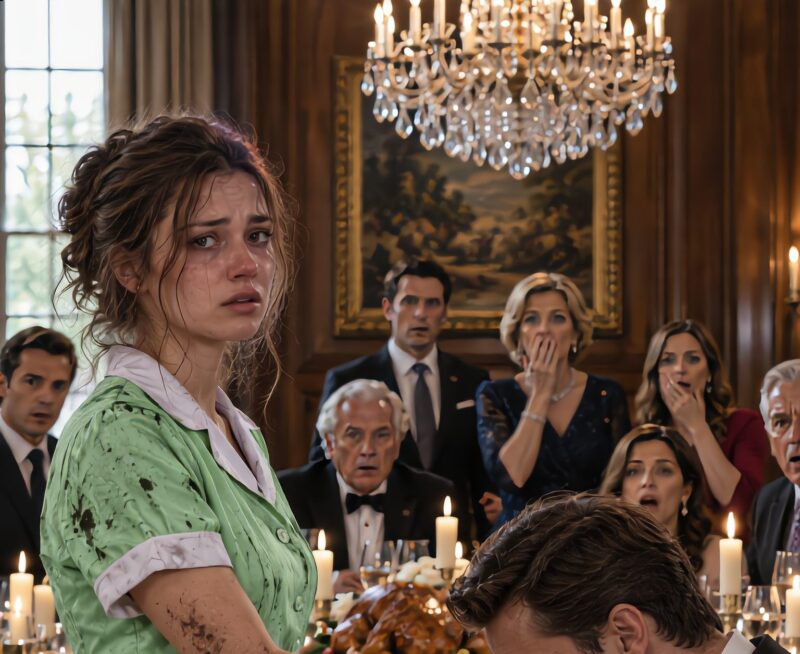
Except mine.
That should have surprised me.
It didn’t.
My father, Richard, had invited nearly everyone we were related to. My mother had spent days arranging flowers, polishing glasses, and planning a dinner that would look perfect in photographs.
Vanessa arrived with her husband and children, dressed like she was stepping into a holiday ad.
My brother Logan came in loud, confident, and already half-celebrating before dinner even started.
The house filled with stories, laughter, and the sound of relatives greeting one another.
I spent most of it standing beside the stove.
Mom had made that decision before the first guest arrived.
She handed me an apron and said, “You’re better in the kitchen anyway.”
I looked toward the dining room.
“Am I eating with everyone?”
She gave me the expression she always used when she wanted me to stop asking questions.
“Emma, just help today. Don’t make this uncomfortable.”
“For who?”
She ignored that.
“Keep the food moving and stay useful.”
Useful.
That was my permanent role in the family.
Vanessa was the impressive daughter.
Logan was the son who would supposedly carry the family name forward.
I was the daughter everyone tolerated because I worked hard and rarely complained.
It hadn’t always been that way.
When I was eighteen, fifty thousand dollars vanished from my father’s company.
Logan had taken it.
My mother found out first.
And instead of exposing him, she came to me.
“He has a future,” she said.
Apparently, mine was expendable.
I was pressured into taking responsibility.
Money intended for my education went toward covering the loss.
Logan walked away untouched.
I carried the shame.
Years later, nobody ever mentioned what really happened.
They didn’t have to.
The story had already hardened around me.
I was the unreliable one.
The difficult one.
The daughter who had “made mistakes.”
So on Thanksgiving, while relatives complimented Vanessa and asked Logan about business, I stood in the kitchen stirring gravy.
I brought in serving dishes.
I cleared plates.
I refilled glasses.
At one point, Mom laughed and called Vanessa’s children “the best thing this family ever produced.”
I was standing directly behind her.
Nobody noticed.
Two hours into dinner, I was scrubbing a roasting pan when the doorbell rang.
I assumed another relative had arrived late.
Then the entire house went strangely quiet.
I turned off the faucet.
Footsteps crossed the hallway.
A man in a dark suit appeared in the kitchen doorway.
Rain still clung to the shoulders of his coat.
He didn’t scan the room.
He didn’t look for my father.
He looked for me.
“Alexander?”
He smiled.
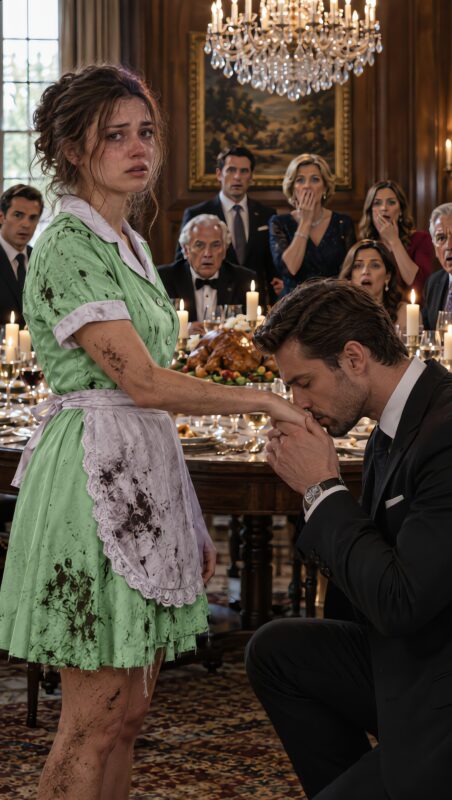
Then he walked across the kitchen, took my damp hand in his, and kissed it.
“Sorry, darling,” he said. “I got held up.”
The room behind him froze.
I could feel everyone staring.
Vanessa stood up.
Logan looked like he’d forgotten how to speak.
Mom’s face went pale.
Dad was the worst.
Because he knew exactly who Alexander Hayes was.
Everyone in business did.
Alexander was the CEO of Hayes Conglomerate.
Billionaire investor.
Deal-maker.
And the man my father had spent months trying to convince to approve a fifty-million-dollar rescue agreement for Whitmore Industries.
Dad finally managed to speak.
“Mr. Hayes?”
Alexander turned calmly.
My father’s eyes moved between us.
“Emma… how do you know him?”
Alexander looked at me, then at the apron around my waist.
His expression changed.
“She’s my fiancée.”
Nobody moved.
Then he looked toward the dining room.
“And I’d like to know why she’s serving dinner instead of sitting at the table.”
Mom rushed to answer.
“It’s not what you think.”
Alexander raised an eyebrow.
“She’s wearing an apron. Everyone else has eaten. She hasn’t.”
His tone stayed calm.
“That seems fairly clear.”
Dad stepped forward nervously.
“Perhaps we should discuss business first.”
Alexander reached behind me.
For one second, Dad looked hopeful, probably expecting him to pull the contract from his jacket.
Instead, Alexander untied my apron.
“We’re not discussing business.”
He set the apron on the counter.
“We’re leaving.”
Dad’s composure cracked.
“Alexander, please. The acquisition is essential.”
Alexander looked directly at him.
“Then perhaps you should have thought about how you treat the woman I’m marrying.”
That was when Logan stood.
“Wait.”
Everyone turned toward him.
His voice sounded different.
Smaller.
“It wasn’t Emma.”
My mother stiffened.
“Logan.”
He ignored her.
“The fifty thousand dollars.”
The room changed instantly.
Dad stared at him.
“What are you doing?”
“Telling the truth.”
He looked at me.
“I took it.”
Vanessa slowly sat back down.
Logan continued.
“Mom knew. She told Emma to take the blame because she thought exposing me would ruin my future.”
Mom snapped, “That is enough.”
But it wasn’t.
Not anymore.
Alexander’s face hardened.
“So you protected him by destroying her reputation.”
Nobody answered.
The silence was enough.
For years, I had imagined this moment.
I thought I would feel furious.
Vindicated.
Triumphant.
Instead, I felt something quieter.
Relief.
I looked down at the apron on the counter.
“I spent years trying to prove I deserved to belong here.”
Mom whispered, “Emma, please.”
I shook my head.
“I worked. I helped. I stayed quiet. I kept hoping eventually someone would make room for me.”
I looked toward the dining room.
“But I don’t want that chair anymore.”
Dad’s face fell.
I continued.
“If I only matter when I’m cooking for you, paying for your mistakes, or protecting your favorite child, then this was never my table.”
Nobody stopped me when I walked out.
Outside, the rain had turned into light snow.
Alexander held my coat open and helped me into it.
When we reached the car, he stopped.
“I’m sorry.”
“For what?”
“You made an entire Thanksgiving dinner and never got one.”
I laughed through tears.
“Maybe I finally got the one I needed.”
We ended up at a tiny restaurant off the highway.
Most of the tables were empty.
The decorations were cheap.
The turkey was average.
The coffee was terrible.
It was the best Thanksgiving meal of my life.
No one expected me to serve.
No one asked me to stay quiet.
No one treated my presence like an inconvenience.
Alexander sat across from me and asked the simplest question.
“Are you okay?”
For once, someone cared about the answer.
That night, I learned I had spent too many years confusing relatives with family.
A family isn’t the group that remembers you when they need something.
It isn’t the table where everyone else is celebrated while you’re told to stay useful.
Sometimes family is one person who walks into a crowded house, notices you’re missing, and refuses to let everyone else pretend that’s normal.