My sister-in-law did not invite me to her televised ice gala out of kindness.
She invited me because she wanted an audience for my humiliation.
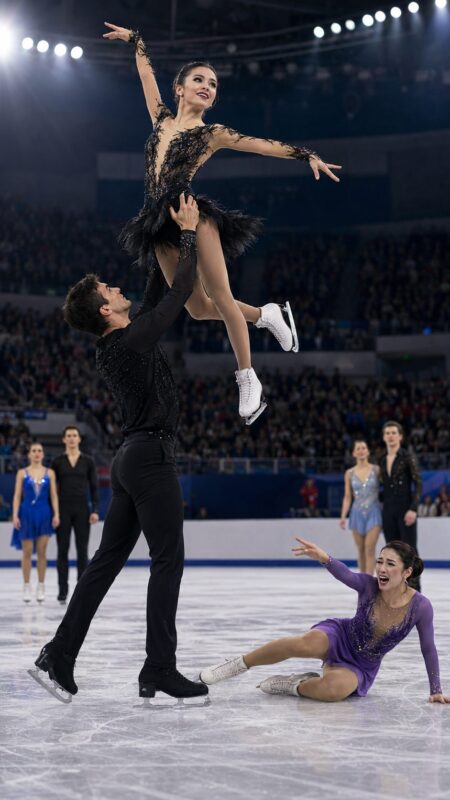
Her instructions arrived in a polished email: every female guest would wear ivory, with one leg exposed through a dramatic slit. To everyone else, it was a stylish theme. To me, it was a weapon.
The scar on my left leg begins above my knee and disappears near my ankle. It is the souvenir of the fall that ended my skating career.
Brianna knew that.
She also knew I had spent three years hiding it beneath boots, trousers, and long skirts.
The afternoon before the gala, I heard her speaking behind a dressing-room door.
“Just wait until the cameras find her leg,” she said. “She’ll look ridiculous next to real athletes.”
Someone giggled.
“She was famous once,” Brianna continued. “Now she is just a warning.”
I stood in the hallway for several seconds, perfectly still.
Then I left without making a sound.
Three years earlier, I had been preparing for the biggest season of my life. I was a national champion, a medal contender, and the skater people expected to see at the Olympics.
During a practice run, I attempted a quadruple Salchow. A flaw in the ice caught my blade at takeoff. I fell with such force that the sound of the break cut through the music.
My tibia and fibula were shattered.
The operation took hours. Recovery took longer. When I finally returned to the rink, doctors told me that the bones might heal, but elite competition was no longer realistic.
They had underestimated me.
So had nearly everyone else.
Except Theo, my husband.
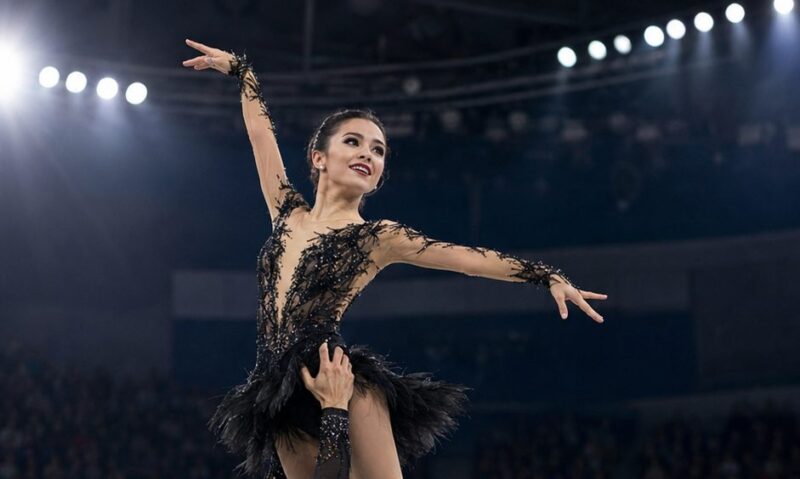
Theo was a choreographer with a brilliant reputation and an inconvenient belief that I was not finished. He found a small, neglected rink outside the city and booked it under another name.
We trained there while the world moved on without me.
For months, the sessions began before dawn. I relearned turns, rebuilt my strength, and taught my injured leg to absorb impact again. I fell often. I cried more than once. But slowly, the ice stopped feeling like the place where my dream had died.
It became the place where I took it back.
At the same time, Brianna rose quickly through the ranks. She had my former coaching team, my old training hours, and every headline that once belonged to me.
Her gala was supposed to celebrate the sport. Instead, she planned to turn my scar into a spectacle.
Two evenings before the broadcast, Theo recorded her conversation outside that dressing room.
When I told him I would not attend, he shook his head.
“You are not going there to be her target,” he said. “You are going there to end the story she wrote for you.”
On the night of the event, he gave me a garment bag.
The costume inside was nothing like Brianna’s required ivory dress. It was dark sapphire, fitted closely to my body, with silver crystals tracing one side like winter constellations. The skirt opened over my left leg.
My scar was visible.
Not hidden. Not apologized for.
Visible.
Brianna was waiting in the production corridor when we arrived.
“What is that?” she demanded. “Everyone is wearing ivory.”
“Not tonight,” Theo said.
He placed a legal notice in the hands of the federation director. Brianna’s competition program used Theo’s choreography and his licensed score. Their contract contained a conduct provision, and her recorded comments had violated it.
She laughed at first.
Then Theo played the recording.
Her own voice filled the control booth.
“Zoom in on the scar. Let people see what she became.”
The laughter from her friends followed.
No one in the room spoke when the clip ended.
Brianna’s face drained of color. “It was private.”
“No,” Theo said calmly. “It was cruel.”
The federation removed her from the program immediately.
But the broadcast still had an unscheduled four-minute gap.
The director looked from the empty rink to me.
Theo held out his hand.
“Use it,” he said.
A few minutes later, the announcer spoke my name.
“Returning to the ice: former national champion Elara Quinn.”
The arena lights came up.
I stepped onto the surface in sapphire and silver. My left leg was bare, my scar clear beneath the spotlight. A hush moved through the crowd.
Then the first note of music sounded.
I began slowly.
One edge. One turn. One breath.
And then I accelerated.
I skated with everything I had learned in the dark hours before sunrise: the rage, the discipline, the grief, and the strength I had earned one painful day at a time.
At the climax, I approached the jump that had once broken my life apart.
The quadruple Salchow.
For a heartbeat, I heard nothing.
Then I took off.
Four rotations.
A clean landing.
My blade carved a deep, unwavering line into the ice.
The audience rose before the final note faded.
Flowers covered the rink. The applause seemed to shake the rafters. At the boards, Theo reached for me, his eyes bright with tears.
“You never lost yourself,” he said.
By morning, my performance was everywhere. The federation offered me a special place at the Olympic trials. Brianna was suspended pending review, and several sponsors ended their contracts with her.
The Olympics are only weeks away now.
Cold weather still makes my leg ache. Some mornings, the scar feels like a warning.
But I know better.
It is not a mark of failure.
It is the signature of my survival.
I am not skating to defeat Brianna.
I am skating because I finally understand that being broken is not the same as being finished.