Six summers had passed since the lake took my husband and our three boys.
I still could not bring myself to change their rooms.
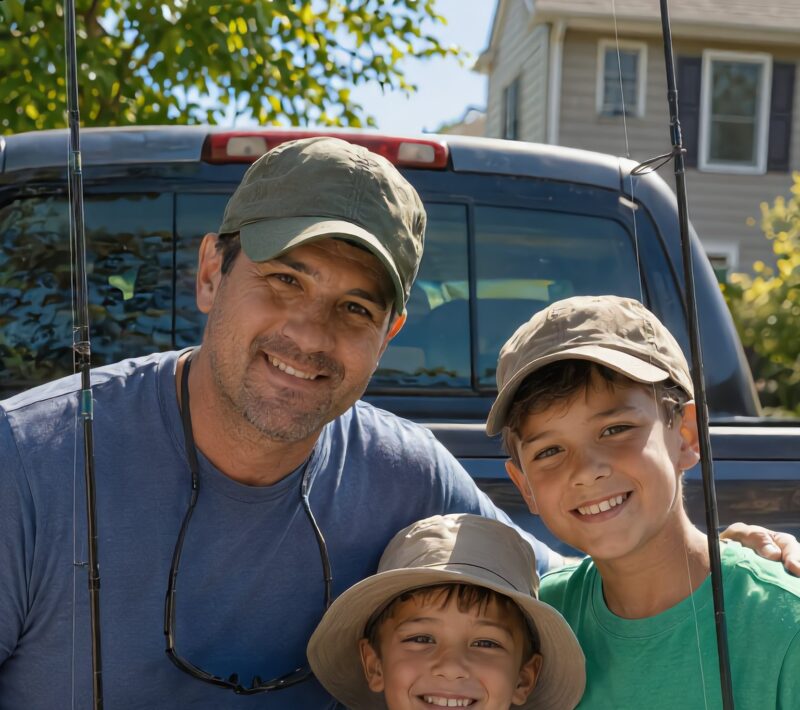
Their beds remained neatly made. A soccer cleat sat beneath one desk. A faded poster curled at the corner on another wall. I knew those rooms could not bring them back, but touching anything inside them felt like admitting that they were truly gone.
The authorities had closed the case as a boating accident.
Daniel’s pickup was found at the public marina. The trailer was empty, and his fishing boat was discovered later, battered against the reeds on the opposite side of the lake. Search crews covered the shoreline for days and dragged the water for weeks.
Nothing was recovered.
The report blamed sudden weather and rough water.
I read it more times than I care to admit.
Still, I could not understand it.
Daniel had treated every fishing trip like a military operation. He carried spare fuel, flares, rain gear, first-aid supplies, and life jackets in every size. He checked the forecast obsessively. He would turn around if the wind changed direction.
That was why the official story never brought me peace.
After the disappearance, Daniel’s brother, Dean, tried to help. He repaired the porch railing, replaced a broken faucet, and arrived with groceries whenever I stopped answering calls. I appreciated him, but I noticed something strange: he could not bear to talk about the lake.
The moment I mentioned it, his face closed.
Six years later, my daughter Sophie asked me to help her sort through the boys’ things.
“We are not throwing them away, Mom,” she said. “We are deciding what to do with them.”
Her words were gentle, but they reached me.
We spent the afternoon opening drawers and boxes. Beneath old headphones, tangled cords, and dead batteries, Sophie found Daniel’s missing phone. He had believed it was gone long before the trip.
We charged it overnight.
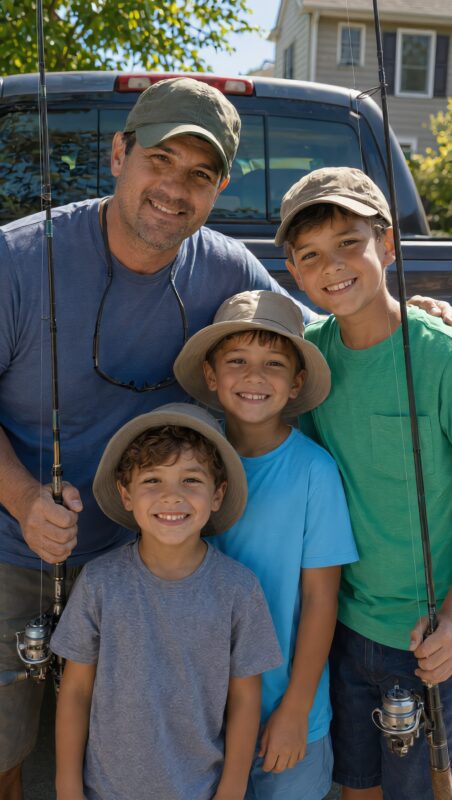
The next morning, we found a video saved in the cloud from the day before Daniel and the boys disappeared.
The recording showed our garage. Daniel was loading rods and tackle boxes into the truck when Dean appeared in the doorway.
“I don’t think I’m coming,” Dean said.
Daniel glanced over his shoulder. “The boys will be disappointed.”
“I know. I just can’t do it tomorrow.”
Dean had recently broken up with someone, and grief had made him withdraw from everyone.
Daniel nodded. “All right. Then come for dinner Sunday. The boys will make enough noise for all of us.”
The video ended.
But the phone held another detail: a receipt and map pin from an outdoor shop far from Daniel’s usual route.
The shop owner remembered them.
“The boys wanted orange signal whistles,” he said. “Your husband bought three for them. He also bought an extra adult vest.”
“Did he say why?”
“He mentioned that his brother might meet them later.”
I drove to Dean’s house before I could change my mind.
When I confronted him, he denied it at first. Then I showed him the video and the receipt.
He sat down hard on the front steps.
He confessed that he had intended to join them at the lake. On the way there, he passed several emergency vehicles speeding toward the marina. He panicked, turned around, and later returned only after the search had started.
“I thought you were already drowning in grief,” he said. “I did not want to add to it.”
“You were part of that day,” I replied. “You should have told me.”
Neither the extra life jacket nor one of the whistles had ever been listed among the recovered items.
With the help of a retired rescue officer, we revisited the search records. He found a brief incident report from the same afternoon: another boat had capsized during the storm. A grandfather and his young grandson had been rescued.
Their rescuers were described as a man and three boys in a fishing boat.
The grandfather still had the whistle.
For six years, it had hung from a hook in his workshop.
When I showed him a family picture, he began to cry.
“That was the man,” he said, pointing at Daniel. “Those were the boys.”
The storm had caught his small boat before he could get back to shore. His grandson, Noah, had gone into the water and was fighting to stay above it when Daniel’s boat came alongside.
Daniel did not pass them.
He stopped.
My boys threw the extra vest to Noah and shouted instructions until he had it on.
“Arms first!” one of them kept calling.
I recognized the phrase immediately. My youngest son used it every morning when he helped his little sisters into their winter coats.
Daniel waited beside the damaged boat until another fisherman arrived and took the grandfather and Noah aboard. Then Daniel and the boys headed toward land.
They never made it there.
The answer was not a miracle.
It was not the impossible hope I had held onto for six years.
It was a final act of kindness.
My family had seen people in danger and stopped to help.
That evening, Sophie and I stood in the boys’ rooms again. The boxes for donations were still waiting.
“Do we keep going?” she asked.
I looked around at the things I had protected for so long.
Then I understood that I had not been preserving their lives. I had been pausing my own.
“Yes,” I said. “We keep going.”
A week later, Sophie and I met Dean, Noah, and his grandfather at the lake.
I brought one of my sons’ fishing rods.
“He would want you to use it,” I told Noah. “He would not want it gathering dust.”
Sophie took a photograph of us near the water.
We were not a replacement for what had been lost. Nothing could ever be that.
But we stood there because my husband and sons had chosen compassion in a moment of danger.
For the first time since they disappeared, I did not stare at the lake and ask why it had taken them.
I remembered why they had stopped.