Seven-year-old Tim walked beside his mother beneath a canopy of amber leaves in the town’s memorial park. The autumn air carried a gentle chill, and the stone monument honoring fallen service members was surrounded by fresh bouquets and softly flickering candles. Most visitors paused only briefly before continuing with the rhythm of their day.
Tim had a habit of noticing the things everyone else overlooked.
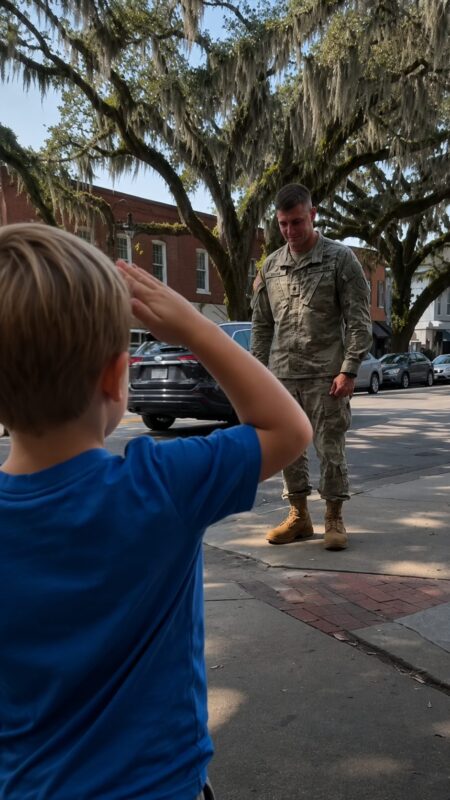
As they approached the memorial, his attention settled on an elderly man standing alone in a decorated military uniform. His medals reflected the afternoon sunlight, but they weren’t what held the boy’s gaze.
The old soldier was carefully holding a weathered photograph.
His lips moved silently, as if speaking to someone who could no longer answer.
A tear slipped down his face.
Then another.
Dozens of people passed him without stopping.
Tim slowly released his mother’s hand.
“Tim?” she asked quietly.
The boy looked back for only a second before walking toward the stranger.
He stood nearby, gathering the courage to speak.
Finally, in a gentle voice, he asked,
“Excuse me, sir… is everything okay?”
The veteran blinked, surprised.
It took him a moment to answer.
He drew a long breath, straightened his shoulders, lifted his hand in salute, and said softly,
“Thank you for your service.”
Tim smiled awkwardly.
“I think you’ve mistaken me for someone else. I’ve never been in the military.”
A faint chuckle escaped the old man.
“No, son. I know exactly who you are.”
He lowered his hand and looked at the photograph.
“You served me in a different way today.”
Tim tilted his head, confused.
The veteran continued.
“Most people notice the uniform. Some admire the medals. Others avoid eye contact because they don’t know what to say. Very few notice the person wearing them.”
He looked directly at the boy.
“But you did.”
“You saw that I was hurting.”
“You stopped.”
“And you cared enough to ask.”
His fingers gently traced the edge of the faded picture.
“This man was my closest friend. We enlisted together when we were barely older than boys ourselves. We planned our futures, promised to stand beside each other, and dreamed about the lives we’d build after coming home.”
His voice became quieter.
“I kept my promise.”
“He never got the chance.”
Silence settled between them.
“Today marks thirty years since we lost him,” the veteran finally whispered. “Every anniversary I come back here. Every year I tell myself I’ll stay strong.”
He managed a sad smile.
“And every year I fail.”
Tim listened with complete attention.
“My mother says crying doesn’t make someone weak,” he said after a moment. “It means something mattered.”
The veteran closed his eyes briefly.
“She’s absolutely right.”
He glanced toward Tim’s mother, who watched from a respectful distance, and offered her a grateful nod.
Then he turned back to the boy.
“When people think about service, they picture uniforms, battles, and medals. Those things matter. But the greatest service we can ever give another person is kindness.”
He paused.
“Listening.”
He smiled gently.
“Showing up when someone feels invisible.”
“That’s what you did today.”
Without another word, Tim stepped forward and hugged him.
The veteran stiffened in surprise before carefully wrapping his arms around the small boy.
His composure finally broke.
Fresh tears rolled down his cheeks, but these felt different.
The sorrow remained.
So did the memories.
Yet now they were joined by something he hadn’t expected to find that afternoon.
Comfort.
Around the memorial, people quietly stopped walking.
One woman wiped away her own tears.
An older gentleman removed his cap.
Several strangers stood silently, paying their respects—not only to those remembered by the monument, but also to the living man who had carried those memories alone for so many years.
When Tim and his mother continued their walk, the boy glanced back one last time.
The veteran remained beside the memorial, holding the faded photograph close to his heart.
This time, however, he stood a little taller.
The loneliness that had surrounded him moments earlier no longer seemed quite so heavy.
“Mom,” Tim asked as they reached the park gate, “why do people so rarely ask if someone needs help?”
She smiled gently.
“Because they’re often distracted by their own lives. They forget that everyone they pass is carrying a story they cannot see.”
She squeezed his hand.
“But every act of compassion, no matter how small, reminds someone they don’t have to carry that story alone.”
Tim nodded thoughtfully.
That simple encounter stayed with him long after the leaves had fallen.
He realized that changing someone’s day—or even their life—doesn’t always require extraordinary courage.
Sometimes the greatest gift anyone can offer is a moment of genuine attention and four heartfelt words:
“Sir… are you okay?”
For someone silently carrying years of grief, those words can mean more than anyone will ever know.