The woman guarding the private elevator looked at me as if I had wandered into the wrong building.
“Staff elevators are around the corner,” she said. “This one is for executives.”
It was 8:12 on Monday morning, my first day at company headquarters.
I glanced at the polished brass doors behind her.
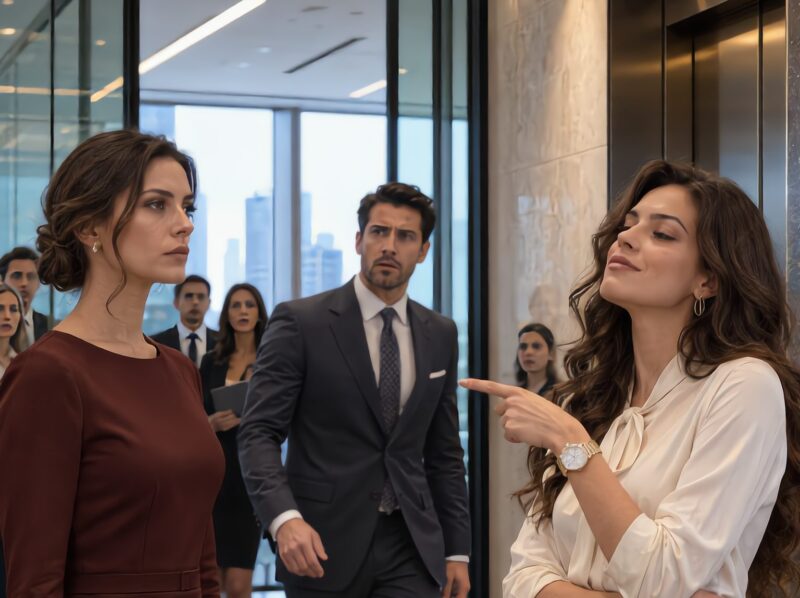
“I’m going upstairs.”
She gave my modest cream dress another dismissive look.
“Not in this elevator.”
Her name badge read JANG CHIN TONG.
I already knew the name.
She had been President Shiao’s executive secretary for nearly six years.
What Jang didn’t know was that President Shiao was my husband.
More importantly, she didn’t know what was scheduled to happen at ten.
The board was about to announce its new chief executive.
Me.
I pressed the elevator button.
Jang stepped closer.
“If you ignore me, you won’t have a job by lunchtime.”
“That would make for an interesting first day.”
I entered anyway.
By the time I reached the executive floor, news of our confrontation had apparently traveled faster than the elevator.
A nervous employee caught me near reception.
“Whatever happened downstairs, apologize to Ms. Jang.”
“Why?”
His voice dropped.
“Because nobody challenges her. President Shiao protects her.”
I was about to ask what he meant when Jang emerged from another hallway.
Something flashed on her wrist.
I stopped.
White ceramic.
Diamond-set markers.
A limited-production watch worth roughly $60,000.
I had spent weeks choosing that exact model for my mother-in-law, Eleanor.
Because I had been overseas when her birthday approached, I had asked my husband to purchase it on my behalf.
Yet Eleanor had never mentioned receiving it.
Now I knew why.
“Interesting watch,” I said.
Jang raised her wrist proudly.
“Thank you.”
“Who gave it to you?”
Her smile widened.
“President Shiao.”
Before I could say another word, the conference-room doors opened.
My husband walked out.
He noticed Jang.
His stern expression softened instantly.
“Tong Tong? Is something wrong?”
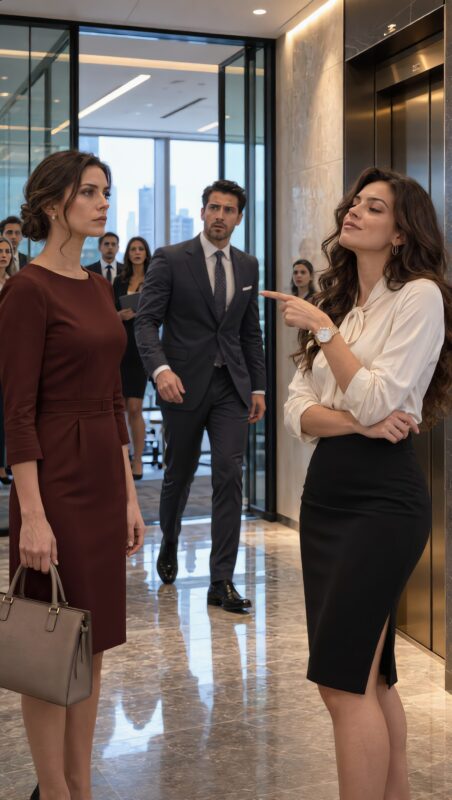
The nickname caught my attention.
Jang immediately pointed toward me.
“This woman ignored my instructions and used the executive elevator. I assume she’s a new intern. Please have HR dismiss her.”
Then Shiao saw me.
He stopped walking.
I waited.
When he remained silent, I said, “Why don’t you introduce us?”
His jaw tightened.
Several employees had gathered nearby.
Finally, he spoke.
“This is my wife.”
Jang’s smile disappeared.
But what happened next bothered me even more.
Instead of walking toward me, Shiao stayed beside her.
He touched Jang’s shoulder.
“It’s just an unfortunate misunderstanding.”
“Maybe,” I said.
Then I pointed toward her wrist.
“But I’d like to understand another one. Why is she wearing Eleanor’s birthday present?”
My husband had no answer.
At exactly ten, I walked into the boardroom.
At 10:18, I walked out as CEO.
My first decision was simple: no employee would ever again be prohibited from using an elevator because of rank.
My second decision made several executives considerably more uncomfortable.
I ordered an independent forensic audit covering the previous five years.
Contracts.
Vendor payments.
Expense accounts.
Security access.
Executive authorizations.
Everything.
The elevator policy was exposed almost immediately.
It had never existed.
Jang had invented it and enforced it herself.
But by early afternoon, nobody cared about elevator rules anymore.
The auditors had found money.
A lot of it.
Millions had passed through consulting companies whose registration documents appeared connected to Jang.
I summoned her.
This time she entered my office without arrogance.
I slid several files across the desk.
“Explain these.”
She scanned the first page.
Her face changed.
“I’ve never seen these transactions.”
“Your information appears on the companies.”
“Shiao said those entities were for employee reimbursements.”
The door suddenly opened.
My husband rushed inside.
“Tong Tong, stop talking.”
That was enough.
I called security.
Two guards escorted Shiao from the room while he shouted that I was making a catastrophic mistake.
When the door closed, Jang remained motionless.
Then she whispered, “There’s something you don’t know.”
I waited.
“Shiao is my brother.”
That revelation changed everything.
Years earlier, Eleanor had given birth while still very young. Under family pressure, she surrendered her daughter for adoption.
That daughter was Jang.
Shiao discovered her identity years later and brought her into the company.
He insisted they keep the relationship secret.
Suddenly, the affection between them made sense.
The money still didn’t.
That evening, the board assembled for an emergency meeting.
Shiao arrived with attorneys.
He looked confident again.
His lawyer distributed a report showing $41.7 million in questionable transfers.
Then came the accusation.
The transactions had supposedly been approved using my executive credentials.
Shiao demanded my immediate suspension pending a criminal investigation.
I stared at the documents.
The trap was almost elegant.
Almost.
The doors opened.
Eleanor walked in with Jang and an independent forensic specialist.
The auditor connected his laptop to the boardroom display.
Within minutes, Shiao’s case began disintegrating.
My credentials had been copied.
The duplicate had been created through systems controlled by the president’s office.
Digital records tied the fraudulent approvals to Shiao’s devices.
And the companies supposedly belonging to Jang?
They had been established using copies of documents she had once provided to her brother.
Jang hadn’t been his partner.
She had been his insurance policy.
So had I.
Shiao had encouraged my appointment because he wanted the fraud discovered while I was CEO.
If investigators followed the false evidence, his wife would take the fall.
If they looked deeper, his secret sister would become the second suspect.
Either way, he expected to survive.
When the evidence finished displaying, Shiao leaned back.
Then he smiled.
“You’re all forgetting one thing.”
Nobody answered.
“I control the family voting trust. By tomorrow, none of you will have seats on this board.”
Eleanor began laughing softly.
Shiao turned toward her.
“What’s funny?”
“You should have read the amended trust.”
His expression changed.
Eleanor had suspected financial misconduct months earlier.
Without telling him, she changed the voting structure.
Control transferred automatically on the morning the new CEO officially assumed office.
Every eye in the room turned toward me.
Shiao slammed his palm against the table.
“You can’t give her my company! I inherited the right to control it!”
Eleanor’s expression hardened.
“You inherited nothing.”
Then came the secret he had spent years protecting.
Jang was Eleanor’s biological daughter.
Shiao wasn’t her biological son.
He had been adopted into the family.
He had hidden Jang not out of loyalty, but fear.
Her existence threatened the story he intended to use to establish himself as the unquestioned heir.
For years, he had manipulated everyone around him to secure something that had never automatically belonged to him.
Then someone knocked.
The boardroom doors opened.
Federal investigators entered.
Shiao stared at Jang.
She finally looked him directly in the eyes.
“I called them.”
Weeks earlier, she had noticed inconsistencies in company files and quietly contacted authorities.
My husband had prepared everyone else to become his scapegoat.
He had simply underestimated how many people had started asking questions.
I removed my wedding ring and placed it on the table.
Then I looked at him.
“Your employment as president ends tonight.”
Security approached.
Before they escorted him away, he turned back toward me.
“This company will collapse without me.”
It didn’t.
Then I faced Jang.
She seemed to expect forgiveness.
Instead, I said, “Your employment ends tonight too.”
Her face fell.
“But I cooperated.”
“And that matters. It doesn’t excuse everything else.”
I reminded her of the employees she had humiliated, threatened, and treated as inferior simply because she believed Shiao made her untouchable.
Being manipulated explained some of her choices.
It didn’t erase them.
She accepted the decision without arguing.
Six months later, Shiao pleaded guilty to fraud and conspiracy.
Our marriage ended soon afterward.
Jang became an important witness in the investigation. Away from the company, she and Eleanor slowly began building the relationship they had been denied for most of their lives.
I wished them well.
I just never rehired Jang.
There was one reminder of that first morning I also refused to keep.
The brass plaque beside the private elevator was removed.
No more EXECUTIVES ONLY.
Months later, I stepped into the elevator after a late meeting.
Inside stood a janitor pushing a cleaning cart, two nervous trainees, a department manager, and one vice president.
When they recognized me, everyone immediately shifted toward the walls.
The janitor even started pulling his cart out.
“Stay,” I said.
He looked uncertain.
“There’s room.”
The doors closed.
Nobody had to leave.
Nobody had to prove they belonged.
As the elevator climbed, I thought about that first morning.
Jang had tried to stop me from going upstairs because she believed status determined who deserved access.
Shiao had lived by the same principle on a much larger scale.
To him, power meant controlling doors—deciding who entered, who advanced, and who remained beneath him.
He spent years constructing an empire around that belief.
In the end, he lost it because he never understood the simplest lesson of leadership:
Reaching the top doesn’t give you the right to push everyone else down.
And sometimes the person you dismiss in the lobby is the one holding the keys by the end of the day.