A Father Called His Five Newborn Children a Burden — Then Reappeared Three Decades Later After They Became Extraordinary
In the blistering heat of July 1995, deep in the rural outskirts near Jackson, Mississippi, five babies entered the world within the span of a single night.
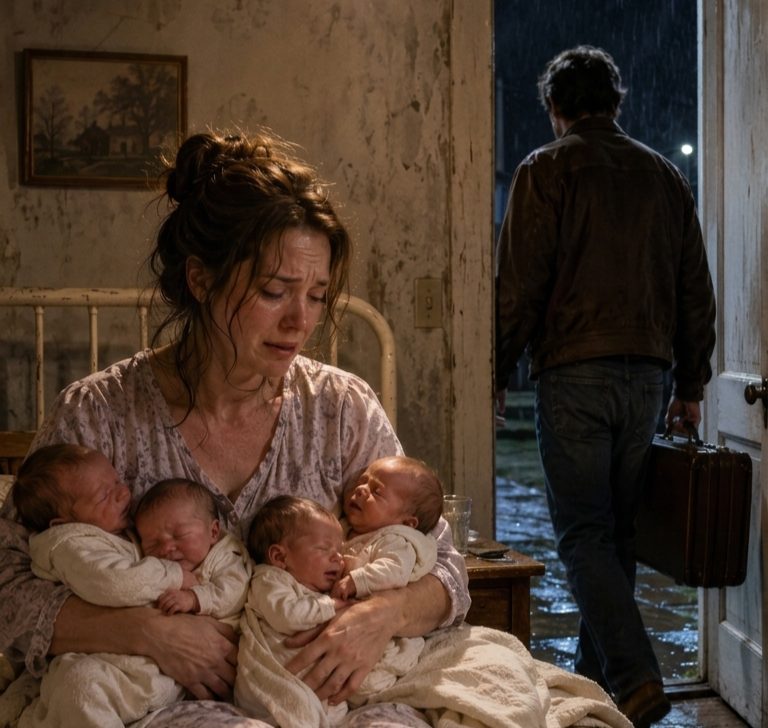
The farmhouse they were born into looked as though it could collapse at any moment.
Rainwater slipped through cracks in the roof whenever thunderstorms passed overhead. The kitchen cupboards were nearly empty except for dust and a few dented cans. The wooden floors creaked under every step, sounding tired, worn out, and ready to give up.
Life had already been unforgiving for the couple who lived there.
Then suddenly, there were five newborn mouths to feed.
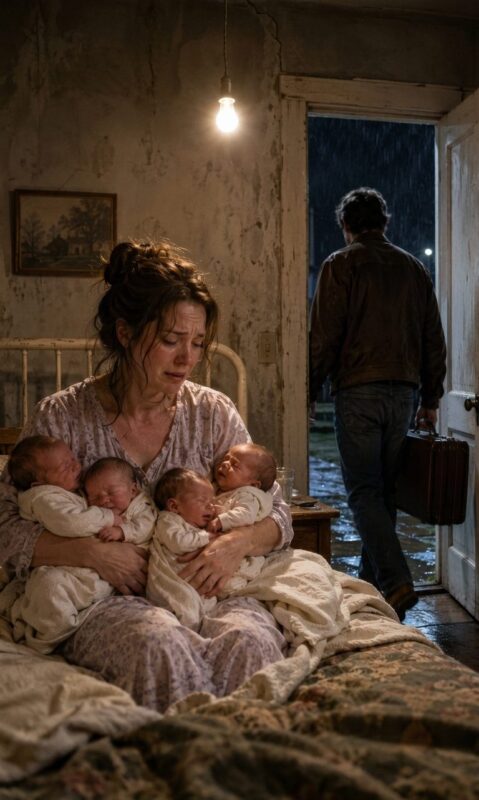
Margaret Hayes lay weak and trembling on an old mattress damp with sweat and exhaustion. Two infants rested against her chest while the other three cried softly from a basket lined with faded towels beside the bed. Pain shot through her body every time she tried to move, but whenever she looked at her children, warmth filled her exhausted eyes.
Her husband saw none of that warmth.
Richard Hayes stormed back and forth across the room, throwing shirts and old clothes into a battered duffel bag like a man preparing to flee a disaster.
“Five babies?” he shouted in disbelief, pulling at his hair. “We can’t even survive now, Maggie! How are we supposed to raise five children?”
Margaret struggled to sit upright despite the agony tearing through her body.
“They’re our babies,” she pleaded softly. “Please… don’t leave us.”
But Richard had emotionally disappeared long before he ever reached the door.
When he looked at the newborns, he didn’t see innocent children.
He saw debt.
Pressure.
Lost freedom.
Endless sacrifice.
Every responsibility he had spent his entire life trying to escape.
“I’m not wasting my life trapped in this misery,” he muttered bitterly.
Margaret’s expression crumbled in heartbreak.
Richard walked to an old dresser standing against the wall and opened a small jewelry box hidden in the top drawer. Beneath faded receipts rested an envelope Margaret had been secretly filling for months.
Three hundred and twelve dollars.
To anyone else, it was pocket change.
To that struggling family, it meant survival.
Baby formula.
Medicine.
Emergency doctor visits.
Hope for tomorrow.
“Richard, please,” Margaret begged through tears. “That money is for the children.”
Ignoring her completely, he shoved the cash into his pocket.
“Then think of it as repayment,” he said coldly, “for ruining my future.”
Before leaving forever, Richard Hayes turned toward the crying newborns one final time and spoke words that would scar the family for decades.
“These kids are nothing but a curse.”
The room fell silent except for the sound of crying babies.
A few minutes later, Richard boarded a Greyhound bus heading to Chicago. He left without kissing his wife, touching his children, or looking back a single time.
That was the first thing he ever gave his family:
His absence.
For years afterward, Margaret Hayes survived on determination alone.
Before sunrise, she cleaned strangers’ homes.
In the afternoons, she worked double shifts at a roadside diner.
Late at night, she folded laundry for wealthy families who rarely remembered her name.
Every evening she returned home exhausted, with swollen feet, cracked hands, aching joints, and tired eyes that seemed far older than the rest of her face.
Yet every time she saw her children, she smiled.
The babies were named Grace, Hannah, Caleb, Ethan, and Rose.
Margaret chose each name with care.
Grace, because kindness mattered more than wealth.
Hannah, because hope can survive even the darkest seasons.

Caleb, because courage protects the people we love.
Ethan, because strength rebuilds what life destroys.
Rose, because beauty can still bloom in the harshest soil.
Their town offered little compassion.
People whispered inside grocery stores whenever Margaret walked through with all five children following close behind her. Neighbors pitied her loudly enough for the children to hear. Others mocked them openly outside churches and from their front porches.
“There goes Margaret and her five little curses,” a woman whispered outside church one Sunday morning.
The children were only six years old.
But every one of them heard the words clearly.
Margaret heard them too.
For one brief moment, she stopped walking. The children looked up at her, waiting for anger to finally break through.
Instead, Margaret slowly knelt in front of them, fixed Caleb’s crooked collar, brushed dust from Rose’s cheek, and spoke in a calm voice only they could hear.
“People who don’t understand blessings,” she whispered gently, “often mistake them for burdens.”
Those words became the foundation of their childhood.
The Hayes children grew up with very little money.
But they never grew up without love.
There were winters when three of the children squeezed together on one sagging mattress because the house was too cold for anyone to sleep alone.
Their clothes and shoes traveled from sibling to sibling until the fabric tore and the soles nearly fell apart.
Some Christmases passed with only a single inexpensive gift waiting beneath the tree for all five children together.
Yet Margaret Hayes gave her children something far more powerful than money.
She gave them resilience.
No matter how many hours she worked or how exhausted she became, Margaret gathered the children around the kitchen table every single night to study. The old light above them buzzed and flickered, the chairs never matched, and dirty dishes often sat nearby because there simply was not enough time to finish every chore before homework began.
Still, Margaret treated those evenings as sacred.
“To stay poor,” she often told them, “people first have to stop believing they deserve better.”
Little by little, each child revealed a remarkable strength.
Grace developed an endless hunger for knowledge. She read everything she could get her hands on — newspapers, grocery ads, instruction booklets, worn library books held together with tape.
Hannah grew sharp-witted and fearless in conversation. Even as a teenager, she could outsmart adults who assumed she was powerless.
Caleb became the family’s protector. He never tolerated anyone insulting his mother or siblings and would stand his ground against anyone, no matter how intimidating they seemed.
Ethan spent hours pulling apart broken radios, bicycles, and household appliances just to understand the mechanics hidden inside before carefully rebuilding them again.
And Rose…
Rose paid attention to things other people overlooked.
She rarely spoke first, but when she did, the room became quiet enough to hear every word.
The five siblings moved through life as one unit.
If one of them had food, the others ate too.
If one faced trouble, all five stood together.
And whenever one succeeded, the victory belonged to the entire family.
Meanwhile, the memory of their father slowly transformed into something painful and distant — less like a real person and more like a warning.
The children knew who he was.
They knew he abandoned them.
And they knew he disappeared after stealing the money meant to buy formula for the babies.
Still, Margaret refused to let bitterness define the home she struggled to protect.
“Never allow his failures to poison your hearts,” she told them one evening after Caleb angrily asked whether Richard Hayes was dead.
Margaret stared into the darkness beyond the kitchen window for several silent moments.
Finally, she answered softly.
“No. But some people vanish long before they’re gone.”
The years rolled forward.
Then the decades followed.
And eventually, the five babies Richard Hayes once called a burden became the very people the nation admired.
By the time the Hayes quintuplets reached thirty, their names were known across America.
Not because they inherited wealth.
Not because life had been generous to them.
But because five children raised in hardship somehow built extraordinary lives.
Grace Hayes became one of Washington’s most respected federal prosecutors, famous for exposing corruption powerful corporations believed nobody would ever uncover.
Hannah Hayes founded a nonprofit organization that helped homeless single mothers rebuild stable lives across several states.
Caleb Hayes joined the Chicago Fire Department and earned recognition as a hero after rescuing children from a burning apartment complex while risking his own life.
Ethan Hayes became a leading aerospace engineer in Houston, helping develop groundbreaking technology for future space programs.
And Rose Hayes wrote a bestselling memoir about poverty, motherhood, survival, and resilience in forgotten parts of rural America.
At the center of every achievement stood one exhausted woman from Mississippi who once worked three jobs simply to keep her children alive.
Margaret Hayes never became wealthy.
She became something far more important.
She became proof that love and sacrifice can change the future of an entire family.
No matter how demanding their lives became, all five siblings returned home every Thanksgiving. Their careers scattered them across the country, yet they always found their way back to the old farmhouse outside Jackson.
By then, the house had changed.
The roof no longer leaked during storms.
Caleb rebuilt the porch himself.
Ethan rewired the entire electrical system.
Hannah paid for a full kitchen renovation.
And Grace quietly paid off the remaining mortgage without telling the others.
Margaret cried the first evening the lights stopped flickering.
Not because the electricity worked properly.
But because, after decades of struggle, she finally felt secure.
Then, on a cold November evening nearly thirty years after Richard Hayes disappeared, a knock echoed through the farmhouse.
Rose opened the door first.
Standing beneath the porch light was an older man wearing a wrinkled coat and carrying a worn duffel bag. Gray hair covered most of his head, and exhaustion had hollowed his face so deeply that he barely resembled the young father who abandoned five newborn children all those years earlier.
But Rose recognized him immediately.
Because some wounds never forget the person who created them.
“Is your mother home?” he asked quietly.
Behind her, the entire house fell silent.
One after another, the siblings emerged into the hallway after hearing the unfamiliar voice drifting through the farmhouse. Caleb froze the moment he saw the man at the door. Hannah’s expression hardened with shock and disgust. Grace revealed nothing at all, her face turning calm and unreadable.
Only Margaret stayed seated at the kitchen table, unable to move, as though someone from a buried nightmare had suddenly stepped back into her life.
Richard Hayes was standing in their doorway again.
For several heavy seconds, nobody spoke.
The man before them looked nothing like the terrifying figure preserved in their childhood memories. Time had worn him down. His shoulders sagged beneath exhaustion, and his hollow eyes carried the desperation of a man who had nowhere left to run.
“I saw Rose on television last month,” Richard said awkwardly, struggling to meet their eyes. “That’s how I found you.”
Rose’s memoir had recently become a national sensation. Millions of people had watched her emotional interview.
One of those viewers had been the father who abandoned them three decades earlier.
“What do you want?” Caleb asked coldly.
Richard hesitated before answering.
“I just wanted to see my family.”
The word family nearly made Hannah laugh out loud.
“You stopped being part of this family thirty years ago,” she snapped.
Richard lowered his gaze.
“I know I failed all of you.”
“Failed us?” Caleb barked, stepping forward. “You robbed five newborn babies and disappeared!”
Margaret rose quickly from her chair before the argument exploded further.
“That’s enough,” she whispered shakily.
The room instantly went silent.
Even after all these years, Margaret’s voice still carried more power than anyone else’s in that house.
Richard looked at her carefully.
“I’m sick,” he admitted quietly. “Heart failure. They diagnosed it last year. I lost my apartment in Chicago because the medical bills destroyed me.” His voice trembled. “I didn’t know where else to go.”
And suddenly, everything changed.
This wasn’t a proud man returning home to seek redemption.
This was a man crushed by life itself.
Grace crossed her arms tightly.
“So after abandoning us for thirty years,” she said bitterly, “you suddenly remembered we existed the moment you needed help?”
Richard stayed silent.
Because there was nothing he could possibly say.
The silence answered for him.
Rain tapped softly against the farmhouse windows while tension thickened inside the room like the storm clouds gathering outside.
Then Margaret slowly walked toward him.
All five children watched carefully, unsure of what she would do next.
After everything Richard had done, nobody could predict her reaction.
Margaret stopped directly in front of him and studied the exhausted face of the man who once called his own children a curse.
“You can come inside,” she said softly.
“Mom—” Caleb protested immediately.
“No,” Margaret interrupted gently. “Listen to me.”
Her eyes moved across each of her children.
“If pain turns us cruel the moment we finally gain power,” she whispered, “then our suffering taught us absolutely nothing.”
Nobody responded.
Because every child standing in that room understood one painful truth:
Their mother was still stronger than all of them combined.
Richard stepped cautiously into the farmhouse, carrying the same shame he had abandoned there thirty years earlier.
But none of the Hayes siblings understood something far more troubling:
Their father’s return was not a coincidence.
And before winter ended, the entire family would uncover the real reason Richard Hayes suddenly reappeared after decades of silence.
The first few days were miserable.
Nobody trusted him.
Caleb barely acknowledged Richard whenever he walked into a room.
Hannah avoided the kitchen completely if he happened to be sitting there with a cup of coffee.
Even Grace, normally composed under pressure, struggled to hide the resentment burning beneath her calm expression.
Only Margaret treated him with simple human decency.
Not warmth.
Not forgiveness.
Just dignity.
Richard slept in the old storage room near the back porch — the same cramped room once filled with broken furniture and water-damaged boxes during the children’s childhood.
At night, Rose sometimes heard him coughing violently through the thin walls while rain pounded the roof overhead.
He looked weak now.
Fragile.
Nothing like the furious man who had walked away decades earlier.
Still, nobody forgot what he had done.
Then one evening during dinner, the tension finally shattered.
“What exactly are we doing?” Caleb demanded suddenly, slamming his fork against the table. “Are we seriously pretending he deserves forgiveness just because he got old and sick?”
Richard immediately looked down.
“Caleb…” Margaret warned softly.
“No, Mom.” Caleb’s voice cracked beneath thirty years of buried anger. “He abandoned us. He left you alone with five babies. He stole from us. And now he suddenly comes back because life finally destroyed him?”
Nobody answered.
Because nobody disagreed.
The silence stretched painfully across the table until Richard finally spoke.
“You’re right,” he admitted quietly.
The response stunned everyone.
For the first time since returning, he didn’t defend himself.
He didn’t lie.
And he didn’t make excuses.
Richard sat quietly at the kitchen table, unable to stop staring at the tremor in his hands while rain whispered against the farmhouse windows.
“For years, I blamed everyone except myself,” he confessed in a low voice. “I thought Chicago would save me. Instead, it became thirty years of cheap apartments, gambling debts, alcohol, lonely nights, and one mistake after another.”
He rubbed his palms together nervously.
“I always told myself I’d return after I fixed my life,” he continued. “But the years kept passing. Eventually, guilt became easier to live with than facing all of you.”
Rose watched him carefully from across the table.
“So why now?” she asked.
Richard met her eyes.
“Because of you.”
The room grew still.
“I saw your television interview,” he explained softly. “You spoke about your mother like she was unstoppable.” His voice faltered. “And even after everything, you never spoke about me with hatred.”
Rose lowered her head slightly.
Because he was telling the truth.
In her memoir, she had never turned Richard into a villain. She described him only as a frightened man who abandoned responsibilities he couldn’t handle.
“That interview changed something in me,” Richard whispered. “I realized your mother spent three decades rebuilding the life I destroyed.”
Margaret blinked back tears.
A moment later, Richard reached into his coat and carefully laid a thick envelope on the table.
Grace looked at it warily.
“What is that?”
“My insurance policy,” Richard answered.
No one moved.
“It isn’t much,” he admitted. “But after the doctors gave me the diagnosis, I changed everything.” He swallowed hard. “Your mother gets all of it.”
Caleb frowned deeply.
“Why would you do that?”
Richard gave a tired, bitter laugh.
“Because she carried the weight of my failures for thirty years.”
Silence stretched across the kitchen.
Then Margaret slowly pushed the envelope back toward him.
“I never stayed for money,” she whispered.
“I know,” Richard replied quietly. “That’s why you deserve every penny.”
Winter arrived heavily in Mississippi after that conversation.
And over time, something unfamiliar began to grow inside the farmhouse.
It wasn’t forgiveness.
Not yet.
But the anger no longer felt as sharp.
The siblings began noticing things they never expected from their father.
Richard woke before dawn each morning to chop wood before Caleb could get outside.
Without being asked, he repaired broken gates, leaking pipes, and sagging fences around the property.
Some evenings, Rose would find him silently studying old family photographs with the expression of someone mourning his own choices.
One afternoon, Hannah discovered him sitting alone inside the barn, crying over a dusty box of childhood drawings the children had made decades earlier.
Margaret had kept every single picture.
Even after he disappeared.
That discovery seemed to break the last wall inside him.
Then, near the end of February, Richard collapsed while unloading groceries from the truck.
By evening, all five siblings stood inside a cold hospital room while doctors explained that his heart failure had worsened rapidly.
There was almost no time left.
Snow drifted quietly beyond the hospital windows while machines beeped steadily beside his bed.
For hours, the room remained nearly silent.
Then Richard slowly turned toward his children.
“There’s something I need all of you to understand before I’m gone,” he whispered weakly.
The room became completely still.
“When I called you a curse…” His voice cracked under the weight of the words. “I was never talking about you.”
Margaret immediately began to cry.
Richard stared toward the ceiling for several long moments before speaking again.
“I was talking about myself.”
Nobody spoke.
“Every time I looked at those babies,” he whispered through tears, “I saw everything I knew I was too weak to become.” His face tightened painfully. “Running away was the greatest mistake of my life.”
Caleb turned his face away, unable to watch.
Grace covered her mouth with shaking hands.
Rose wept openly beside the bed.
And Margaret — tired, aging, but still full of impossible kindness — reached forward and wrapped her hand gently around Richard’s trembling fingers despite all the pain he had caused her.
Richard Hayes passed away three days later.
The funeral drew hundreds of people.
Not because Richard had been admired.
But because the family Margaret raised had touched countless lives.
Firefighters stood beside federal lawyers.
Teachers embraced aerospace engineers.
Women from Hannah’s shelters cried beside strangers holding copies of Rose’s bestselling memoir.
And at the center of the crowd stood five children who had once been called a burden.
Not destroyed.
Not forgotten.
Loved beyond measure.
After the burial, the siblings returned to the farmhouse as golden sunlight spread across the Mississippi fields behind the house.
Before stepping onto the porch, Caleb paused and looked at his brothers and sisters.
“You know what’s unbelievable?” he asked quietly.
“What?” Ethan replied.
Caleb glanced toward the kitchen window, where Margaret moved slowly beneath the warm light inside.
“He spent thirty years believing he walked away from weakness.”
The others followed his gaze toward their mother.
Then Caleb smiled sadly.
“And he never understood he left behind the strongest family he would ever see.”