My Mother Gave Me a Plastic Plate at Her 50th Anniversary Party — She Didn’t Know I Owned Her House
At my parents’ fiftieth-anniversary celebration, seventy guests ate from elegant ivory china.
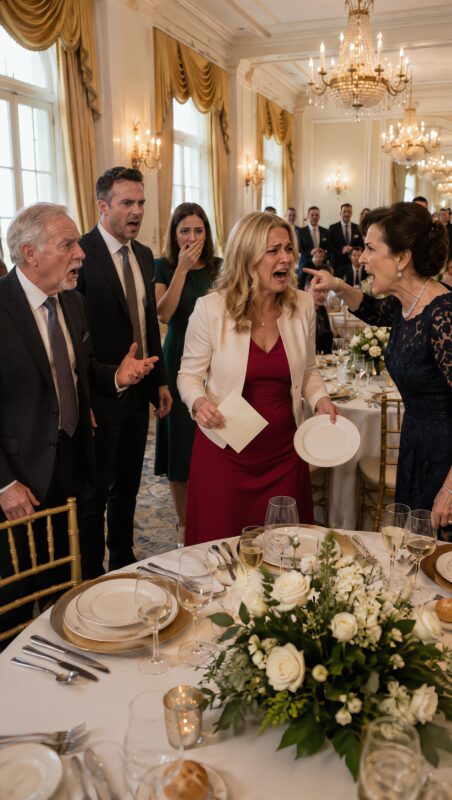
I was the only person given plastic.
The party filled the ballroom of an upscale San Francisco hotel. Crystal glasses reflected the chandeliers, white linen covered every table, and an enormous arrangement of roses stood behind my parents.
Mom had spent months telling everyone how important the evening was.
What she didn’t mention was that I had paid for it.
When I reached the family table, Mom intercepted me.
“Natalie, yours is over here.”
My seat was at the far end, beside the doors the hotel staff used to carry dishes in and out.
There was no crystal glass.
No linen napkin.
And instead of the china everyone else had, a flimsy plastic plate waited for me.
I stared at it.
Mom leaned close.
“Don’t make a scene, sweetheart. You know where you fit.”
My brother Derek heard her.
He smiled.
My sister Claire heard her too.
She looked away.
Years earlier, I might have demanded an explanation.
That evening, I didn’t.
I reached into my handbag and touched the cream-colored envelope I had brought as my parents’ anniversary gift.
Inside was something worth far more than anything else in the ballroom.
The deed to their house.
They simply didn’t know it yet.
I placed the plastic plate back on the table.
Then I walked out.
From my car, I called Melissa, my attorney.
“Natalie? Aren’t you supposed to be at the anniversary party?”
“I just left.”
“What happened?”
“Remember the property transfer scheduled for Monday?”
“Yes.”
“Cancel it.”
Melissa went silent.
“Are you sure?”
I looked through the windshield at the hotel entrance.
“Completely.”
Eleven years earlier, my parents had lost their previous home after a series of financial problems.
I stepped in.
Through my company, I purchased a house for them to live in. They paid $900 a month toward expenses while I covered everything else—the mortgage, taxes, insurance, maintenance, and repairs.
To relatives and friends, however, Mom and Dad spoke as though they owned the property.
I never corrected them.
For their fiftieth anniversary, I had decided to make their story true.
The documents inside my envelope would have transferred the house to them permanently.
One plastic plate changed my mind.
Not because plastic offended me.
Because it finally made something impossible to deny.
My family didn’t consider me an equal.
They considered me useful.
The following morning, Melissa prepared a standard lease based on the property’s market value.
Monthly rent: $6,800.
Dad called almost immediately.
“Have you lost your mind?”
“No.”
“You’re charging your retired parents nearly seven thousand dollars a month because your mother gave you the wrong plate?”
“She didn’t give me the wrong plate.”
“What does that mean?”
“She gave me exactly the plate she intended to give me.”
He went quiet.
“And this isn’t punishment,” I continued. “It’s the end of a subsidy.”
That afternoon, Derek arrived at my office without an appointment.
“You’re kicking Mom and Dad out.”
“No. They can stay if they sign the lease.”
“They can’t afford that!”
I opened a file.
“Speaking of things people can’t afford…”
I placed two documents in front of him.
His signature appeared at the bottom of both.
Promissory notes.
Total outstanding balance: $186,000.
Derek’s anger vanished.
“You wouldn’t.”
“I wouldn’t what?”
“Make me repay that.”
“Why not?”
“Dad said we were done with it.”
I almost laughed.
“Interesting. I don’t remember Dad being the person who transferred the money.”
Derek stared at me.
For years, I had rescued his business whenever another bad decision brought it close to failure.
Yet at family gatherings, he was still introduced as the successful entrepreneur.
Claire was the accomplished nurse.
I was Natalie.
The dependable one.
The person everyone called when a tuition payment was due, a business needed saving, or a bill became inconvenient.
I had even paid much of Claire’s nursing-school tuition.
But gratitude rarely followed.
My parents rejected the lease.
I instructed Melissa to sell the property.
Then Dad collapsed.
Mom called from the hospital, frantic, saying he might be having a heart attack.
I immediately drove there.
Halfway to the hospital, Melissa called.
“Pull over somewhere.”
Something in her voice frightened me.
I stopped.
“What happened?”
“I found a deed filed eight months ago.”
My stomach tightened.
“What deed?”
“Someone tried to transfer your parents’ house out of your company and into your father’s name.”
The county had rejected the transfer because the notary information was invalid.
That should have ended it.
It hadn’t.
Dad had apparently used the forged deed to apply for a $300,000 home-equity loan.
My signature appeared on the application.
I had never signed it.
Then Melissa told me the proposed purpose of the loan.
Property renovations.
Contractor:
Derek’s company.
I finally understood the plan.
My father would claim ownership of my property, borrow against it, and direct the money into my brother’s failing business.
When I entered the hospital waiting room, Mom and Derek were sitting together.
I didn’t even take off my coat.
“Which one of you forged my signature?”
Derek turned white.
Mom jumped to her feet.
“Keep your voice down.”
“That wasn’t my question.”
“Your father was trying to help this family.”
“With property that belongs to me?”
“We’ve lived there for eleven years!”
“And that somehow makes forgery acceptable?”
Before she could respond, Dad appeared in a wheelchair.
The doctors had ruled out a heart attack.
It had been a severe panic attack.
Dad saw my expression.
Then he noticed my phone.
His shoulders dropped.
“You found the loan application.”
It wasn’t a question.
“We planned to pay it back,” he said quickly.
“How?”
Nobody answered.
I looked from Dad to Derek and finally to Mom.
That silence explained more than any confession could have.
They didn’t think they were stealing from me.
In their minds, what belonged to me already belonged to them.
My generosity had been repeated so many times that they had stopped seeing it as generosity.
It had become an expectation.
Later that afternoon, I sat across from Melissa in her office.
“I don’t want criminal charges,” I said.
“You understand what they attempted?”
“Yes.”
“Then what do you want?”
“An ending.”
We prepared a settlement.
My parents would move out within sixty days and permanently surrender any claim to the property.
Derek would formally acknowledge his $186,000 debt and begin repayment.
My family would cover the legal expenses caused by the fraudulent paperwork.
In exchange, I would not report the attempted fraud.
At the settlement meeting, Mom still seemed convinced that everything had begun with dinner.
“You’re destroying this family over a plastic plate.”
Melissa quietly slid a document across the table.
It was the anniversary-party invoice.
**$18,420.**
Mom read it twice.
Then she looked at me.
“What is this?”
“The party.”
Her eyes widened.
“You paid for it?”
“All of it.”
For the first time, she seemed to understand the absurdity of what she had done.
She had used my money to host an elegant celebration where she deliberately gave me the cheapest place setting in the room.
“It was supposed to be funny,” she whispered.
“No.”
I looked at the invoice, then at her.
“It was honest.”
Mom frowned.
“What?”
“That plate showed me exactly how you saw me.”
Eventually, everyone signed.
My parents moved into a perfectly comfortable condominium.
Mom told several relatives that I had made them homeless.
I stopped correcting stories told by people committed to misunderstanding me.
The house sold for $2.35 million.
But the money wasn’t the part I remembered most.
Months later, Claire asked to meet.
She arrived looking nervous.
“I should have left with you that night.”
I waited.
“I saw the plate. I heard what Mom said. I knew it was cruel.”
“Then why didn’t you say anything?”
“I wanted to avoid a fight.”
I nodded.
“So did I. For years.”
Claire looked down.
“I’m sorry.”
Nothing came after those words.
No request.
No explanation.
No financial problem she needed me to solve.
Just an apology.
That made it different.
We began rebuilding our relationship carefully.
Nearly a year after the anniversary party, Claire and I met at a small neighborhood restaurant.
There were no chandeliers or crystal glasses.
When our food arrived, it came on ordinary white ceramic plates.
Claire caught me looking at mine.
“What?”
I smiled.
“Nothing. I just like this plate.”
She laughed.
Then she raised her glass.
“To cheap plates?”
“To honest tables,” I replied.
We clinked glasses.
For years, I had believed generosity was the price of admission to my own family.
If I paid enough bills, solved enough emergencies, and rescued enough people, surely I would eventually earn the same respect everyone else received automatically.
I know better now.
If you have to buy your place at a table, it was never truly yours.
That afternoon, nobody needed my credit card.
Nobody needed a loan.
Nobody expected me to shrink so they could feel important.
I was simply Natalie.
And there was a place waiting for me.
No payment required.