A Stranger Claimed My 92-Year-Old Grandpa’s Stadium Seats — His Teenage Son’s Response Silenced Everyone
Football had been part of my grandfather Jeremy’s life for ninety-two years.
Every weekend followed the same ritual. He would pull his worn blue scarf from the hallway drawer, settle into his old armchair, and watch his beloved team play. Beside him was another chair that no one used anymore.
It had been June’s.
My grandmother had died twelve years earlier, but Grandpa never stopped imagining her sitting there beside him.
Then, one spring morning, his doctor gave me news I had been dreading. Jeremy’s heart was becoming increasingly fragile, and there was no guarantee we would have many more opportunities to make special memories together.
A few weeks later, our team announced its biggest home match in years.
I knew immediately what I wanted to do.
I emptied most of my savings and bought two accessible seats with an excellent view of the pitch.
When Grandpa opened the envelope containing the tickets, he stared at them for several seconds.
Then his eyes filled with tears.
“You spent far too much on me.”
“I spent it on us,” I replied.
On match day, Jeremy dressed carefully and tucked a photograph of June into his jacket pocket.
When we finally reached our seats, he took out the picture and held it toward the bright green field.
“Look, June,” he murmured. “We finally got here.”
I thought nothing could spoil that moment.
I was wrong.
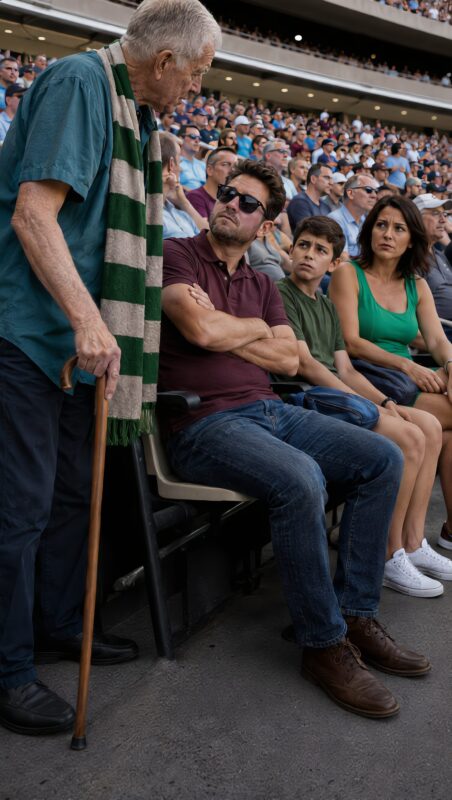
Minutes before kickoff, a well-dressed man appeared with his wife and teenage son. He checked the seat numbers, looked at us, and declared that he and his family wanted our places.
I thought he was joking.
“We bought these seats,” I told him. “They’re accessible seats for my grandfather.”
The stranger barely glanced at Jeremy.
“At his age, what difference does it make where he sits?”
Then he added with a dismissive shrug, “He probably won’t remember any of this tomorrow anyway.”
His wife looked uncomfortable.
His teenage son looked horrified.
I immediately turned to find a steward, but Grandpa stopped me.
“Leave it,” he said softly. “I didn’t come here to spend the afternoon arguing.”
Against every instinct I had, I helped him step aside.
The stranger sat down triumphantly. His wife followed, although she clearly wanted to disappear.
Their son remained standing.
His name was Brandon.
“Excuse me, sir,” he called.
Grandpa turned around.
Brandon reached into his backpack and removed a faded captain’s armband.
“My grandfather gave me this before he died,” he said. “He wore it whenever he came here.”
Then the boy faced his father.
“He taught me that being a captain means giving someone else your place when they need it more.”
His father stiffened.
“Brandon, sit down.”
The teenager didn’t move.
“You just said this man wouldn’t remember today,” Brandon replied. “Maybe he will. But even if he doesn’t, I will.”
Nobody around us spoke.
“And Grandpa would have remembered too,” Brandon continued. “He would have been embarrassed by us.”
He walked over and offered Jeremy the armband.
“I don’t think my father deserves to wear this today. I want you to have it.”
Jeremy studied the boy for a moment before gently pushing his hand back.
“No, young man. If your grandfather trusted you with it, you keep it. Just make sure you become the kind of person who deserves to wear it.”
That sentence changed everything.
A woman several seats away stood up.
“Give the gentleman his seat back.”
Someone behind her agreed.
Then another voice joined in.
Within seconds, the stranger found himself surrounded by supporters demanding that he move.
His confidence disappeared.
Without another argument, he and his wife returned to their original row.
But Brandon remained beside us.
He suddenly lifted the old armband into the air.
“This man has waited almost his entire life for a day like this,” he called out. “If you think he deserves the best view we can give him, stand up.”
For a moment, nothing happened.
Then one supporter rose.
Another followed.
Soon almost everyone in the section was standing.
A steward arrived to investigate the commotion. After hearing the story, he smiled and asked us to follow him.
He found Grandpa and me two accessible seats even closer to the pitch.
Brandon came with us.
From the opening whistle, Jeremy seemed transformed. He forgot his aching knees and his tired heart. He and Brandon analyzed every pass, criticized substitutions, predicted attacks, and celebrated tackles like two lifelong friends.
At halftime, Brandon’s father appeared.
The arrogance had disappeared from his face.
He looked at his son.
“Do you think I could wear your grandfather’s armband during the second half?”
Brandon considered the request.
Then he shook his head.
“Not yet.”
His father swallowed.
“Fair enough.”
After he walked away, Grandpa smiled at Brandon.
“That wasn’t easy.”
“No,” Brandon admitted.
“The important things rarely are.”
The second half began, and our team soon conceded a goal.
The entire stadium groaned.
Jeremy simply lifted his faded scarf above his head.
“Plenty of time left!”
I knew that phrase.
For years, nearly every birthday card Grandpa had given me contained the same lesson:
Never give up before the final whistle.
With two minutes remaining, our team scored the equalizer.
The crowd exploded.
Then came added time.
Our striker escaped his defender.
A teammate found him with a perfect pass.
He struck the ball.
Goal.
The stadium became a wall of sound.
Jeremy rose halfway from his seat, waving his scarf and laughing through tears.
“Did you see that, June?”
When the celebration finally settled, he took my grandmother’s photograph from his pocket.
“We saw it together,” he whispered.
Then he turned to Brandon and reached for the captain’s armband.
The boy immediately handed it over.
But Grandpa didn’t put it on himself.
Instead, he carefully fastened it around Brandon’s arm.
The teenager stared at him.
Jeremy smiled.
“Remember something. A captain isn’t the person who gets the best seat. A captain is the person who notices when someone else needs one.”
Brandon looked toward his father.
Several rows behind us, the man slowly stood.
This time there was no arrogance in his expression.
He placed a hand against his chest and nodded to his son.
It wasn’t an apology.
Not yet.
But it looked like someone had finally understood that he owed one.
After the match, as we prepared to leave, Grandpa noticed a discarded cup beneath the seat.
He picked it up.
“Take this with us. There’ll be a bin outside.”
I laughed.
“After everything today, you’re worried about one paper cup?”
Jeremy shrugged.
“You should always leave a place a little better than you found it.”
Brandon heard him.
Without hesitation, he collected two more pieces of rubbish from the row.
That was when I understood what Grandpa had really accomplished that afternoon.
I had brought him to the stadium because I wanted to give him one final extraordinary football memory.
Instead, Jeremy had given someone else something that might last much longer.
He had shown a teenager that respect is not measured by the seat you can claim, the authority you can demand, or how loudly you can make others move aside.
Sometimes character is revealed by something much simpler:
whether you are willing to give up your place for someone who needs it more.
Grandpa had spent nearly a century loving football.
That afternoon, he didn’t just watch an unforgettable match.
He made sure its most important lesson would survive long after the final whistle.