A TWELVE-YEAR-OLD BOY STOOD OUTSIDE OUR MANSION FOR HOURS. WHEN I ASKED WHY HE WOULDN’T LEAVE, HE WHISPERED, “THIS USED TO BE MY HOME. MY PARENTS DIED, AND I HAVE NOWHERE TO GO BACK TO.” BUT WHEN I SHOWED HIM WHAT WE’D FOUND HIDDEN UPSTAIRS, HE BURST INTO TEARS.
Alex first spotted the boy shortly after breakfast.
He was standing beyond the tall black gates of the family estate, gazing at the enormous white mansion as though he recognized every window.
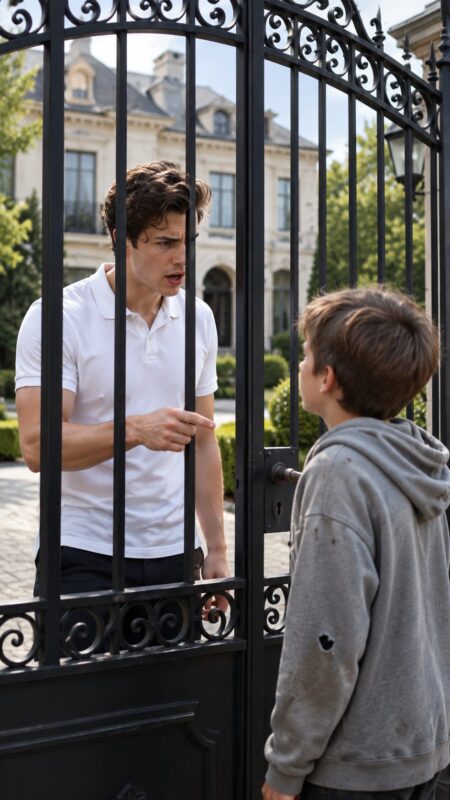
The child couldn’t have been older than twelve.
His gray sweater was worn at the elbows, his sneakers were dusty, and a faded backpack hung from one shoulder.
At first, Alex paid little attention.
Strangers occasionally stopped to admire the property.
But when he looked outside an hour later, the boy was still there.
He hadn’t moved.
He simply stood watching the house.
Curious and slightly concerned, Alex walked down the driveway.
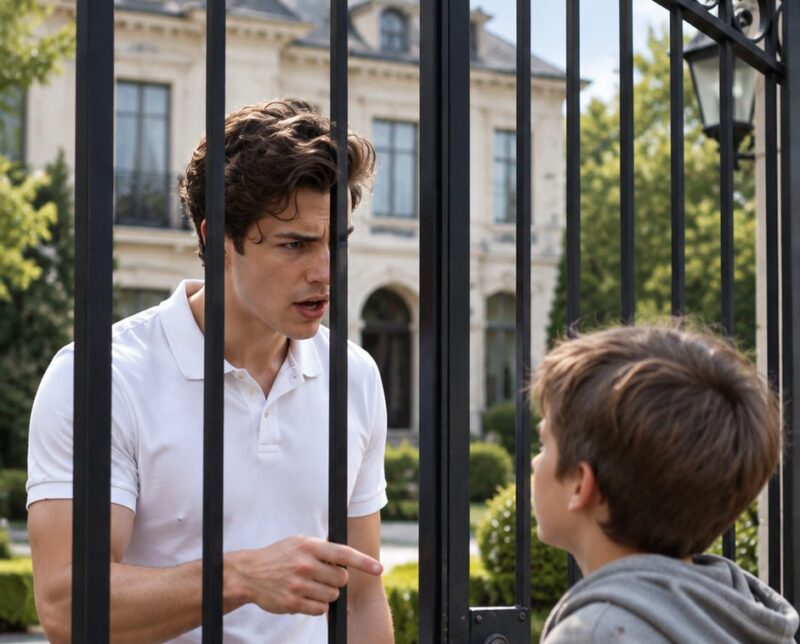
“Hey, kid,” he called through the gate. “Are you waiting for somebody?”
The boy flinched.
“No, sir.”
“Then why have you been staring at our house all morning?”
The child lowered his eyes.
For several seconds, he seemed unsure whether he should answer.
Finally, he whispered, “Because I used to live here.”
Alex frowned.
“Here? In this mansion?”
The boy nodded.
“Before the accident.”
“What accident?”
“My parents died in a car crash. I was little when it happened.”
His voice became quieter.
“After that, everything changed. I never got to come home again.”
Alex felt a sudden ache in his chest.
His parents had purchased the estate six years earlier after the bank took possession of it.
He’d heard that the previous family had suffered a tragedy, but nobody had ever explained what happened.
“What’s your name?” he asked gently.
“Ethan Wilson.”
Alex went still.
“Wilson?”
“Yes.”
“What were your parents’ names?”
“Michael and Sarah.”
Alex stared at him.
Those names were familiar.
Several months earlier, his father had hired workers to renovate the second-floor study.
While dismantling an old built-in wardrobe, one of the carpenters had discovered a small wooden chest hidden behind the paneling.
Inside were faded photographs, children’s artwork, and a silver pendant.
One photograph showed a young couple embracing a little boy.
On the back, someone had written:
**“Michael, Sarah, and Ethan. Summer 2018.”**
Alex looked carefully at the child standing outside the gate.
“Ethan, would you wait here for a moment?”
The boy looked frightened.
“Did I do something wrong?”
“No. I think there’s something inside that you might recognize.”
Alex hurried into the mansion.
He climbed the staircase, entered his father’s study, and retrieved the old wooden box from a cabinet.
When he returned, Ethan was still standing exactly where he’d left him.
The moment the boy saw the box, his eyes widened.
“Where did you get that?”
“We found it during renovations.”
Ethan took a shaky breath.
“My dad used to keep our special things in a box like that.”
Alex carefully lifted the lid.
On top lay the family photograph.
Ethan reached for it with trembling fingers.
He stared at the smiling woman in the picture.
Then his eyes filled with tears.
“That’s my mommy.”
His finger moved toward the man beside her.
“And that’s Dad.”
For a long moment, he couldn’t speak.
Finally, he whispered, “I thought I’d lost every picture of them.”
Alex watched him hold the photograph against his chest.
He suddenly understood that the boy hadn’t come to admire a beautiful building.
He’d come searching for a piece of his family.
Without another word, Alex unlocked the gate.
“Come inside.”
Ethan immediately shook his head.
“I can’t.”
“Why not?”
“Because this house belongs to you now.”
Alex glanced toward the mansion.
“That’s true. But it used to be your home, and you deserve to see it again.”
The boy hesitated.
“Really?”
“Really.”
Slowly, Ethan stepped through the gate.
He followed Alex along the driveway, looking around with wide eyes.
He recognized the large oak tree beside the garden.
The stone fountain near the entrance.
The narrow path leading toward the backyard.
“My dad taught me to ride a bicycle right there,” he said, pointing toward the driveway.
Alex smiled.
“Did you fall?”
“A lot.”
For the first time, Ethan laughed.
“Dad kept running behind me because he thought I’d crash into the fountain.”
They reached the front door.
Ethan stopped.
His expression became serious again.
Alex opened it.
“Ready?”
The boy nodded.
They stepped inside.
Ethan stood motionless in the entrance hall.
He looked toward an empty corner.
“There was a piano here.”
Alex turned.
“We still have it. My parents moved it into the living room.”
Ethan’s face brightened.
“Can I see it?”
“Of course.”
He hurried into the adjoining room.
There, beside the tall windows, stood an old black piano.
Ethan approached it as though it were something precious.
“My mom played this every Sunday morning,” he whispered.
He gently touched the polished wood.
“She used to play while Dad made pancakes. Sometimes she’d sing, and he’d pretend he was a famous dancer.”
Alex laughed softly.
“Sounds like they were fun.”
“They were.”
Ethan sat on the piano bench.
He lifted his hands toward the keys but stopped.
“I don’t remember how to play.”
“That’s okay.”
“I used to know one song.”
“Maybe it’ll come back to you.”
Ethan pressed a single key.
The note echoed through the room.
He smiled faintly.
Then he stood.
“Could I see upstairs?”
Alex nodded.
“Show me the way.”
To his surprise, Ethan remembered the layout perfectly.
He climbed the staircase, turned left, and walked down the long hallway.
At the final door, he stopped.
“This was my bedroom.”
Alex opened it.
The room had become a guest suite.
The walls were a different color, the furniture was new, and the curtains had been replaced.
Ethan stepped inside cautiously.
He walked toward the window.
“My dad made me a wooden airplane,” he said. “It was painted red and blue.”
He smiled at the memory.
“I tried flying it out this window once. Instead, I broke the glass.”
Alex chuckled.
“Were your parents angry?”
“Mom was. Dad tried not to laugh.”
For a brief moment, Ethan looked like any other child remembering a funny family story.
Then something near the doorway caught his attention.
He froze.
Alex followed his gaze.
On the wooden doorframe were several faint pencil lines.
Beside them, handwritten labels had survived years of renovations.
**Ethan — 5 years old.**
**Ethan — 6 years old.**
**Ethan — 7 years old.**
The boy approached the frame.
He touched the lowest mark.
Then the next.
Finally, he rested his palm against the highest line.
“My dad made these,” he whispered.
Alex said nothing.
“Every birthday, he’d make me stand here without shoes. Then he’d put a book on my head and mark how tall I’d grown.”
Ethan tried to smile.
“He always told me I was getting too big to carry.”
His voice broke.
A tear slid down his cheek.
Then another.
He stood with his hand against the doorframe, silently crying.
Alex remained beside him.
He didn’t interrupt.
He simply gave Ethan time.
Eventually, the boy wiped his face with his sleeve.
“I’m sorry.”
“You don’t need to apologize.”
Ethan looked around the room.
“After my parents died, I went to live with relatives. Later, I stayed with different families for a while.”
He swallowed.
“I kept thinking about this house. I wanted to come back, but I was scared.”
“Of what?”
“That nothing would be left.”
Alex listened.
“I thought maybe someone had torn it down. Or changed everything. And if all the things I remembered were gone…”
His voice faded.
Alex gently finished the thought.
“You were afraid you’d lose another connection to your parents.”
Ethan nodded.
Alex handed him the wooden box.
“Your parents aren’t here anymore, Ethan. But the love they gave you doesn’t disappear because someone else owns the building.”
The boy looked at the photographs.
“Do you really think so?”
“I do.”
That evening, Alex told his father everything.
He explained how he’d found Ethan outside the gates and how the boy had recognized the photographs, the piano, and the markings on the bedroom doorframe.
His father listened carefully.
Then he asked, “Does someone know where Ethan is?”
Alex admitted he wasn’t sure.
The following morning, his father contacted the appropriate people to make sure the child was safe.
They learned that Ethan was living with his aunt in a neighboring town.
She had taken responsibility for his care but hadn’t realized how deeply he missed his childhood home.
When Alex’s father explained the visit, she became emotional.
“He still talks about his parents,” she said. “Especially their old house. I didn’t know he’d gone there.”
They agreed that Ethan could return for another visit, this time with her permission.
A week later, a car pulled up outside the mansion.
Ethan stepped out with his aunt.
Alex was waiting at the entrance.
“Hey, Ethan!”
The boy smiled.
“You remembered me.”
Alex laughed.
“Of course I did.”
Inside, the family had prepared a warm dinner.
On the dining room table lay all the photographs and drawings discovered during the renovation.
There was also the silver locket.
Ethan picked it up carefully.
“My mom wore this.”
He opened it.
Inside was a tiny photograph of him as a baby.
His eyes filled again.
Alex’s father gently pushed the box toward him.
“These things belong with you, Ethan. We were only keeping them safe.”
The boy looked stunned.
“You’re giving them to me?”
“They were always yours.”
Ethan held the locket tightly.
“Thank you.”
During dinner, he told stories about his parents.
He described his mother’s terrible jokes, his father’s love of old movies, and the family dog that used to steal socks from the laundry basket.
Everyone laughed.
For the first time in years, Ethan could talk about his childhood without feeling that he was making people uncomfortable.
After dessert, Alex’s father disappeared into the garage.
When he returned, he was holding a pencil, a ruler, and a small measuring tool.
“Ethan, come upstairs with me.”
The boy looked puzzled.
“Why?”
“You’ll see.”
They walked to his old bedroom.
Alex’s father stopped beside the marked doorframe.
“Something seems to be missing here.”
Ethan looked at the pencil lines.
“What?”
“Well, the last measurement says you were seven.”
He smiled.
“But you’re twelve now, aren’t you?”
Ethan nodded.
“Then we have some catching up to do.”
The boy stared at him.
“Are you going to measure me?”
“If you’ll let me.”
Ethan’s lips trembled.
“Yes, please.”
He stood with his back against the wood.
Alex placed a book gently on his head.
His father drew a fresh pencil line.
Then, beside it, he carefully wrote:
**Ethan — Age 12. Returned.**
The boy stared at the new words.
“But…” he began.
Alex looked at him.
“What is it?”
“This isn’t my house anymore.”
Alex’s father knelt beside him.
“Ethan, owning a house and belonging somewhere aren’t always the same thing.”
He pointed toward the old measurements.
“Your father put those marks here because he loved watching you grow. We wouldn’t dream of erasing them.”
Alex smiled.
“And now there’s another one.”
Ethan looked from the old lines to the new one.
For the first time since the accident, he felt that a piece of his childhood had been returned to him.
From that day forward, Sunday became Ethan’s favorite day of the week.
With his aunt’s approval, he visited Alex’s family regularly.
Sometimes they played games in the garden.
Sometimes he helped prepare dinner.
And sometimes he sat at his mother’s old piano, slowly relearning the melodies he’d once heard every weekend.
Alex even found a music teacher willing to help him.
At first, Ethan struggled.
His fingers stumbled over the keys.
But he kept practicing.
One Sunday, he finally played a simple tune from beginning to end.
When he finished, he looked toward Alex.
“My mom used to play that.”
Alex smiled.
“Then I think she’d be proud.”
Ethan smiled back.
The months passed.
The mansion began to feel less like a painful reminder of what he’d lost and more like a place where his memories were welcome.
Nobody tried to replace his parents.
Nobody asked him to forget them.
Instead, Alex’s family encouraged him to tell stories, share photographs, and remember the people who had loved him first.
Then came Ethan’s thirteenth birthday.
His aunt brought him to the mansion for a small celebration.
There was cake, music, and a table covered with presents.
But before the candles were lit, Alex had one more surprise.
“Come upstairs.”
Ethan immediately smiled.
“I know where we’re going.”
They walked to the familiar bedroom.
The doorframe still held the old pencil marks.
Five.
Six.
Seven.
Twelve.
Alex handed him a ruler.
“Ready for another one?”
Ethan stood straight against the wood.
Alex carefully marked his new height.
Then he wrote:
Ethan — Age 13. Always Welcome Back.
The boy read the words twice.
Then he turned toward Alex.
“You know, when I first came here, I thought I’d lost everything.”
Alex listened.
“My parents were gone. Our house belonged to someone else. And I thought there wasn’t anywhere left that still felt like home.”
He looked at the pencil marks.
“But you kept all of this.”
Alex shook his head.
“We didn’t know what those marks meant when we bought the house.”
He smiled.
“But now we do.”
Ethan wiped his eyes.
“Thank you for not erasing them.”
Alex placed a hand on his shoulder.
“Some things deserve to be preserved.”
The boy stepped forward and hugged him.
For a long moment, neither spoke.
Downstairs, the birthday cake was waiting.
His aunt was laughing with Alex’s parents.
And the old piano stood near the window, ready for another Sunday melody.
Ethan’s childhood home had changed owners.
Its rooms looked different.
New people lived inside.
But the memories of Michael and Sarah Wilson were no longer hidden away in a forgotten wooden box.
They were part of the house again.
And every time Ethan visited, another memory found its way back.
Alex’s family had purchased the mansion, but they never tried to claim the childhood that belonged to Ethan.
Instead, they gave him something far more meaningful than ownership.
They gave him a place where his parents were remembered, his stories were welcomed, and the door would always open when he returned.
Because sometimes home isn’t the building that belongs to you.
It’s the place where someone is happy to see you come back.