MY THREE-YEAR-OLD DAUGHTER SNEAKED INTO MY MILLIONAIRE BOSS’S FORBIDDEN OFFICE AND ASKED, “WHY DOES YOUR FACE ALWAYS LOOK SO ANGRY?” I EXPECTED HIM TO FIRE ME IMMEDIATELY. INSTEAD, HER NEXT WORDS MADE THE ENTIRE ROOM FALL SILENT.
I was carrying a tray of freshly brewed coffee when I heard a familiar little voice coming from the upstairs study.
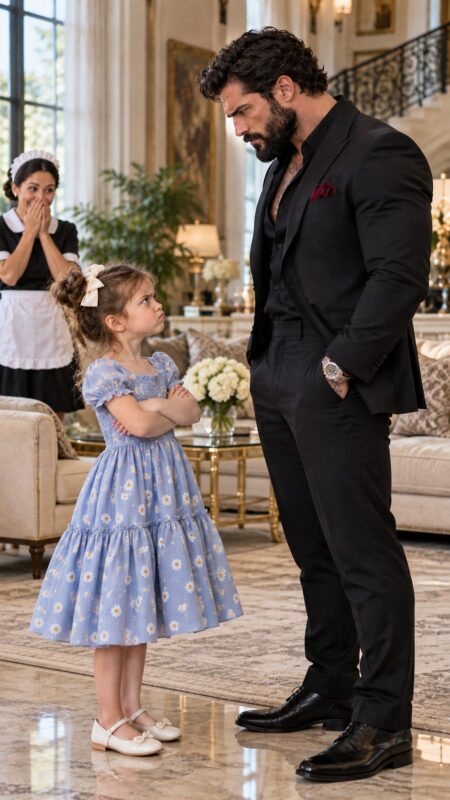
“Are your eyebrows stuck like that?”
My hands trembled.
There was only one child inside that enormous mansion.
My daughter, Mia.
And she was speaking to Vincent Castalano.
The one man nobody in that house dared to interrupt.
I’d been employed as a housekeeper at the Castalano estate for almost two years. During that time, I’d learned that Vincent valued privacy above everything else.
His study was strictly forbidden territory.
Even senior employees needed permission to enter.
And bringing children to work was absolutely prohibited.
Unfortunately, that morning, I’d broken both rules.
My regular babysitter had called in sick. The only available daycare demanded seventy dollars upfront, and my bank account was nearly empty.
I couldn’t afford to miss another shift.
So I’d brought Mia along, hoping she’d spend the morning quietly coloring in an unused sitting room.
Clearly, that plan had failed.
I rushed upstairs, my heart pounding.
The sight inside the study nearly stopped me in my tracks.
Vincent stood behind his enormous wooden desk, wearing his usual perfectly tailored black suit.
His tattooed hands rested on a stack of documents.
His trusted adviser, Renzo, stood nearby with two security guards.
And directly in front of them was my tiny daughter.
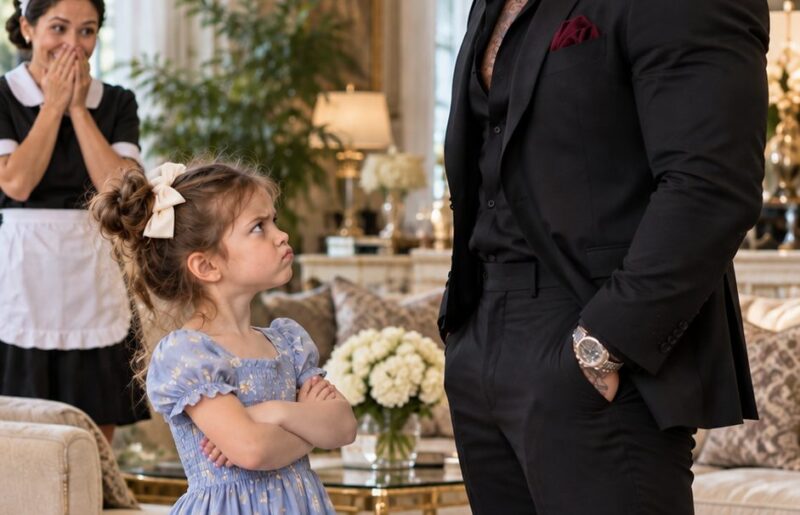
Vincent was staring down at her with his famously intimidating expression.
Mia stared right back.
Then she placed both hands on her hips, narrowed her eyes, and copied his stern face.
“You look like this,” she announced.
Renzo turned away, clearly struggling not to laugh.
“MIA!”
My daughter glanced over her shoulder.
“Oh! Hi, Mommy!”
I hurried forward.
“Mr. Castalano, I’m so sorry. She wasn’t supposed to leave the downstairs room. I promise this won’t happen again.”
Vincent raised his hand.
I immediately stopped talking.
Then he did something completely unexpected.
He walked around his desk and crouched in front of Mia.
“Do you think I look frightening?” he asked.
Mia tilted her head.
“Not frightening. Just grumpy.”
One guard coughed into his fist.
Vincent’s eyebrows lifted.
“And why do you think I’m grumpy?”
“Because you make the same face Mommy makes when she sees how much everything costs.”
My cheeks burned.
I wanted to disappear.
But Vincent’s lips twitched.
“Is that so?”
Mia nodded enthusiastically.
“Except Mommy’s eyebrows aren’t as big.”
Renzo finally lost his battle and laughed.
For a moment, Vincent looked genuinely surprised.
Then a low chuckle escaped him.
I’d never heard him laugh before.
Neither, apparently, had anyone else in the room.
Mia smiled proudly, as though she’d just accomplished something remarkable.
“See? You look nicer now.”
Vincent shook his head.
“You’re a very unusual little girl.”
“I’m three,” she replied seriously.
“As you’ve made abundantly clear.”
While Vincent finished speaking with Renzo, Mia discovered a pencil and some blank paper.
She settled on the carpet and began drawing.
A few minutes later, she proudly presented her masterpiece.
It showed a tall figure with enormous eyebrows, tiny feet, and two circles floating beside his head.
“That’s you!”
Vincent examined the paper.
“Why do I have wheels?”
Mia frowned.
“Those are your ears!”
Renzo laughed so loudly that one of the guards joined him.
Vincent stared at the picture for another moment.
Then he began laughing again.
This time, he didn’t try to stop.
I stood frozen, watching the most feared man in the mansion laugh at a drawing made by a three-year-old.
Eventually, his attention returned to me.
“Why did you bring her here?”
I swallowed.
“My babysitter is ill, sir. I couldn’t find anyone else, and I can’t afford to lose today’s wages.”
“Why not use a daycare?”
“The emergency center wanted seventy dollars. I didn’t have enough.”
Vincent was silent.
Then he turned toward Renzo.
“What happened to the children’s room in the west wing?”
Renzo’s expression changed.
“It’s still locked, sir.”
“Is the furniture there?”
“Yes. But nobody has used that room for several years.”
Vincent glanced at Mia, who was now drawing another picture.
“Have it opened and cleaned.”
Renzo hesitated.
“Sir, are you certain?”
“I wouldn’t have said it otherwise.”
Then Vincent looked at me.
“Whenever your childcare arrangements fall through, you may bring Mia here. She’ll stay in that room under appropriate supervision.”
I stared at him.
“Mr. Castalano, I don’t know what to say.”
“Thank you would be sufficient.”
“Thank you. Truly.”
He nodded toward Mia.
“However, my office is not a playground.”
Mia looked up.
“Can I come when you need help smiling?”
Vincent pressed his lips together.
“Especially not then.”
But his eyes were smiling.
By late afternoon, the west wing had been transformed.
The staff opened the windows, polished the furniture, and brought in books, stuffed animals, puzzles, crayons, and comfortable bedding.
A professional caregiver was arranged to supervise Mia whenever she needed to stay.
The room was beautiful.
But something about it seemed strangely untouched.
There were faded stars painted across the ceiling.
A small wooden bookshelf stood against one wall.
And in the corner sat an old rocking horse that looked as though it had been waiting for someone for years.
I wondered why Vincent had kept such a lovely room closed.
That evening, Mia discovered a folded sheet of paper on her little table.
Someone had drawn a tiny girl with gigantic eyebrows and impossibly long arms.
Below the picture were four words.
“You’re no artist either.”
Mia burst into giggles.
I recognized Vincent’s handwriting immediately.
The following day, he surprised me again.
As I finished my work, he approached.
“Would you and your daughter join me for dinner this evening?”
I hesitated.
He noticed.
“There’s no special occasion. I simply thought some company might be pleasant.”
I agreed.
Dinner was surprisingly relaxed.
Mia spent most of the meal explaining why her stuffed rabbit needed its own bedroom.
Vincent listened as though she were presenting an important business proposal.
Then, while reaching for her dessert, Mia noticed an old photograph on the mantelpiece.
It showed Vincent smiling broadly with a little girl sitting on his shoulders.
“Who’s that princess?” she asked.
Vincent’s smile faded.
He looked at the photograph.
“Her name was Sofia.”
“Is she your little girl?”
“Yes.”
“Where is she now?”
The room grew quiet.
Vincent took a slow breath.
“Sofia passed away when she was four.”
Mia lowered her spoon.
Even at three, she seemed to understand that something sad had happened.
“Do you miss her?”
Vincent nodded.
“Every single day.”
For the first time, he began talking about his daughter.
Sofia had loved yellow roses.
She’d adored picture books and insisted that every bedtime story needed a happy ending.
She used to race through the mansion, leaving toys everywhere and drawing funny faces on scraps of paper.
Then she was gone.
After her death, Vincent couldn’t bear to enter her playroom.
He ordered the door locked.
He stopped hosting family gatherings.
He avoided birthdays, celebrations, and anything that reminded him of the happiness he’d lost.
The mansion became a place of perfect order and terrible silence.
Now I understood why reopening the west wing had shocked Renzo.
It wasn’t just an unused room.
It was Sofia’s room.
Mia quietly climbed down from her chair.
She walked toward Vincent and placed her little hand on his knee.
“Mr. Vincent?”
He looked at her.
“Yes?”
“You know something?”
“What?”
“It’s okay to laugh when you miss somebody.”
His expression changed.
Mia continued.
“Mommy says being sad doesn’t mean you can’t have happy days.”
Vincent looked away.
His eyes were shining.
“That’s very wise advice.”
Mia studied his face.
“Are those tears?”
He nodded.
“Yes, sweetheart.”
She reached for a napkin and offered it to him.
“Here. Mommy cries sometimes too. She says it’s dust, but there’s never any dust.”
I couldn’t help laughing.
Vincent laughed as well, wiping his eyes.
And something about that moment stayed with me.
For years, this powerful man had surrounded himself with guards, expensive furniture, and strict rules.
Yet a small child had reached him with nothing more than honesty and kindness.
Over the following weeks, the atmosphere in the mansion slowly began to change.
Vincent started greeting employees instead of walking past them.
He occasionally joined Mia for a few minutes of drawing.
He even allowed Renzo to tease him about his growing collection of ridiculous portraits.
One afternoon, he announced that the west wing would become a permanent childcare facility for employees.
Qualified caregivers were hired.
The rooms were renovated.
Safety equipment, educational toys, and comfortable furniture were installed.
When someone asked why he was investing so much money, Vincent answered simply.
“People shouldn’t have to risk their jobs because they have children who need care.”
For many employees, it was life-changing.
Parents who’d struggled with unreliable babysitters finally had dependable support.
The mansion that once echoed with nothing but footsteps now filled with children’s voices.
Vincent never admitted how much he enjoyed the change.
But I noticed that he frequently found excuses to walk past the playroom.
And whenever Mia spotted him, she’d shout, “Mr. Angry Eyebrows!”
He would sigh dramatically.
“My name is Vincent.”
“I know!”
“Then use it.”
“Okay, Mr. Vincent Angry Eyebrows!”
Renzo laughed every single time.
Months passed.
Mia’s drawings became a permanent feature of Vincent’s study.
He framed her first portrait and placed it beside several important business awards.
When visitors asked about the strange artwork, he would say, “That’s the most accurate portrait anyone has ever made of me.”
Then Sofia’s birthday arrived.
Vincent asked whether Mia and I would accompany him to the cemetery.
We agreed immediately.
Mia chose a bouquet of yellow roses.
She also spent hours making a drawing.
When we reached Sofia’s grave, Vincent stood quietly beside the headstone.
Mia placed the flowers down.
Then she carefully set her picture beside them.
It showed two little girls holding hands beneath a rainbow.
Vincent crouched beside her.
“Who did you draw?”
“Me and Sofia.”
He looked at her gently.
“But you never met my daughter.”
Mia nodded.
“I know. But you told me about her favorite flowers and her stories. I think we would’ve been friends.”
Vincent covered his mouth.
For a long moment, he couldn’t speak.
Then he began to cry.
He didn’t apologize.
He didn’t turn away.
He simply held Mia’s hand while the tears fell.
I realized then that my daughter hadn’t helped him forget Sofia.
She’d helped him feel safe remembering her.
A full year passed after Mia’s unexpected visit to the forbidden study.
By then, everything had changed.
The once-silent west wing was filled with children playing.
Employees smiled more often.
Vincent’s study contained colorful drawings alongside expensive contracts.
And the man who once frightened everyone had become someone Mia greeted with hugs.
One afternoon, I entered his office carrying paperwork.
On his desk stood a new framed picture.
Three figures were holding hands.
A tall man in a black suit.
A woman with long hair.
And a little girl wearing a bright dress.
All three had enormous eyebrows.
Beneath them, Mia had carefully written, with a little assistance:
“THE PEOPLE I LOVE.”
Vincent noticed me looking.
He picked up the frame.
“Do you know what frightened me most after Sofia died?” he asked.
I shook my head.
“That if I allowed myself to be happy again, it would somehow mean I loved her less.”
He looked toward the window.
“I kept her room locked because I thought that was how I was supposed to remember her.”
I sat quietly.
“But Mia made me realize something,” he continued. “My daughter brought happiness into this house. She wouldn’t have wanted me to spend the rest of my life refusing to feel it.”
I smiled.
“She sounds like she was a wonderful little girl.”
“She was.”
His voice softened.
“And Mia reminds me that there are still wonderful things happening in the world.”
That evening, as I prepared to leave, Mia suddenly ran toward his office.
Instinctively, I almost called her back.
Then I stopped.
The door that had once been forbidden was wide open.
Vincent was reviewing documents when Mia appeared.
“Goodbye, Mr. Angry!”
She hugged his legs.
He looked down at her.
“We’ve discussed this nickname.”
“I know.”
“And what did we decide?”
Mia grinned.
“That you need to smile more!”
Vincent tried to look stern.
But Mia reached up and gently touched his eyebrows.
“There! You’re doing it again!”
He burst into laughter.
I stood in the doorway, watching them.
A year earlier, I’d entered that mansion terrified of losing my job because I couldn’t afford childcare.
I’d never imagined that my daughter’s innocent curiosity would change so many lives.
Vincent had given Mia a place where she could feel safe.
He’d given struggling parents a chance to work without fear.
And he’d given me the kindness I’d desperately needed.
But Mia had given him something just as precious.
She’d reminded him that grief didn’t have to become a prison.
That memories could bring warmth as well as sadness.
And that opening his heart to others didn’t mean closing it to Sofia.
The man who once locked every door to protect himself from painful memories had finally learned to leave them open.
Not because he’d forgotten the daughter he’d lost.
But because a little girl with crayons and absolutely no fear had reminded him how to welcome happiness back into his life.
Tighten the story’s repeated emotional beatsMake Vincent’s transformation more gradual