After a grueling twelve-hour shift, my thoughts were consumed by one thing—how I was going to keep paying for my sister’s treatment. That’s when a small girl stepped up to my register, clutching a single bottle of milk, and softly asked if she could pay for it tomorrow.
I assumed turning her down would be the hardest moment of my night. I couldn’t have been more wrong.
At forty-one, my life had narrowed to endless shifts, aching limbs, and a steady stream of medical bills. My younger sister, Dana, was seriously ill, and her care demanded more than I could realistically afford. With no family left to lean on, everything depended on me.
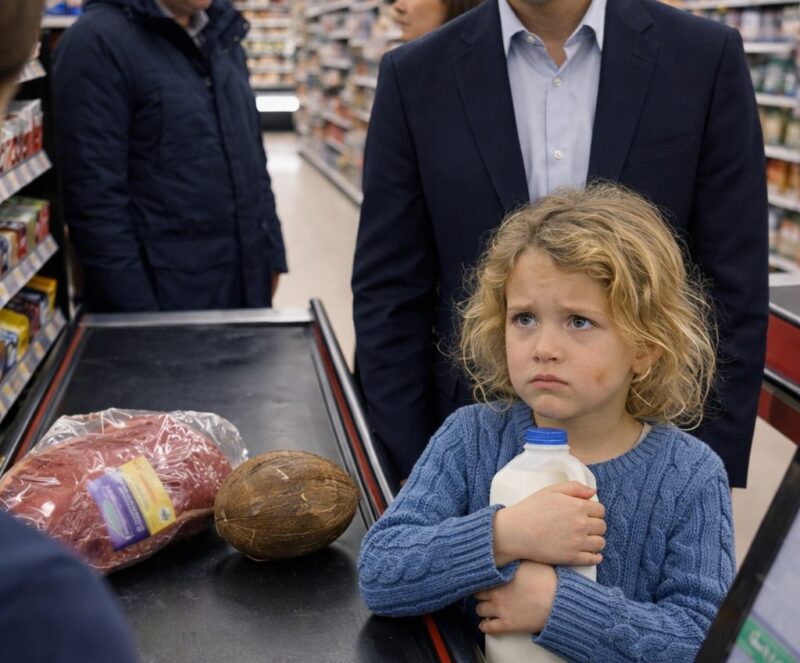
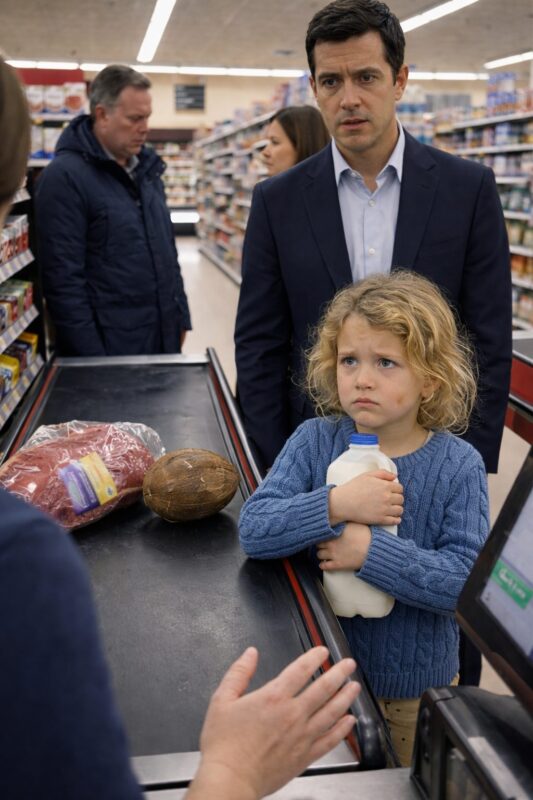
The girl looked no older than eight. Her sweater was frayed, her hands reddened by the cold, and her expression carried a quiet restraint, as if she had already learned not to expect too much from the world. Holding the milk tightly, she asked again—barely above a whisper.
I told her gently that I couldn’t allow it. Store rules. She hesitated, then explained that her twin brother had been crying all night with a fever. Their mother, Marilyn, would get paid the next day. She promised she would come back.
Something inside me wouldn’t let it go.
As the line behind her grew restless, I noticed a man standing nearby. He was well-dressed, clearly out of place, but instead of impatience, there was something else in his expression—intense, unsettled focus. It made me uneasy.
I asked my manager for a brief break, grabbed essentials—bread, soup, fruit, medicine, and extra milk—and paid for them myself. When I handed her the bags, her eyes filled with tears. She whispered her thanks and hurried out.
The man followed.
I thought that would be the end of it.
But the following day, he was waiting outside the store.
He looked completely different—drained, disheveled, as if he hadn’t slept. He introduced himself as Daniel and told me that when the girl mentioned her mother’s name, something clicked. Marilyn had once been the love of his life. Years ago, he had walked away, pressured by his family.
Then he saw the girl—and recognized himself in her.
He admitted he followed her from a distance, found their home, and confirmed the truth: Marilyn had twins—and never told him.
I didn’t approve of how he handled it, but I heard him out.
Marilyn and the children were sick. The girl—Lucy—had mentioned me, telling him I had helped them. Now, he believed Marilyn trusted me more than she trusted him. He asked me to come with him.
I hesitated. My phone was full of missed calls from the clinic—more problems, more expenses. But in the end, I agreed.
Their home was small but spotless, the kind of place kept together through sheer determination. Lucy greeted me with a smile. Her brother, Ben, lay on the couch, flushed with fever. Marilyn looked exhausted—and when she saw Daniel, her entire demeanor shut down.
The tension between them was immediate and heavy. I stepped in, distracting the children while they exchanged sharp, painful words. It was clear the situation couldn’t wait.
I told them they needed medical help right away. Daniel had already arranged for a private doctor. Marilyn resisted at first, but when it came down to her children, she gave in.
The diagnosis was serious: the kids had the flu, but Marilyn had pneumonia and needed urgent care. Over the next few days, Daniel covered all expenses and tried to build some kind of connection—but it wasn’t easy. You don’t become a father overnight.
I made that clear to him. He accepted it.
Meanwhile, my own situation was unraveling. Dana’s treatment was at risk again. When Daniel found out, he offered to help—but I refused to be treated like a problem to solve.
He didn’t argue. He simply said he wanted to give something back for what I had done for his children.
The next day, he showed up again—right after my shift, just like he promised.
And for the first time in a long time, I let myself believe that maybe things didn’t have to stay this hard forever.