After Four Months Away With the Navy, I Returned Home to Find My Nine-Year-Old Son Working Through Tears at Midnight. His Hidden Notebook Exposed My Husband’s Betrayal—and a Secret Plan to Take Away Our Home…
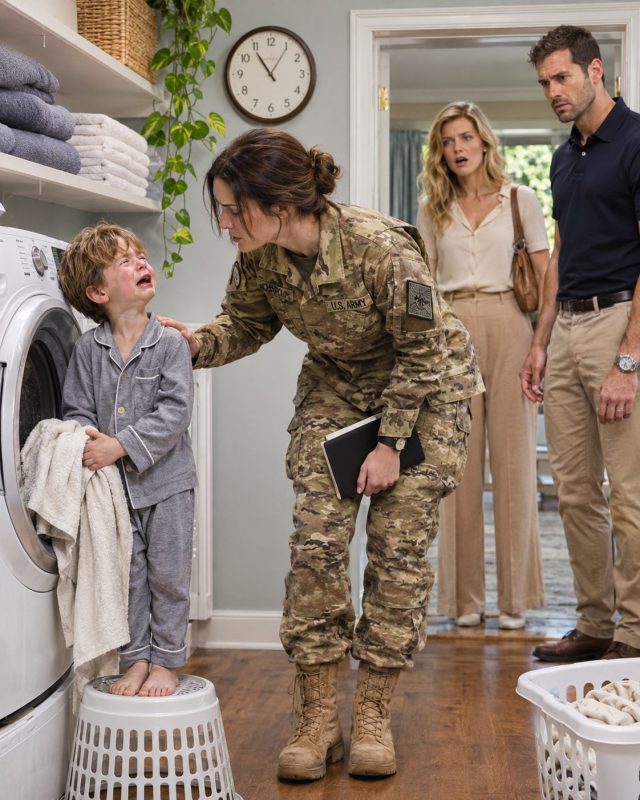
“Please, Mom, leave the washing machine running. I’m not allowed to sleep until I’ve finished everything.”
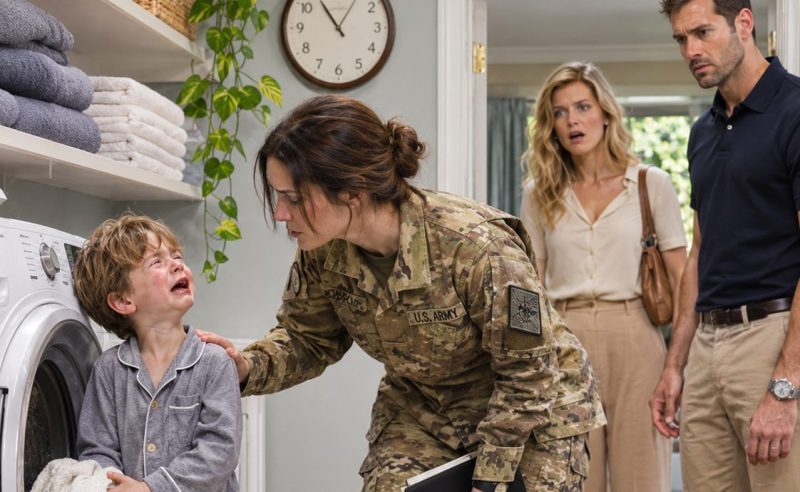
It was almost midnight when I stepped through my front door after four months at sea. I’d returned a week ahead of schedule, hoping to surprise the two people I loved most.
Instead, I found my nine-year-old son, Owen, desperately trying to finish an enormous load of laundry.
I’m Hannah Mercer, forty-three years old, with twenty-three years of service in the United States Navy.
“Where’s your dad?” I asked.
“In your bedroom. Mom, please don’t make him angry.”
I switched off the washing machine, assured Owen that he could rest, and helped him settle on the couch.
Then I went upstairs.
Hearing a woman’s laughter coming from our bedroom, I pushed open the door.
Gregory, my husband, was sitting beside an unfamiliar blonde woman. An unfinished bottle of wine stood beside them.
“Hannah? What are you doing here?”
His companion looked equally startled.
“You said she wouldn’t be back for months!”
I asked the woman to leave immediately.
Rather than apologizing, Gregory accused me of neglecting my parental responsibilities. According to him, assigning Owen household chores was necessary to compensate for my frequent absences.
I walked away before the argument could escalate.
Back in the living room, Owen handed me a spiral-bound notebook.
“Dad and Miss Palmer wrote these rules.”
I turned the pages and discovered a demanding daily schedule of household tasks, accompanied by instructions forbidding him from discussing them with me.
What Owen said next was even more unsettling.
“Dad told me Miss Palmer would have our house soon. He said she was going to replace you.”
The woman’s name was Sabrina Palmer. She and Gregory had undermined my son’s confidence in me, suggesting that my military responsibilities made me an inadequate mother.
By the following morning, I had begun uncovering the extent of their deception.
Our security recordings documented the unreasonable demands placed on Owen while Gregory and Sabrina spent their evenings relaxing.
The financial records were equally alarming.
Almost $46,000 had vanished from our shared savings and been deposited into an account belonging to Chesapeake Bay Land Group.
I arranged a meeting with Claudia Dawson, an experienced family law attorney.
“Everything else can wait,” she told me. “We need to make sure your son is safe.”
Child psychologist Dr. Miriam Foster evaluated Owen and discovered that he was experiencing considerable anxiety. He had come to associate affection with obedience and flawless performance.
Gregory, meanwhile, attempted to secure primary custody by presenting my military career as evidence that I couldn’t provide sufficient stability.
He also tried to influence Owen’s account of recent events.
Fortunately, during a confidential interview with a specialist, Owen felt comfortable enough to explain what had actually happened.
“Dad wanted me to say I liked living with him better. I’m sorry, Mom.”
I reminded him that he had done the right thing by being truthful.
While the custody dispute continued, Claudia uncovered Sabrina’s connection to Chesapeake Bay Land Group.
Gregory had applied for a commercial loan, offering our family residence as potential collateral. The application included an authorization bearing what appeared to be my signature.
There was one significant problem.
According to official Navy records, I had been aboard a military vessel in the Atlantic when the authorization was supposedly signed.
Once informed of the discrepancy, the lender suspended the application.
Gregory confronted me angrily.
“You’re ruining a perfectly good business opportunity!”
“You had no authority to involve our home without my permission.”
Our neighbor, Dorothy Jenkins, agreed to testify about the excessive responsibilities Owen had been expected to manage during my absence.
One evening, while sitting together in the living room, I asked Owen why he had never mentioned his situation during our video conversations.
“Dad said telling you would cause trouble with your Navy job. I thought being really helpful would make him happy with me.”
I gently took his hand.
“Sweetheart, you deserve love and kindness whether you’ve finished your chores or not.”
When our custody hearing finally arrived, Gregory’s lawyer described him as a dedicated father who simply valued discipline.
Claudia presented a very different picture through the security recordings, psychological findings, notebook entries, and witness testimony.
Gregory maintained that his intentions had been educational.
“Age-appropriate responsibilities are one thing,” Claudia responded. “Expecting a nine-year-old to complete demanding household tasks late at night is quite another.”
Gregory struggled to defend his decisions.
After reviewing the evidence, the judge awarded me primary custody, established supervised visitation for Gregory, and granted Owen and me permission to continue living in our home.
Further examination of the disputed signature revealed substantial inconsistencies. The commercial loan application was canceled, and Gregory was ordered to provide an accounting of the missing savings.
His relationship with Sabrina eventually ended.
As for me, I applied for a shore-based Navy position and created a dependable support network to ensure Owen would always receive appropriate care during any future absences.
Recovery didn’t happen overnight.
But gradually, the little boy I remembered began to reappear.
Owen discovered a passion for soccer, started inviting classmates over, and became increasingly comfortable expressing his feelings.
He no longer apologized for leaving toys on the floor or asking to take a break.
Twelve months later, he entered his school’s writing competition and won first place with an essay titled “The Bravest Person I Know.”
During the awards ceremony, he stood before teachers, students, and parents and read the closing lines of his essay.
“My mom protects people when they need help. She also taught me that making mistakes doesn’t mean someone will stop loving you. That’s why she’s the bravest person I know.”
The auditorium filled with applause.
I couldn’t hold back my tears.
For years, I had understood courage through the responsibilities of military service. Yet my son had shown me another equally meaningful kind of bravery: speaking the truth, asking for help, and learning to trust again.
My marriage was over, but our lives were beginning a healthier chapter.
There were unfinished puzzles on our coffee table, soccer shoes beside the front door, and occasionally an untidy kitchen.
And I wouldn’t have exchanged that beautiful imperfection for anything.
Because a happy home isn’t measured by the cleanliness of its rooms or the number of completed chores.
It’s measured by the freedom children have to laugh, learn, make mistakes, and grow without fearing the loss of affection.
Every night, Owen went to bed knowing that tomorrow would bring another opportunity to be himself.
And that he was loved simply because he was my son.