My husband believed divorcing me would clear the way for a perfect future with his pregnant girlfriend. In his eagerness to become a free man, he signed our settlement without examining the seventh page.
His mother laughed at the prospect of me raising our daughter alone. Neither suspected that months later, a routine ultrasound appointment would bring their family’s darkest secrets into the open.

The morning my marriage ended, Graham Pierce appeared more impatient than emotional.
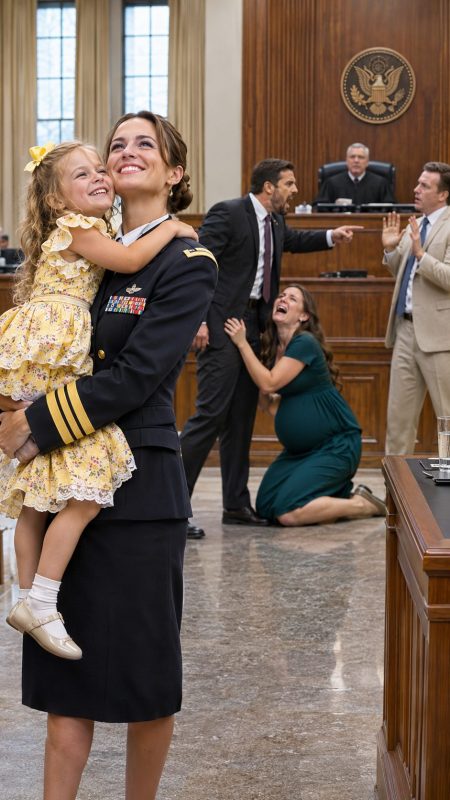
Inside the courthouse in Portland, Maine, he hurried through the paperwork, barely acknowledging the documents his attorney placed before him.
His mother, Marjorie, looked equally pleased.
“Let’s see how long you survive without Graham,” she remarked. “Running a lobster business while raising a child? You’ll be begging to come back by Christmas.”
I remained silent.
Arguing with her would have accomplished nothing.
Weeks earlier, Graham had informed me that Kelsey, the woman he had been seeing behind my back, was pregnant.
He intended to marry her as soon as our divorce became official.
There was, however, something about his announcement that puzzled me.
Two years earlier, Graham had undergone a vasectomy, and subsequent medical tests had confirmed that the procedure was successful.
Still, his relationship with Kelsey was no longer my responsibility.
My attention was focused on Maisie, our six-year-old daughter, and the future I wanted to create for her.
Having previously served in U.S. naval intelligence, I understood the value of preparation, precision, and reliable documentation.
My grandfather had left me an established lobster fishing enterprise in Stonington. The inheritance included a commercial fishing boat, a private wharf, and two commercial fishing licenses.
Graham had always considered the business insignificant.
He had never bothered to discover its true financial worth.
My attorney, Ellen Rusk, ensured that every inherited asset was accurately documented on Page Seven of our financial disclosure, along with an independent valuation.
When the judge asked Graham whether he had examined the settlement thoroughly, he confidently answered yes.
His impatience would eventually cost him dearly.
That evening, Maisie and I reached Stonington, where Amos Reed, my grandfather’s trusted longtime deckhand, was waiting to welcome us.
Our new life began beside the harbor.
I immersed myself in the business, learned from experienced fishermen, and gradually established my reputation within the community.
Maisie settled into her new surroundings, while Graham became increasingly inconsistent about maintaining contact with her.
Then, during one Sunday telephone call, he unexpectedly began asking questions about the boats, the wharf, and my company’s financial performance.
I immediately understood what had happened.
Someone had finally encouraged him to read Page Seven.
Early the following morning, Marjorie called.
“You deliberately concealed a fortune from my son!”
“Nothing was concealed,” I replied. “The information was available to him before he signed.”
She insisted that I transfer one of my commercial fishing licenses to Graham if I wanted to avoid another legal dispute.
I refused.
Soon afterward, Graham filed a challenge to our divorce settlement and attempted to reverse the agreement permitting Maisie to reside with me in Stonington.
Ellen countered his claims with the original financial records and official court transcripts.
Then an unexpected development changed everything.
Beth, Graham’s sister-in-law, contacted me and requested a confidential conversation.
What she revealed explained why his family had been so determined to finalize our divorce quickly.
Walter, Graham’s father, had been improperly moving funds from his car dealership through Graham’s chain of health clubs to cover financial shortfalls.
An audit was already underway, and the family feared that lengthy divorce proceedings might expose their financial misconduct.
But Beth’s revelations did not end there.
Her husband, Cole, Graham’s younger brother, had been secretly seeing Kelsey.
Marjorie knew about their relationship and had actively encouraged them to conceal it.
Suddenly, Graham’s enthusiasm about becoming a father again took on an entirely different meaning.
Several days later, Marjorie invited me to a private ultrasound appointment attended by members of the Pierce family.
I decided to go.
At first, the appointment proceeded normally.
However, a discussion about family medical history eventually prompted the specialist to ask Graham about his previous vasectomy.
With his permission, she reviewed the relevant medical records.
“Your follow-up tests confirmed that the procedure was successful,” she explained. “Pregnancy afterward is rare. Given the circumstances, would you consider establishing paternity through appropriate testing?”
Graham shifted awkwardly in his chair.
Before he could answer, Beth stood up.
“I think it’s time everyone heard the truth.”
She presented photographs and financial records confirming Cole’s secret meetings with Kelsey.
Kelsey’s composure disappeared.
“Cole promised me nobody would question the pregnancy. He said everyone would assume Graham’s vasectomy had failed!”
Graham slowly turned toward his brother.
“You knew this baby might be yours?”
Cole remained silent.
Then Graham asked another question.
“Did Mom know?”
After a long hesitation, Cole answered.
“She discovered everything at Christmas.”
Marjorie immediately began defending herself.
“I was trying to keep this family together!”
Graham stared at her.
“By letting me believe a lie?”
The confrontation brought another confession.
Walter acknowledged the financial misconduct involving his dealership and Graham’s health clubs.
The respectable family image they had spent years cultivating fell apart beneath the weight of their own dishonesty.
Before the day ended, Graham abandoned his attempt to challenge our financial settlement.
The court later upheld Maisie’s relocation and reaffirmed our parenting agreement.
After Kelsey gave birth, a paternity test established that Cole was the baby’s biological father.
Beth subsequently ended her marriage. Walter closed his dealership and cooperated with investigators. Graham began attending counseling and slowly worked toward becoming a more dependable father to Maisie.
Meanwhile, life in Stonington continued to improve.
My grandfather’s business expanded, and I introduced a supervised educational program through which local teenagers could safely learn about the fishing industry and its traditions.
For the first time in years, my days were defined by meaningful work rather than family conflict.
One crisp autumn evening, Maisie and I walked toward the lighthouse overlooking the harbor.
She stood watching its beam move across the darkening water.
“Mom, does that light help people find their way when they get lost?”
“Yes,” I answered. “It helps guide boats safely home.”
She thought about my explanation for a moment.
“That’s what you did for us, Mommy. You found our home when everybody else forgot where they were going.”
I squeezed her hand, deeply moved by her words.
At that moment, I realized how little Graham’s mistakes mattered to the life we had created.
I had honored my grandfather’s memory, protected my daughter, and discovered the satisfaction of building something through my own determination.
I did not need to celebrate the Pierce family’s troubles to appreciate my happiness.
Their dishonesty had consequences, but those consequences were no longer mine to manage.
My daughter deserved a childhood filled with security, laughter, and love. I deserved a future free from manipulation and resentment.
In the end, the most valuable thing I gained from my divorce wasn’t financial independence or control of a successful business.
It was peace.
Because moving forward isn’t about proving your worth to those who underestimated you.
It’s about creating a life so fulfilling that their opinions no longer matter.