An old woman who had spent years in solitude once opened her door to four former prisoners for a single night. By the next morning, something had happened that left the entire village shaken.
She had been alone ever since the death of the only person she truly cared about. Her home was small and worn, built of aging wood, with a sagging roof and windows that, in winter, disappeared beneath thick sheets of ice. Her pension barely covered her needs, and her strength had begun to fail, yet she refused to leave. She clung to that house as if it were the last thread tying her to her past. Neighbors sometimes stopped by with soup or firewood, but most days she managed on her own.
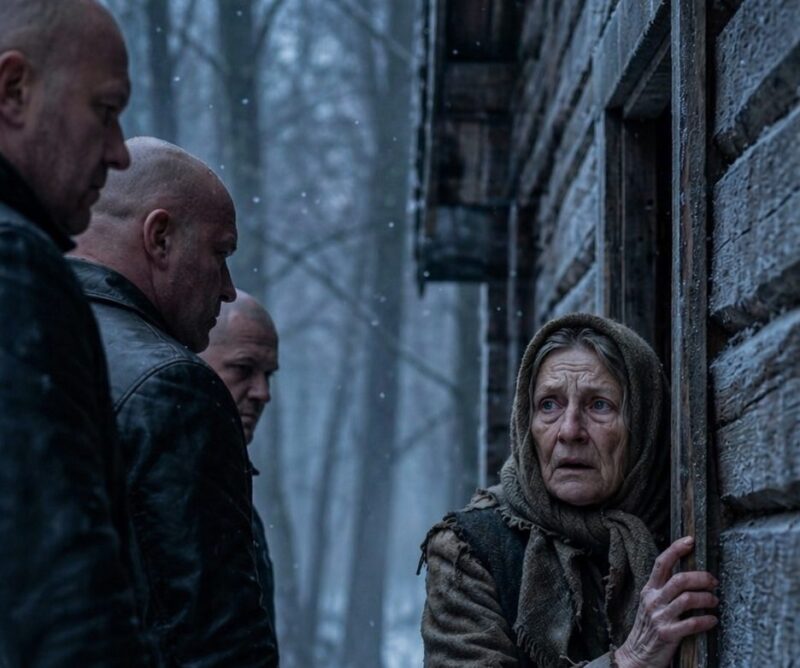
That evening, a fierce storm swept in without warning. The wind roared through the forest like a living force, snapping branches and bending trees. Snow flew in sharp gusts, cutting into the skin. Within hours, the road leading to the village vanished under heavy drifts, and visibility dropped so low that even the nearest house faded into the storm.
She sat by the stove, trying to warm her stiff fingers, listening to the wind hammer against the walls. Then suddenly—three loud knocks echoed through the house.
She froze. At such an hour, in weather like this, no one came without a serious reason.
Slowly, she walked to the door and opened it just enough to look outside. Four tall, broad-shouldered men stood there, dressed in dark clothes. Their hair was cut short, their faces stern, their skin marked with tattoos. One of them held a large black duffel bag.
“Good evening,” one of them said. “Could you let us stay here for the night? The road is completely blocked. We won’t cause any trouble.”
“I live alone,” she replied quietly. “There’s hardly any space… and I have nothing to offer you.”
“We don’t need food. Just a place to wait until morning.”
She hesitated, looking from their hardened faces to the raging storm behind them. Leaving them outside meant certain danger. Despite her fear, compassion won.
“Come in,” she said at last.
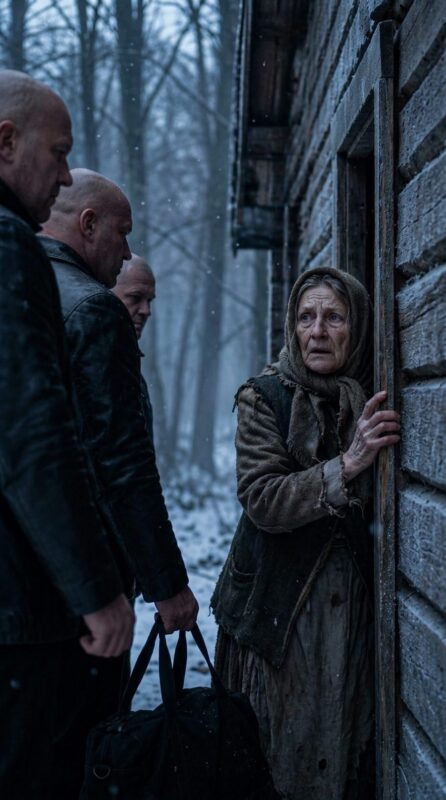
Inside, the men behaved respectfully. They took off their shoes and sat near the stove. She put the last of her bread on the table, poured them hot water, and added more wood to the fire.
At one moment, as one of them opened his bag, she caught sight of what was inside—something heavy and metallic, along with a thick roll of cash tied together. She said nothing and quickly looked away, but she understood enough: these were not harmless men.
The night passed slowly. She slept little, listening to every small sound, expecting trouble. But none came. The house remained quiet.
And yet, by morning, something happened that no one in the village could have imagined.
At dawn, the men were already awake. Hearing movement outside, she looked through the window. One of them was on the roof, fixing a damaged metal sheet that had been leaking for months. Another was chopping firewood and stacking it neatly. A third carried water from the well, while the fourth repaired the broken gate.
She stepped outside and watched in silence as they worked as if it were their own home.
When the storm finally eased and the road became visible again, the men prepared to leave. The house quickly returned to its usual stillness. Before departing, the man who had spoken first placed a bundle of money on the table.
“This is for your kindness,” he said. “And for not judging us.”
“Whether you deserve judgment or not,” the woman replied calmly, “only you can know. But I couldn’t leave you in the cold.”
He nodded slightly, and soon the four figures disappeared down the forest road.
When the neighbors learned who had spent the night in her home, the entire village buzzed with shock. Some believed she had gone mad, others said she had simply been lucky.
But for her, the most important thing was something else entirely. In just one night, she understood a simple truth: sometimes those who seem the most dangerous are the ones who show the greatest gratitude—far more than those who pass by every day without ever noticing either the cold or her loneliness.