At a tram stop late in the day, something extraordinary broke the monotony of routine. A stray dog suddenly approached a young woman and carefully dropped a spotless white envelope into her hands. The moment she opened it, her expression changed instantly—what she read left her shaken.
Only moments before, the scene had been entirely ordinary. People stood around looking worn out—some scrolling on their phones, others quietly waiting for their ride. Emma, exhausted after work, was focused on one thing: getting home as quickly as possible. She didn’t even notice the dog emerging from a narrow alley nearby.
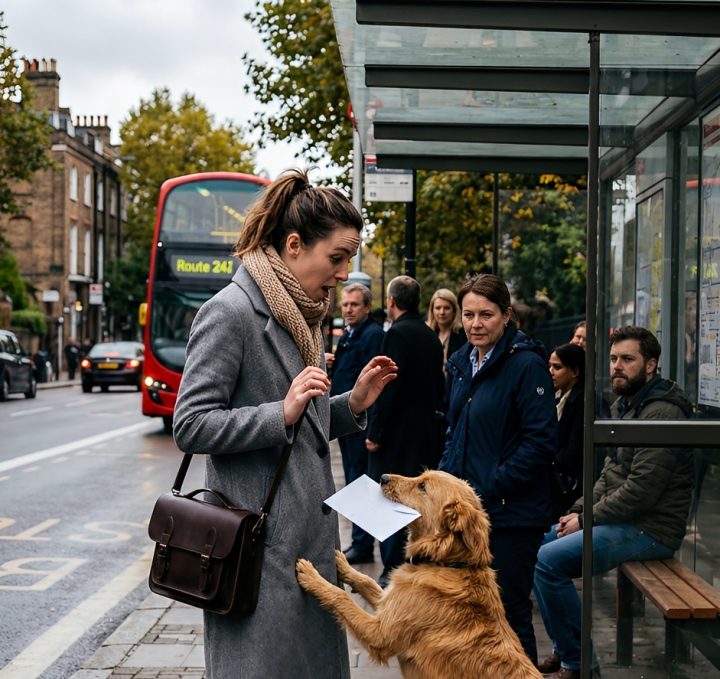
The animal looked neglected—its fur tangled, its paws dirty—but it moved with clear intention. It passed through the crowd, studying faces as though searching for someone. No one paid attention until it stopped directly in front of Emma.
Everything seemed to pause.
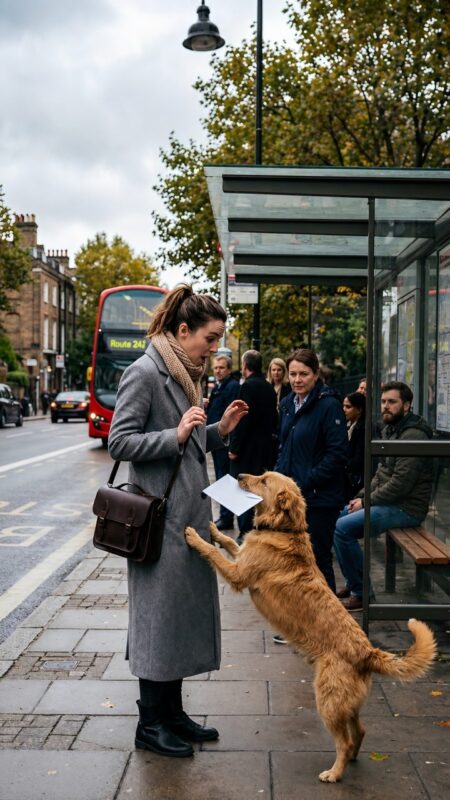
The dog slowly lifted itself onto its hind legs and placed its paws against her coat. Clamped gently in its mouth was a clean, untouched envelope—something that didn’t match its rough appearance at all. But what unsettled Emma most were its eyes. There was urgency in them, something deeper than instinct—a silent plea. It felt as though the dog had chosen her specifically.
People nearby began to whisper. Someone muttered, “Is that even normal?”
Emma hesitated, glancing around as if expecting someone to explain. No one did. The dog gave a soft whimper, its body trembling as it held onto her coat, as though afraid she might walk away.
Carefully, Emma extended her hand. It shook slightly. She almost took the envelope—but stopped. Doubt crept in. What if this was some kind of trick? What if it was dangerous?
She took a step back.
The dog let out a deeper, more desperate sound. This time, it pressed closer, more urgently, as if it understood time was running out.
At that moment, an elderly woman stood up from a nearby bench and approached.
She looked at the dog, then at Emma, and said calmly,
“Take it. Animals don’t make mistakes. They always find the right person.”
Emma paused for only a second before finally accepting the envelope.
Inside was a short message, written in haste:
“Help me…”
Below it was an address.
A cold shiver ran through her. Without wasting a moment, Emma pulled out her phone and called emergency services, quickly relaying the location. Her voice trembled, but she was certain—this was serious.
Within minutes, police and paramedics arrived. They forced their way into the apartment—and what they found left them stunned.
An elderly woman was lying on the floor near the wall. She was conscious but barely able to move. It was clear she had fallen. A phone lay just out of reach—close enough to see, but impossible for her to grab. She had been trapped there for hours, unable to call for help.
Next to her stood a small table, a sheet of paper, a pen—and her dog.
With the last of her strength, she had written the message, added her address, and entrusted it to her pet. She didn’t know if he would understand. She didn’t know if he would succeed.
But he did.
He ran out into the streets, searching for help—approaching strangers, looking into their eyes, waiting for someone to respond.
Until he found Emma.
As the rescuers carried the woman out on a stretcher, she slowly turned her head toward the doorway. The dog walked up to her quietly.
And in that moment, she began to cry.
Because she realized—she had been heard.
And everyone who witnessed it understood one simple truth:
If not for that dog, she would not have survived.