I was seventy-eight when I became the wife of Walter Bennett, a wealthy eighty-two-year-old widower who occupied the most luxurious suite in our senior residence.
Our lives could hardly have been more different.
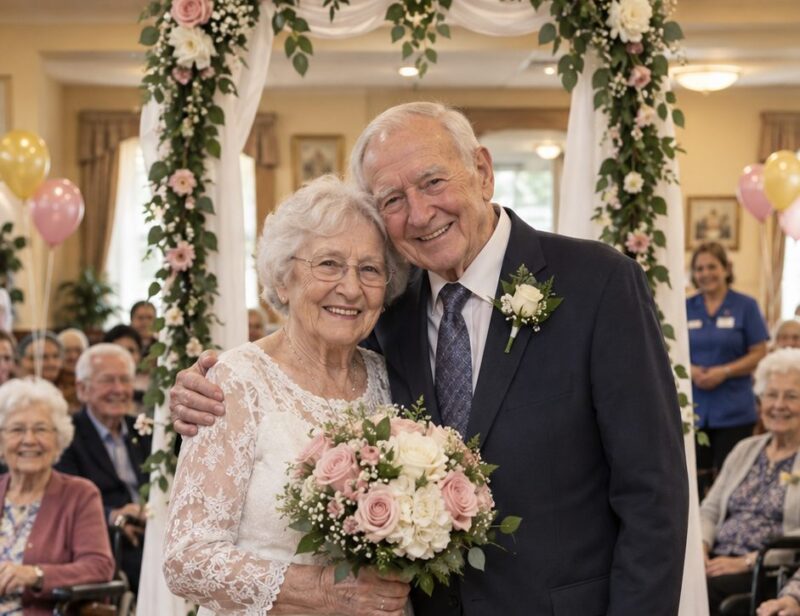
I survived comfortably enough on my pension in a modest room several floors below. Walter lived upstairs with round-the-clock nursing assistance, a private cook, and every convenience his considerable fortune could provide.
Yet none of that mattered when we sat across from each other at a chessboard.
We first spoke one afternoon beneath the enormous oak tree in the courtyard. Walter noticed the chess set beside me and asked whether I needed an opponent.
That single game became dozens.
Soon we were meeting regularly for tea, jazz, conversation, and chess. Walter told me stories about his younger years, though I noticed there were parts of his past he carefully avoided discussing.
His wife, Diana, had died years earlier. He had three adult children, but visits from them were rare.
“They’ll become interested when they think I’m dying,” Walter once remarked.
Unfortunately, he was right.
As his health worsened, Adrian, Celia, and Thomas began appearing far more frequently. They didn’t come alone. Lawyers accompanied them.
They wanted authority over Walter’s finances and medical care.
Walter hated the idea.
One evening, he surprised me with a proposal.
It wasn’t romantic in the traditional sense. He explained that marriage would give me a stronger position to defend his wishes if his children attempted to take control.
By then, Walter had become the closest person in my life.
So I said yes.
What followed were two of the most peaceful years I could remember.
I moved into his penthouse, but our days remained simple. We read novels aloud, listened to old jazz records, argued cheerfully over chess moves, drank tea on the balcony, and watched the evening sky change colors.
Neither of us needed excitement.
We needed company.
Walter died with my hand wrapped around his.
At the funeral, however, his children behaved as though I had no right to grieve.
Their coldness became open hostility within days.
About a week after the service, Walter’s longtime attorney, Mr. Grant, contacted me and asked me to come to his office.
A sealed envelope rested on his desk.
“If this concerns Walter’s inheritance, give it to his children,” I said immediately. “I never wanted his fortune.”
Mr. Grant didn’t answer right away.
Instead, he told me Adrian and his siblings had challenged the marriage. They claimed Walter had been mentally incapable of making decisions and accused me of taking advantage of a vulnerable elderly man.
The accusation was almost absurd.
Only days before his death, Walter had still been correcting my chess strategy—and winning.
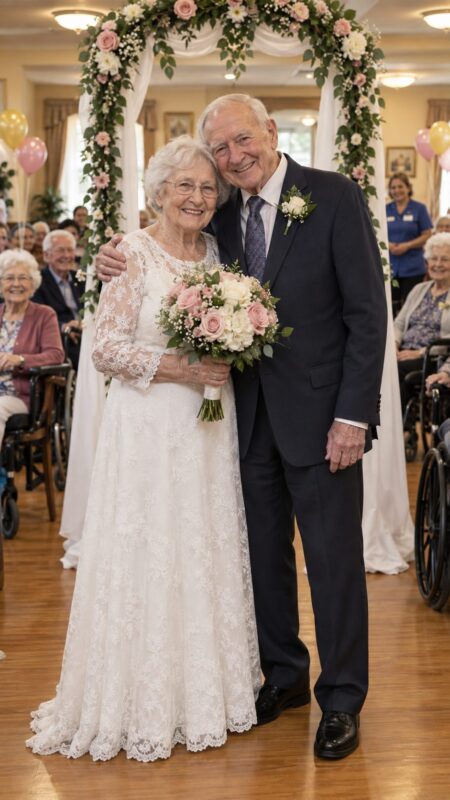
Mr. Grant assured me that Walter’s doctors had documented his mental competence.
Then he tapped the envelope.
“The lawsuit isn’t the biggest surprise,” he said. “This is.”
I opened it.
The first thing I found was an old photograph.
Walter appeared decades younger, standing outside a government building beside a dark-haired woman. Between them stood a little girl in a yellow raincoat.
Something red was clutched in the child’s hand.
A doll.
My breath caught.
When I was seven, I had owned a tiny red doll just like it. After my mother vanished from my life, I buried that doll beneath a willow tree because looking at it reminded me of her.
I turned the photograph over with shaking fingers.
Then I unfolded Walter’s letter.
The first few lines changed everything I believed about my life.
Rose—the woman in the photograph—was my mother.
The little girl was me.
And Walter Bennett was not simply the man I had married.
He was my biological father.
Walter explained everything in the pages that followed.
When I was three years old, he received an opportunity to join a shipping company that promised money, influence, and a completely different future. Accepting the position meant abandoning his old life.
He accepted.
My mother and I became the price of his ambition.
Walter claimed that before disappearing, he created a small financial trust for me. Years later, he discovered that an attorney working for my grandmother had taken the money.
But Walter never returned.
Instead, he built another life.
He married Diana and became the father of Adrian, Celia, and Thomas while the daughter from his first family grew up without him.
Decades later, after Diana’s death and the decline of his own health, guilt apparently caught up with him.
Walter began searching for me.
Eventually, he discovered where I lived.
That was why he had moved into our residence.
He hadn’t chosen the penthouse because of the view.
He had chosen the building because I was already there.
Suddenly, every memory felt different.
The afternoon beneath the oak tree.
His invitation to play chess.
His questions about my childhood.
The strange sadness that occasionally crossed his face when I spoke about my mother.
None of it had been coincidence.
Walter had recognized me from the beginning.
He simply hadn’t told me.
Even his proposal had concealed another motive.
He knew his children would fight over his estate, and he wanted to place me in a position they couldn’t easily erase.
His total fortune—business holdings, real estate, investments, and private assets—was valued at roughly $74 million.
I sat motionless.
For two years, I had believed I was sharing my final chapter with a husband.
Walter had known he was spending his final chapter with the daughter he abandoned.
I barely had time to absorb that truth before Adrian, Celia, and their attorneys arrived.
Adrian immediately ordered me out of the penthouse.
He accused me of manipulating a confused old man and stealing money that belonged to his family.
Mr. Grant allowed him to finish.
Then he opened another folder.
Walter had undergone evaluations by three independent neurologists. Each had concluded that he understood his decisions and was mentally competent when the relevant legal documents were signed.
More importantly, Walter had reorganized his estate eighteen months before his death.
Most of his wealth had already been transferred into an irrevocable trust.
His children couldn’t simply reverse it because they disliked the outcome.
The trust named one beneficiary.
Me.
Adrian stared at the paperwork in disbelief.
I reached for the photograph Walter had left behind and slid it across the table.
“Before you accuse me of stealing from your father,” I said, “you should know who I am.”
Celia picked up the picture.
I pointed toward the little girl in the yellow raincoat.
“That’s me.”
The room fell silent.
Then I told them the sentence Walter had been too afraid to say while he was alive.
“Long before Walter became your father, he was mine.”
Their attorneys quickly advised them not to say anything further until every document had been examined.
I had heard enough anyway.
I opened the door.
“You wanted me out of this home,” I said. “Instead, I’m asking you to leave.”
They did.
Later, I walked onto the balcony alone.
From there, I could see the courtyard and the old oak tree where Walter had first approached me.
The chessboard was still beneath it.
I had inherited more money than I could possibly spend.
But wealth couldn’t purchase the childhood I’d lost.
It couldn’t give me the birthdays Walter missed, the questions he never answered, or the decades in which I believed my father had simply disappeared.
His final act couldn’t erase his first one.
And his secret hurt almost as much as his abandonment.
He had known exactly who I was for two years and still denied me the chance to decide what kind of relationship I wanted with him.
But anger wasn’t the only thing I felt.
Those afternoons beneath the oak tree had mattered to me.
So had the music, the books, the conversations, and the comfortable silences.
Walter had lied about who he was.
The companionship itself hadn’t been a lie.
That distinction helped me decide what to do with his money.
I told Mr. Grant that I wanted $50 million placed into a permanent charitable endowment bearing Walter and Rose Bennett’s names.
The fund would assist elderly residents who couldn’t afford safe housing, necessary medical treatment, or private nursing care.
Mr. Grant asked whether I was certain.
“I’ve spent most of my life without millions,” I told him. “I don’t need a mansion now.”
Then I explained what I did want.
I wanted fewer elderly people sitting alone in forgotten rooms because they didn’t have enough money to receive decent care.
If Walter’s fortune could provide dignity and comfort to them, then perhaps something meaningful could grow from all the choices that had caused so much pain.
That night, I returned to the balcony and sat in Walter’s favorite chair.
His letter was in my hands.
I read it slowly for the last time.
Forgiveness didn’t mean rewriting the past.
Walter abandoned my mother and me.
He hid the truth when he finally returned.
He made decisions about my life that belonged to me.
Nothing in his will could change that.
Still, I refused to let those failures erase every peaceful moment we had shared.
I remembered his laugh when I made a terrible chess move.
I remembered jazz drifting through the penthouse.
I remembered books left open between our chairs and long evenings watching the sunset.
Those memories belonged to me too.
The horizon gradually turned gold, then violet.
I folded Walter’s letter and placed it beside me.
For the first time since learning the truth, I looked toward the oak tree without wondering what I should have said to him.
“I forgive you, Walter,” I whispered.
Then my eyes settled on the empty chessboard below.
“The game is finished.”