Seven days after I married a seventy-two-year-old stranger in a hospital room, I became a widow.
Less than an hour later, a gray-haired attorney found me sitting beside the empty bed and placed a heavy green backpack at my feet.
“Julian left this specifically for you,” he said.
I reached for the bag, but the man didn’t let go immediately.
“There are things your husband never told you.”
At twenty-nine, I wasn’t supposed to be anybody’s widow.
Then again, I hadn’t expected to become Julian’s wife either.
A year earlier, my mother had died, and afterward I struggled to recognize the person I’d been before losing her. Friends tried to help. Work kept me occupied. Nothing really touched the emptiness.
Eventually, I began volunteering at the hospital where she’d once received treatment.
My role was simple.
I visited patients who had no one else.
Sometimes I brought coffee or books. Sometimes I listened to stories I’d already heard three times. Sometimes I sat silently beside someone because conversation wasn’t what they needed.
The work didn’t erase my grief.
It gave it somewhere useful to go.
Then I walked into Julian’s room.
He was seventy-two, physically weak, and living with severe heart failure. His body seemed tired of fighting, but his sense of humor remained surprisingly intact.
The first time I introduced myself as a volunteer, he smiled.
“So you’re here because nobody else wants the job?”
“I’m here because I volunteered.”
“That’s somehow even more suspicious.”
I laughed.
That was the beginning.
I returned the following afternoon.
And the afternoon after that.
We talked about ordinary things—bad hospital coffee, old movies, music, books, places we’d visited, and places we’d wished we had.
Julian rarely spoke about his family.
I rarely spoke about my mother.
But somehow, we understood the things the other person avoided saying.
One afternoon, I found him unusually quiet.
He held out his hand.
I took it.
“Nora, I want to ask you for something unreasonable.”
“That doesn’t sound promising.”
A faint smile appeared.
“Marry me.”
I thought the medication had confused him.
When I realized he was serious, I pulled my chair closer.
“Julian, you’ve known me for days.”
“I know.”
“You’re asking a volunteer to marry you.”
“I know that too.”
“Then why?”
He stared toward the window.
“When my time comes, I don’t want to feel like I’m just another patient number being closed out of a system.”
Then he looked at me.
“I want one person to be able to say I mattered to them at the end.”
His request stayed with me for two nights.
It made little practical sense.
But I understood loneliness.
And I understood what it meant to desperately want another human being beside you.
So I agreed.
There was no chapel, white dress, bouquet, or photographer.
A hospital chaplain came to Julian’s room.
I happened to be wearing a bright yellow sweater.
When the chaplain mentioned rings, Julian looked around and laughed.
“We may have overlooked that detail.”
A soda can stood on his bedside table.
Julian removed the pull tab and held it up.
“Problem solved.”
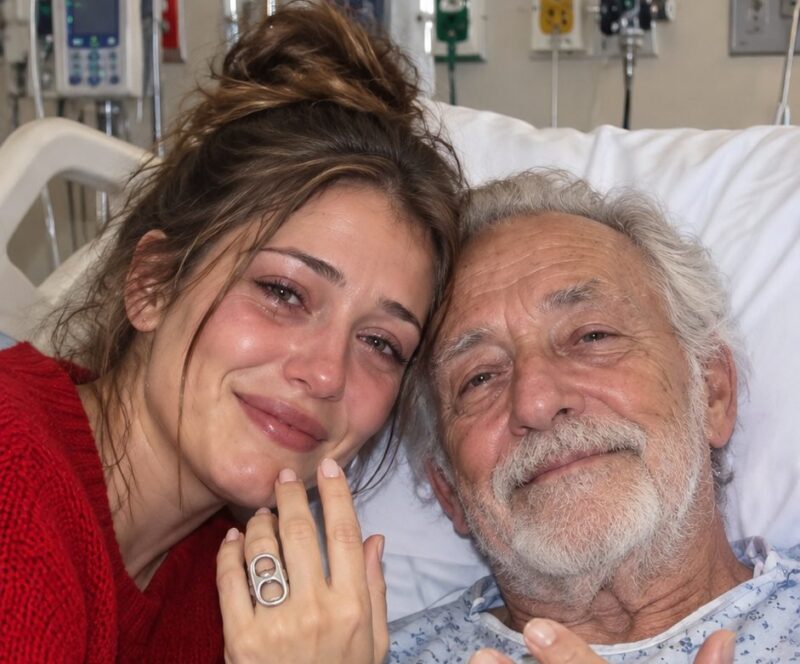
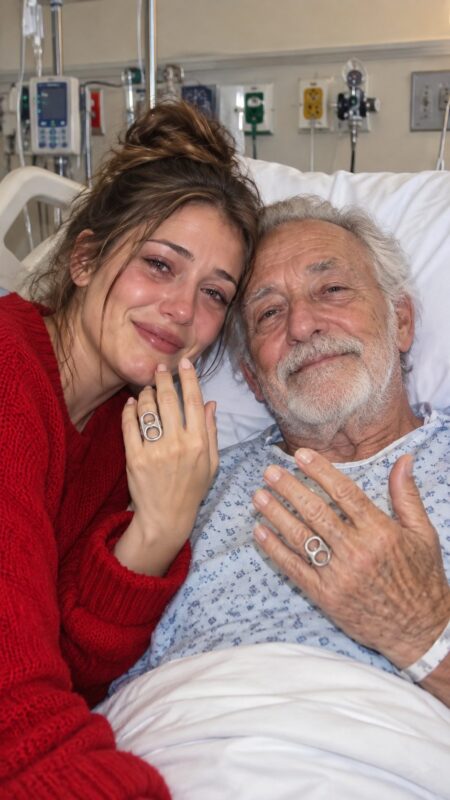
He slipped the ridiculous piece of aluminum onto my finger.
I couldn’t stop laughing.
Neither could he.
For seven days, technically, I was Mrs. Julian’s wife.
But nothing about our relationship suddenly became romantic or conventional.
We were simply two people who had chosen not to let the other feel alone.
I spent those days beside him.
When Julian wanted conversation, we talked.
When he was tired, I read.
When speaking became difficult, I held his hand.
Eventually, the room became quiet.
And Julian was gone.
I remained there long after the medical staff had finished what they needed to do.
I’d known him for almost no time at all.
Yet his empty bed somehow made the room feel enormous.
That was when the attorney arrived.
His name was Mr. Harris.
The green backpack he carried looked ordinary, but when he placed it in my hands, its weight surprised me.
“What did Julian put in here?”
“Answers,” he said.
He unzipped it.
Inside were several envelopes, an old wooden box, and a thick collection of documents.
My name appeared across the front page.
I looked up immediately.
“Why did Julian have a file about me?”
Mr. Harris hesitated.
“Because Julian knew about you before you knew about him.”
A chill ran through me.
He explained that Julian had first noticed me volunteering months earlier.
From a distance, he’d watched me visit patients who rarely received visitors. He noticed that I didn’t leave when conversations became difficult or when patients had nothing cheerful to say.
Eventually, Julian asked his attorney to find out who I was.
I didn’t know whether to feel touched or disturbed.
“He investigated me?”
“He wanted to understand why you were here.”
Mr. Harris told me Julian had learned about my mother’s death.
That explained why I kept returning to the hospital.
I opened the first envelope.
Julian had written it by hand.
He reminded me of something he’d once overheard me telling a nurse.
No one should reach the end of life believing nobody cares whether they’re there.
Apparently, Julian had remembered those words long after I’d forgotten saying them.
His letter explained that he’d allowed me to believe the marriage was about his fear of dying without a spouse.
That hadn’t been the whole truth.
What Julian wanted wasn’t a title.
He wanted to leave this world knowing that, for a brief period, another person had genuinely seen him.
Then Mr. Harris opened the folder.
Julian had spent years quietly financing programs for isolated elderly people.
He had established a charitable foundation that provided money to hospitals, care facilities, and organizations helping patients without reliable family support.
His name rarely appeared publicly.
He preferred it that way.
Now the foundation needed someone to oversee its next chapter.
Julian had chosen me.
“This isn’t personal inheritance,” Mr. Harris explained. “The foundation’s assets remain dedicated to its mission. Julian wanted you to decide how that mission continues.”
I opened another envelope.
This one contained only a few words.
Julian asked me not to forget the people who had already been forgotten by everyone else.
I couldn’t hold back my tears.
Then Mr. Harris gave me the wooden box.
I lifted the lid.
Inside was the pull tab Julian had used as my wedding ring.
Underneath it rested one final message.
He wrote that I had given him seven days in which he felt like a person instead of a diagnosis.
He hoped the foundation would give me years in which I could offer that same gift to others.
Three months later, an unused room near the hospital’s geriatric wing was renovated.
We filled it with comfortable chairs, books, puzzles, warm lamps, and a coffee machine.
A small sign outside read:
JULIAN’S CORNER
Patients could come there when they wanted company.
Volunteers read aloud, played cards, listened to memories, or simply sat nearby.
Nobody had to earn anyone’s attention.
And nobody was required to fill the silence.
I placed Julian’s soda pull tab inside a small glass display near the entrance.
Most visitors assumed it was some strange decoration.
I never corrected them.
Years passed.
One evening, I was called to sit with an elderly woman whose relatives lived far away.
She was frightened and kept watching the doorway.
Eventually, she reached toward me.
I took her hand.
“Are you leaving too?” she asked.
“No.”
Her fingers tightened around mine.
“Will you stay for a while?”
I thought about my mother.
Then Julian.
Then a yellow sweater, a hospital chaplain, and the cheapest wedding ring imaginable.
I smiled.
“As long as you need someone here.”
Her shoulders relaxed.
That night, I understood something I’d spent years trying to learn.
Time isn’t always what gives a relationship its meaning.
Some people share forty or fifty years.
Others cross paths for only a season, an afternoon, or a week.
Julian and I had seven days.
He didn’t erase the grief I’d carried after losing my mother.
Instead, he showed me what I could do with it.
And those seven unexpected days shaped every year that followed.