Eight months after losing my husband, Daniel, I believed I had already endured life’s greatest heartbreak. I survived on a small Social Security payment and learned to count every dollar. Then a single accident outside a neighborhood supermarket changed everything.
A devastating fall left me with a shattered hip, three complicated surgeries, and a permanent dependence on a wheelchair. Overnight, my two-story house became a place I could no longer live in safely.
With nowhere else to turn, I called my only son.
Ethan listened quietly, promised he would talk things over with his wife, Lauren, and said he’d call me later that evening.
The phone never rang.
The next morning I packed a suitcase, hired a cab, and went to his house myself. I wasn’t looking for charity or sympathy. I simply hoped my son would remember that family takes care of family.
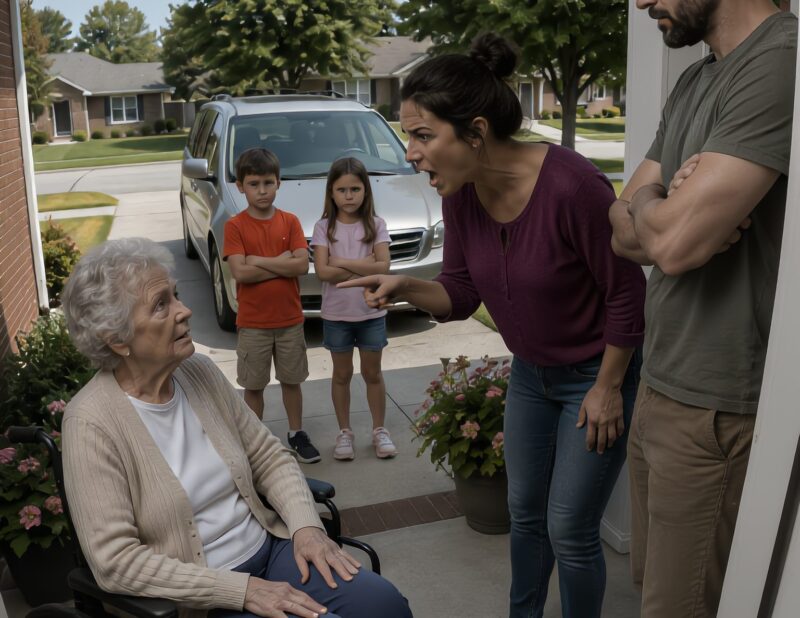
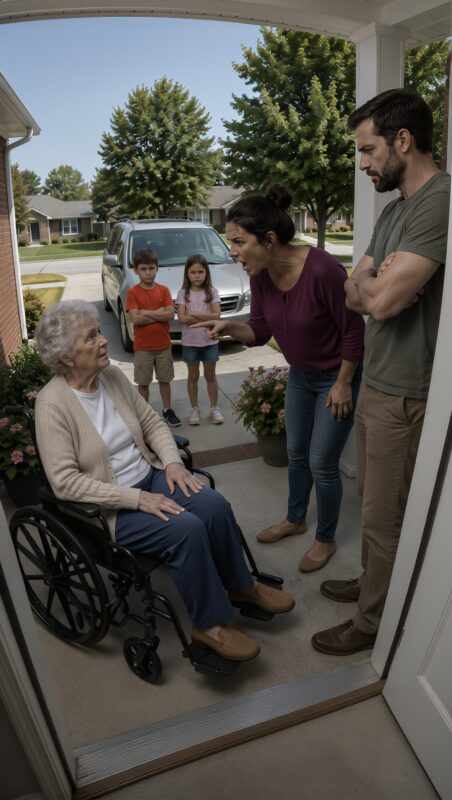
Instead, Ethan stepped onto the porch, closed the front door behind him, and refused to let me cross the threshold. Through the glass I caught a glimpse of Lauren ushering my grandchildren into another room.
“We’ve got our own lives to manage,” he said flatly. “You can’t just show up expecting to move in.”
I reminded him that years earlier Daniel and I had contributed most of the money needed for that very house.
“That was financial assistance,” he answered. “Not a lifetime obligation.”
He conveniently ignored the fact that almost none of that money had ever been repaid.
I returned home devastated.
The following afternoon, while sorting through Daniel’s old study, I found a small envelope tucked inside a desk drawer. It contained a private banking card. Written neatly across the back were an account number and a simple instruction.
For emergencies only.
Unsure what it meant, I visited the bank listed on the card. The branch manager examined it, immediately recognized Daniel’s signature, and personally escorted me into a private office.
After confirming my identity, he opened an account and rotated his monitor toward me.
Displayed across the screen was a balance that made my heart stop.
$47,362,891.42
For several seconds I couldn’t speak.
Daniel had always lived modestly. He drove an old Honda, clipped coupons, repaired things instead of replacing them, and worried over every monthly expense.
Yet, without ever mentioning it, he had quietly built an extraordinary investment portfolio spanning technology, healthcare, manufacturing, hospitality, and other industries.
The manager explained that Daniel had prepared detailed instructions years earlier.
The account was never to be disclosed unless I faced severe financial hardship, a major medical emergency, or abandonment by my immediate family.
There was one additional directive.
“My son’s ability to influence Margaret’s decisions must remain restricted until she freely chooses otherwise.”
Daniel had seen a painful truth long before I was willing to admit it.
He believed our son cared more about wealth than about the people who loved him.
As I tried to process everything, Ethan finally called.
Proudly, he announced that he had found information about a government housing program that could help me relocate.
Only yesterday those words would have broken my heart.
Now they meant nothing.
That same afternoon Daniel’s attorney, Rebecca Lawson, arrived carrying several confidential files.
She explained that every significant asset had been transferred into protected trusts. A charitable organization had been established in my name, and Daniel had even retained professionals to quietly monitor my well-being after his passing.
The moment Ethan refused to welcome me into his home, every legal safeguard Daniel had designed automatically sprang into effect.
Before leaving, Rebecca handed me one final envelope.
Inside was a handwritten letter.
“If Ethan ever attempts to control your future,” Daniel wrote, “everything has already been prepared.”
A few weeks later his prediction came true.
Believing I owned little beyond my aging house, Ethan filed a petition asking the court to declare me mentally incompetent so he could become my legal guardian.
He had no idea Daniel’s legal team had anticipated exactly that move.
The instant the paperwork reached the courthouse, the protective provisions activated.
Long-hidden debts Ethan had accumulated became immediately collectible. Financial institutions froze several of his accounts. Business partners withdrew from ongoing ventures. Independent medical specialists confirmed I remained fully capable of managing my own affairs, and the guardianship petition collapsed before it gained any momentum.
Several days later, Ethan and Lauren appeared at my front door.
Their confidence had vanished.
“Mom,” Ethan said quietly, “we handled everything the wrong way.”
Then he asked the question Daniel had expected all along.
“Would you help us?”
Without saying a word, I handed him one of Daniel’s financial folders.
He opened it.
His eyes fixed on a single number.
$47,362,891.42
He looked up in disbelief.
“All of this belongs to you?”
“Yes.”
His voice barely rose above a whisper.
“Why didn’t you tell me?”
I held his gaze.
“Because I needed to know how much I mattered before you believed I had something you wanted.”
At last, the lesson became painfully clear.
He hadn’t lost an inheritance because of bad fortune.
He lost it the moment he chose to abandon his own mother.
I never came to his rescue.
Instead, I expanded the foundation Daniel created, continued growing the investments he had built over a lifetime, and devoted our resources to helping families who truly needed someone to believe in them.
Looking back, Daniel’s greatest gift was never the millions he quietly accumulated.
It was leaving me the wisdom to recognize genuine love, the strength to walk away from betrayal, and the freedom to spend the rest of my life surrounded by people whose loyalty could never be measured in dollars.