Eight Months Pregnant, My Husband Locked Me Outside in Deadly Cold. When His Police Officer Brother Arrived, He Froze and Whispered, “Forrest, Not Again. Please Tell Me You Didn’t Do What You Did to Jade.”
At eleven o’clock on a bitter January night, my husband pushed me onto our back porch and locked the door behind me.
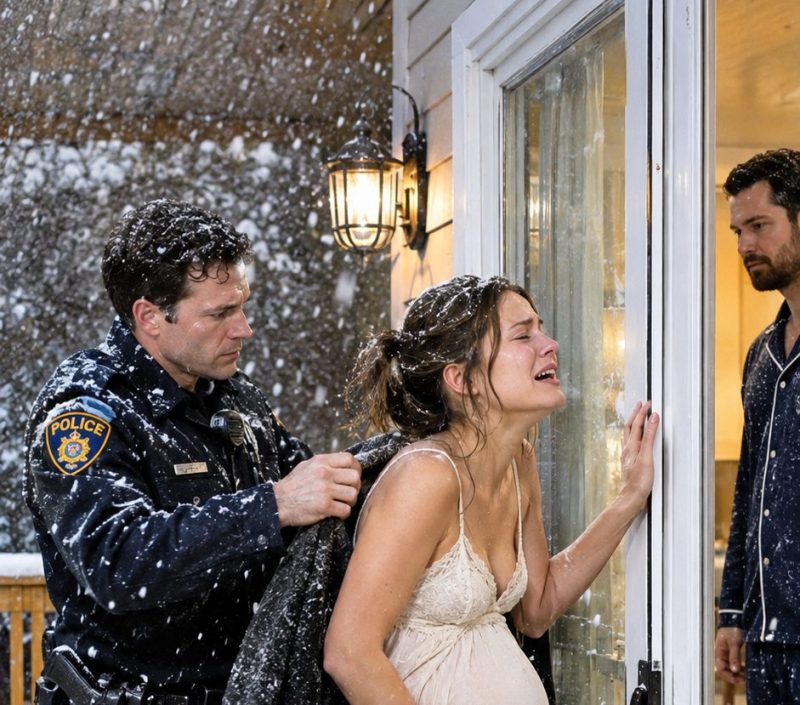
I was eight months pregnant, wearing only a thin cotton nightgown and socks. The temperature in Minneapolis had fallen to nine degrees below zero.
“Forrest, please!” I shouted through the glass. “Our baby could be in danger!”
He stood inside the warm kitchen, watching me with a look of complete indifference.
“Maybe you’ll finally learn to keep your mouth shut,” he replied.
Then he switched off the lights and walked away.
I was twenty-seven years old, and until that moment, I’d spent nearly four years convincing myself that my marriage could still be saved.
My husband, Forrest, was a respected software engineer. He earned an impressive salary, owned a beautiful house, and had a reputation for being generous and charming.
Our neighbors admired him.
His colleagues praised him.
Whenever we attended social gatherings, he introduced me as the love of his life.
But the man everyone adored was nothing like the husband I knew.
Behind closed doors, Forrest controlled our finances, monitored my friendships, and demanded explanations whenever I left the house.
He frequently took my car keys, claiming I needed his permission to drive.
If I challenged him, he accused me of being ungrateful.
If I cried, he called me dramatic.
And if I defended myself, he insisted I was disrespecting him.
When I discovered I was pregnant, I hoped the arrival of our daughter would inspire him to change.
Instead, his behavior became more frightening.
That afternoon, I’d attended a prenatal appointment.
My doctor had expressed concern about my elevated blood pressure and advised me to rest and avoid unnecessary stress.
By the time I returned home, I was exhausted.
I lay down for a while, leaving a basket of Forrest’s clean laundry beside the bedroom door.
When he arrived that evening, it was the first thing he noticed.
“Why haven’t you put my clothes away?”
“I wasn’t feeling well,” I explained. “The doctor said I need more rest.”
He stared at me.
“So being pregnant means you don’t have to do anything anymore?”
“That isn’t what I said.”
“Don’t argue with me, Kenna.”
I tried to remain calm.
“I’m only explaining what happened.”
But he wasn’t interested in explanations.
He wanted obedience.
Minutes later, I found myself standing outside in the freezing darkness while he locked the door.
I knocked repeatedly.
“Forrest! Please open up!”
No answer.
I tried the gate leading to the driveway, but it was locked.
My phone was inside.
The wind cut through my nightgown, and I became increasingly frightened about my unborn daughter’s safety.
I kept calling for help, hoping someone would hear me.
Then a light flashed in the house next door.
I turned.
Our elderly neighbor, Thelma, was standing at her window.
She was seventy-four, a retired librarian who occasionally brought us homemade cookies.
I’d always considered her kind but reserved.
Now she was staring directly at me, holding a telephone.
She pointed toward it.
I realized she was calling the police.
Relief washed over me.
A short time later, emergency lights appeared outside our house.
A police officer hurried through the side entrance and into the backyard.
“Ma’am, are you all right?”
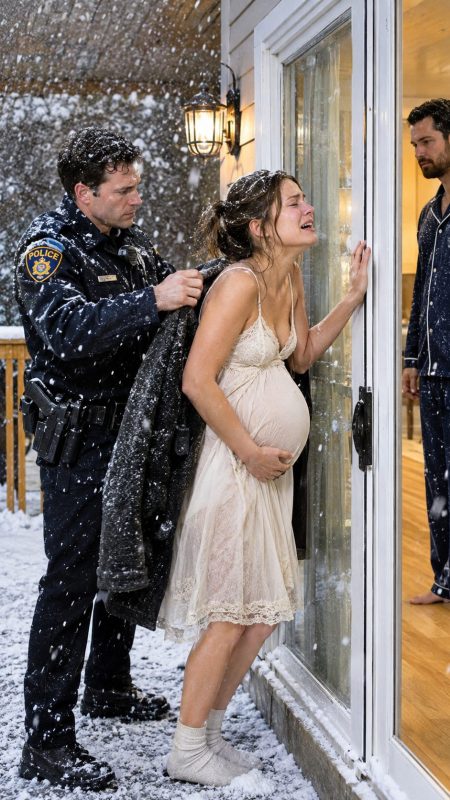
I could barely answer.
He immediately removed his coat and wrapped it around my shoulders.
Then he looked at my face.
His expression changed.
“Kenna?”
I recognized him.
“Porter?”
It was Forrest’s younger brother.
Porter had worked in law enforcement for several years. Although we were related by marriage, I’d rarely seen him because Forrest insisted they had never gotten along.
I’d always believed their disagreements were ordinary family problems.
But the look on Porter’s face suggested otherwise.
He glanced toward my pregnant stomach, then at the locked patio door.
“What happened?”
“Forrest locked me out,” I whispered. “He won’t let me back inside.”
Porter went completely still.
Then he turned toward the house.
His voice was barely audible.
“Forrest, not again. Not after Jade.”
I stared at him.
“Who’s Jade?”
Porter looked at me, but instead of answering, he approached the door.
“Police! Forrest, open up!”
A light appeared inside.
My husband entered the kitchen, looking furious.
“What are you doing here, Porter?”
“Unlock the door.”
“Get off my property.”
“Kenna needs medical attention. Open it immediately.”
Forrest folded his arms.
“This is between my wife and me.”
Porter requested additional assistance and warned his brother that the situation was an emergency.
When Forrest continued refusing to open the door, Porter forced entry to get me somewhere warm.
Other officers arrived shortly afterward.
Forrest began shouting that the whole situation was a misunderstanding.
He claimed I’d gone outside voluntarily and was exaggerating because we had argued.
But his explanations did nothing to change what the officers had witnessed.
He was taken into custody while paramedics examined me.
As they helped me toward the ambulance, Forrest shouted from the doorway.
“Kenna! Tell them the truth!”
I looked at him.
For years, I’d defended him whenever someone noticed something was wrong.
I had made excuses for his temper and explained away his restrictions.
But this time, I remained silent.
At the hospital, doctors diagnosed mild hypothermia.
They were also concerned because the stress had triggered premature contractions.
My daughter wasn’t due for another five weeks.
I lay in a hospital bed while the medical team closely monitored her heartbeat.
I was terrified.
Every change on the monitor made my heart race.
The doctors worked to stabilize my condition and prevent an early delivery.
After two difficult hours, the contractions finally stopped.
My daughter’s heartbeat remained steady.
The doctor told me we were both stable, although I would need continued observation.
For the first time that night, I felt I could breathe again.
The following morning, someone knocked softly on my hospital room door.
Porter stood outside.
He was wearing ordinary clothes, and his expression was troubled.
“May I come in?”
I nodded.
He sat beside my bed.
For a long moment, neither of us spoke.
Then I asked the question I’d been waiting to ask.
“Who is Jade?”
Porter lowered his head.
“Jade was Forrest’s first wife.”
My stomach tightened.
“His first wife?”
He nodded.
I stared at him in disbelief.
“Forrest told me he’d never been married.”
“I’m sorry, Kenna. I assumed he’d told you about her.”
I shook my head.
“He never mentioned anyone named Jade.”
Porter sighed.
“Six years ago, Jade was pregnant. She suffered a serious fall during the winter and later lost her baby.”
I felt a chill that had nothing to do with the weather.
“What happened?”
“The family was told she’d slipped on icy steps. Forrest insisted it was an accident.”
Porter paused.
“But something about the situation never seemed right.”
“Why?”
“Jade was terrified of Forrest afterward. She avoided family gatherings, wouldn’t speak openly about the incident, and eventually moved to Arizona.”
He looked directly at me.
“When I saw you outside last night, I realized my suspicions might have been justified.”
I felt sick.
Another pregnant woman.
Another freezing night.
And the same man.
“Porter,” I said quietly, “there’s something I’ve never told anyone.”
He waited.
“Several months ago, Forrest installed electronic locks throughout the house.”
Porter nodded.
“He said they were security upgrades. But afterward, he started using them to control where I could go.”
I explained how Forrest sometimes prevented me from entering certain rooms or leaving through particular doors.
He insisted the restrictions were necessary because I couldn’t be trusted to make sensible decisions.
“Do you have any evidence?” Porter asked.
I hesitated.
“Possibly.”
Months earlier, I’d connected an old tablet to the home’s security application.
The program automatically saved a history of every time a lock was activated or deactivated.
Forrest knew about the main system, but he didn’t realize the tablet still received its activity records.
“It’s in my bedroom,” I explained. “In the bottom drawer of my nightstand.”
Porter told me that investigators could seek permission to retrieve it and examine the stored data.
Within days, the tablet became a crucial part of the investigation.
The records showed forty-one incidents in which Forrest had used electronic locks to restrict my movement or deny me access to parts of our home.
Some entries matched situations I remembered clearly.
Others reminded me of arguments I’d tried desperately to forget.
When the investigators compared the records with messages and other evidence, a troubling pattern emerged.
Forrest had been using technology to reinforce his control over my everyday life.
But the investigation became even more significant when Porter contacted Jade.
At first, she refused to discuss her marriage.
She’d spent years trying to rebuild her life in Arizona and wanted nothing to do with Forrest.
Then Porter explained what had happened to me.
He told her I was eight months pregnant and had been locked outside in freezing weather.
There was a long silence.
Finally, Jade began to speak.
Her fall six years earlier hadn’t been a simple accident.
On the night it happened, Forrest had become angry during an argument and locked her outside their house.
She’d been pregnant and frightened.
While trying to reach a safe entrance, she’d slipped on the icy steps.
She was seriously injured and later lost her baby.
Afterward, Forrest pressured her to tell everyone that she’d gone outside on her own and fallen.
She was afraid of what he might do if she contradicted him.
So she kept quiet.
Eventually, she escaped the marriage and moved away.
For six years, she carried the truth alone.
Now she was ready to tell investigators what had really happened.
When I learned about Jade’s experience, I struggled with conflicting emotions.
I was heartbroken for her.
Angry at Forrest.
And frightened by how easily I might have suffered a similar tragedy.
But I also felt something unexpected.
Relief.
For years, Forrest had told me I was too sensitive and that I exaggerated everything.
Hearing Jade’s account helped me recognize that his behavior was not normal, and I had never deserved it.
The investigation continued.
Thelma provided details of what she’d witnessed that night.
The emergency call established when she’d contacted the authorities.
The responding officers documented the conditions in which they’d found me.
Hospital records confirmed the medical consequences.
The electronic locking system revealed earlier incidents.
And Jade’s testimony helped establish that Forrest had engaged in similar behavior during his previous marriage.
Forrest continued denying responsibility.
He claimed I had misunderstood his actions.
He described the electronic locks as ordinary security equipment.
He even suggested that Porter was motivated by their longstanding family disagreements.
But the evidence contradicted his explanations.
Eventually, the case proceeded to court.
I was nervous about testifying.
Forrest had spent years convincing me that speaking against him would destroy my life.
Even after everything that had happened, part of me still feared his reaction.
But I wasn’t facing him alone.
A victim advocate supported me through the proceedings.
Thelma attended.
Porter was there when his presence was permitted.
And Jade traveled from Arizona to testify.
I met her outside the courtroom.
She was a few years older than me, with kind eyes and a quiet voice.
For a moment, we simply looked at each other.
Then she stepped closer.
“Kenna?”
I nodded.
“I’m Jade.”
I reached for her hand.
“I’m so sorry for what happened to you.”
Her eyes filled with tears.
“I’m sorry you had to go through something similar.”
We stood together, two women connected by an experience neither of us had chosen.
“I wish I’d spoken sooner,” she whispered.
I shook my head.
“You’re speaking now. That matters.”
Her testimony was difficult but important.
The court heard how Forrest had treated her during their marriage and what had happened during that winter night.
Investigators also presented the evidence from my case.
The medical findings, electronic records, emergency call, and witness statements supported the prosecution’s account.
Forrest’s confident demeanor gradually disappeared as the proceedings continued.
He could no longer control what everyone heard.
He could no longer silence me by raising his voice.
And he could no longer rely on his charming public image to explain away his behavior.
In the end, the court found him guilty of domestic assault, false imprisonment, and child-endangerment offenses.
He received a three-year prison sentence.
A protective order was also issued to prevent further contact.
When the case ended, I stepped outside the courthouse and looked up at the sky.
The afternoon was bright and clear.
For the first time in years, I didn’t have to worry about rushing home before Forrest became angry.
I didn’t have to ask permission to go somewhere.
I didn’t have to explain whom I’d spoken to or how I’d spent my day.
My future still held uncertainty, but my decisions were finally mine to make.
Five weeks after the night that changed my life, I went into labor.
This time, I was in a safe environment, surrounded by medical professionals who treated me with patience and care.
After a successful delivery, I heard my daughter’s first cry.
The nurse placed her in my arms.
She weighed seven pounds, two ounces.
I stared at her tiny face, overwhelmed by the realization that she was finally here.
Healthy.
Safe.
And completely unaware of everything we’d overcome before her birth.
I named her Rosamund.
A few days later, Thelma arrived at the hospital carrying a carefully wrapped package.
“I made something for the baby,” she said shyly.
Inside was a soft pink blanket embroidered with delicate white flowers.
I ran my fingers over the stitching.
“Thelma, this is beautiful.”
She sat beside me, looking emotional.
“I keep thinking about that night,” she admitted. “I wish I’d understood sooner what was happening in your house.”
I reached for her hand.
“You saw that I needed help, and you acted. That’s what matters.”
She shook her head.
“What if I hadn’t looked outside?”
“But you did,” I replied gently. “And I’ll always be grateful.”
Then I smiled.
“There’s someone I’d like you to meet.”
I lifted my daughter from her crib.
“Thelma, this is Rosamund Thelma.”
Our neighbor blinked.
“I’m sorry, what did you say?”
“Her middle name is Thelma.”
She stared at me.
“You named her after me?”
I nodded.
“After the woman who refused to ignore someone in trouble.”
Tears filled her eyes.
She leaned forward and gently touched Rosamund’s tiny hand.
“Oh, my goodness,” she whispered. “What an extraordinary gift.”
I watched them together and knew that my daughter would grow up surrounded by people who understood what kindness truly meant.
The months that followed brought challenges of their own.
I had to rebuild my confidence, adjust to motherhood, and learn how to make decisions without anticipating someone else’s anger.
I began attending counseling.
I reconnected with friends I’d gradually lost during my marriage.
I learned to manage my own finances and enjoy simple freedoms I’d once taken for granted.
Some days were difficult.
But every small step reminded me that I was moving toward a better life.
Jade and I continued talking.
At first, we exchanged occasional messages.
Then we began calling each other regularly.
Our friendship grew from shared understanding rather than shared fear.
We encouraged each other, celebrated progress, and reminded each other that our experiences did not have to define the rest of our lives.
Porter became Rosamund’s godfather.
Although his relationship with Forrest had caused painful complications within the family, he’d shown me that protecting someone sometimes meant refusing to excuse a relative’s behavior.
Thelma became an honorary grandmother.
She visited often, bringing homemade meals, children’s books, and thoughtful advice.
Rosamund adored her.
And I never forgot that one telephone call had changed the direction of our lives.
Several weeks after we settled back into the house, Porter came over to replace the damaged patio door and install a safer locking system.
I watched as he finished the work.
Then he showed me the mechanism.
“This door has a manual release on the inside,” he explained. “It can’t be used to trap someone outside through the electronic system.”
I looked at the glass.
Beyond it was the same porch where I’d stood trembling in the winter darkness.
For a moment, memories rushed back.
The freezing air.
The locked gate.
The fear for my unborn daughter.
And the terrible realization that my husband had deliberately left me in danger.
But then I heard Rosamund making happy little sounds from her stroller.
I turned toward her.
She was waving her arms, smiling at the sunlight streaming through the window.
Suddenly, the porch looked different.
It was no longer a place that represented helplessness.
It was simply part of our home.
A place where, one day, Rosamund might play under the summer sunshine.
A place where I could sit with a cup of tea and enjoy the garden.
A place that no longer belonged to frightening memories.
I thanked Porter.
He smiled.
“You deserve to feel safe here, Kenna.”
His words stayed with me.
For so long, I’d believed safety depended on keeping Forrest happy.
I thought avoiding arguments meant protecting our marriage.
I mistook his jealousy for devotion and his restrictions for concern.
Whenever he claimed he was protecting me, I tried to believe him.
But genuine love doesn’t require someone to surrender their independence.
It doesn’t use fear to demand obedience.
And it doesn’t punish someone for having opinions, friendships, or dreams of their own.
Real love respects boundaries.
It encourages confidence.
It creates a sense of security rather than taking it away.
One peaceful evening, I carried Rosamund into her nursery.
The room was softly lit, and snow was falling beyond the window.
I dressed her in warm pajamas and placed her in her crib.
She looked up at me with wide, curious eyes.
I rested my hand gently beside hers.
“Sweetheart,” I whispered, “there’s something I want you to know.”
She made a tiny sound.
I smiled.
“You never have to earn love by being afraid of someone.”
I knew she was too young to understand my words.
But I needed to say them.
“You deserve kindness. You deserve respect. And your voice will always matter.”
Outside, the snow continued falling.
A few months earlier, winter had represented one of the most frightening experiences of my life.
Now I watched the white flakes settle across the garden and felt an unfamiliar sense of calm.
My daughter was safe.
Our home was peaceful.
And the people around us cared without demanding anything in return.
I thought of Thelma, who had noticed me when I needed help.
Of Porter, who had chosen to protect me rather than defend his brother.
And of Jade, who had found the courage to speak about the past so the truth could finally be heard.
Their actions reminded me that compassion often begins with a simple decision not to look away.
That January night, Forrest had locked me outside because he believed fear would make me obedient.
He thought the cold would teach me to stop questioning him.
Instead, his actions exposed the truth he’d worked so hard to conceal.
I lost the marriage I’d once fought desperately to preserve.
But I regained something far more important.
My freedom.
My confidence.
And the chance to raise my daughter in a home where love would never be confused with control.
As I switched off the nursery light, I looked back at Rosamund sleeping peacefully.
I couldn’t promise that her life would be free of difficulties.
But I could promise to teach her how to recognize respect, trust her instincts, and ask for help whenever she needed it.
I would teach her that disagreement wasn’t disobedience.
That boundaries weren’t selfish.
And that no one, regardless of how much they claimed to love her, had the right to take away her freedom.
Because the most important lesson I learned wasn’t simply how to escape a harmful marriage.
It was understanding that love should never make a person afraid to be themselves.
And my daughter would grow up knowing that she deserved nothing less.