My Father Left Me Nothing in His Will. Just Hours Later, My Husband Kicked My Son and Me Out of Our Home—But the Secret Hidden Inside Grandpa’s Wooden Boat Exposed a Betrayal Neither of Them Saw Coming.
“Your father left you absolutely NOTHING, Claire! Pack your things and get out!”

My mother-in-law’s voice echoed through the hallway as she hurled another suitcase toward the front door.
Marjorie stood there with her arms crossed, a satisfied smirk on her face.
Beside her, my husband, Grant, watched without saying a word.
My twelve-year-old son, Wyatt, stood behind me, trembling as he held a framed photograph of his biological father, Evan, who had died years earlier.
“Grant, please,” I whispered. “You can’t throw us out tonight. We have nowhere to go.”
He adjusted his expensive watch and looked at me coldly.
“That’s no longer my problem.”
Just three hours earlier, we’d attended the reading of my father Thomas Marlow’s will.
Dad had been a successful businessman who had spent decades building a considerable fortune. But when his attorney announced the terms of his estate, everyone in the room fell silent.
My father hadn’t left his money directly to me.
Instead, he’d placed his entire fortune in a protected trust for Wyatt, with an independent trustee responsible for managing the assets.
At first, I was confused.
Grant, however, looked furious.
And Marjorie’s expression told me everything.
They hadn’t been waiting for my father to die because they loved him.
They’d been waiting for his money.
Now that their plan had failed, they had no reason to pretend anymore.
“You’ve been living off my son’s generosity long enough,” Marjorie snapped.
I stared at her.
“I’ve worked throughout this marriage. I’ve paid bills, bought groceries, and helped maintain this house!”
Grant shrugged.
“Then you should have saved more.”
Outside, heavy rain struck the windows.
I had less than three hundred dollars in my bank account.
My next paycheck wasn’t due for another week.
And I had a frightened child who didn’t understand why the man he’d trusted as a stepfather suddenly wanted him gone.
As I reached for our bags, Wyatt spoke.
“Mom, wait.”
He hurried toward the bookshelf.
“Grandpa’s boat. I can’t leave without it.”
The little wooden tugboat had been one of Dad’s final gifts to him.
My father had spent weeks building it by hand, carefully sanding the hull and painting its smokestack bright yellow.
Marjorie snatched it from the shelf.
“You want this ridiculous toy?”
She tossed it toward Wyatt.
“Fine! There’s your inheritance!”
He caught it against his chest.
I took his hand and led him outside.
Neither Grant nor Marjorie offered us an umbrella.
The front door slammed behind us.
For several minutes, we sat in my car while rain streamed down the windshield.
Wyatt stared at the house.
“Mom, did we do something wrong?”
I reached across the seat and squeezed his hand.
“No, sweetheart. We didn’t.”
“Then why don’t they want us anymore?”
I couldn’t find an answer that wouldn’t break his heart.
Finally, I started the engine.
I worked as a paramedic, and when I called my supervisor, Denise, she immediately offered us a safe place to spend the night at the ambulance station.
She found clean blankets, brought Wyatt a sandwich, and promised we could stay until morning.
I thought the worst part of the night was over.
I was wrong.
At exactly 2:13 a.m., Wyatt shook my shoulder.
“Mom, wake up.”
I opened my eyes.
“What happened?”
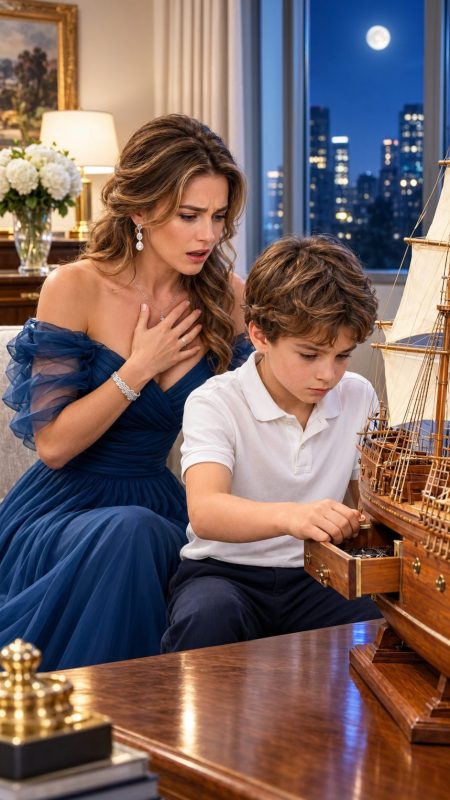
He was sitting beside me, holding the wooden tugboat.
“Grandpa knew.”
I frowned.
“Knew what?”
“That Grant and Grandma Marjorie would throw us out.”
My heart began pounding.
“Why would you say that?”
Wyatt turned the boat upside down.
“Grandpa told me that if we ever had nowhere to go, I should remember how a captain finds his way home.”
Before I could respond, he gripped the yellow smokestack and twisted it.
A faint click broke the silence.
The smokestack lifted, revealing a concealed compartment inside the boat.
Wyatt carefully tipped its contents onto the blanket.
Two small keys.
A flash drive.
And a folded envelope.
My name was written across the front in Dad’s unmistakable handwriting.
Beneath it were eight words that made my blood run cold.
“CLAIRE—IF THEY THREW YOU OUT, READ THIS.”
I opened the envelope with shaking hands.
My father’s letter began:
“My darling Claire,
“If you’re reading this, then my fears about Grant were justified. I’m sorry I couldn’t protect you sooner, but I refused to let him take what belongs to you and Wyatt.”
Tears blurred the page.
Dad explained that he’d become suspicious of Grant months earlier.
He’d noticed strange questions about his investments, persistent requests for financial information, and a sudden interest in how his estate would be divided.
Grant had even tried persuading him to transfer ownership of several properties before his death.
Dad refused.
Instead, he changed his estate plan.
He placed his assets in a trust for Wyatt because he knew an independent trustee could prevent Grant from accessing the money.
But that wasn’t the only precaution he’d taken.
The next paragraph made me stop breathing.
“Marjorie believes I gave her the money to purchase her condominium. That is not true.”
I stared at the letter.
Two years earlier, Dad had provided four hundred and sixty thousand dollars to help Marjorie acquire a luxury condominium.
She’d repeatedly described it as a generous gift.
But according to Dad, she’d signed a formal loan agreement requiring repayment on demand.
A copy of the contract was enclosed with the letter.
The original was held by his attorney.
Then came another warning.
“Grant may produce documents claiming I borrowed money from him. Do not accept those papers without examination. For years, I’ve placed a tiny blue mark beneath my signature on important documents. Grant doesn’t know about it.”
I read that sentence twice.
The letter ended with an explanation of the keys.
They opened Dad’s townhouse near the Elizabeth River.
He’d arranged for Wyatt and me to live there.
I pressed the paper against my chest.
Even after his death, Dad had found a way to protect us.
By sunrise, I had contacted his attorney and explained what we’d discovered.
She confirmed that the townhouse was available to us and that the necessary arrangements were already in place.
Wyatt and I drove there that morning.
But when we opened the front door, we found something disturbing.
Drawers had been pulled open.
Books lay scattered across the floor.
Several framed photographs had been removed from the walls.
Someone had searched the property.
A neighbor approached us as we carried our bags inside.
“Are you Thomas’s daughter?”
“Yes.”
She looked relieved.
“I’ve been trying to find someone from the family. Two people came here yesterday, and I saw them again earlier this morning.”
My stomach tightened.
“Who?”
“A man and an older woman. They said they were handling your father’s affairs.”
“Did you recognize them?”
She nodded.
“I’ve seen them visit before.”
Grant and Marjorie.
They’d already been searching Dad’s townhouse.
And judging by the mess, they’d been desperate to find something.
Fortunately, they hadn’t thought to examine the toy boat.
Nine days later, I learned exactly what they were looking for.
Grant filed a legal claim against my father’s estate, demanding $1.25 million.
According to the documents, Dad had supposedly borrowed the money to support a failed business venture.
Grant presented a promissory note bearing what appeared to be my father’s signature.
For one terrible moment, I wondered whether he’d actually succeed.
Then I examined the document.
And noticed two details.
First, the signature didn’t contain Dad’s tiny blue mark.
Second, the note was dated October 3.
I knew that date.
It was the day Dad had been admitted to intensive care.
He’d been unconscious and unable to communicate.
There was no possible way he could have signed a loan agreement that afternoon.
I immediately contacted Audrey Halbrook, the attorney handling Dad’s estate.
She studied the papers carefully.
“Claire, don’t confront Grant. Let me investigate this properly.”
I handed her Dad’s letter and the copy of Marjorie’s loan agreement.
Then I remembered the flash drive.
That evening, with Audrey’s help, I opened the files.
There were photographs, scanned documents, and several audio recordings.
In the first recording, I heard Grant’s voice.
“Thomas, just sign the blank pages. I’ll have the financial details filled in later.”
Dad sounded exhausted but firm.
“I don’t sign documents I haven’t read.”
Grant’s tone changed.
“You won’t be here forever. When you’re gone, Claire will do whatever I tell her.”
My hands went numb.
I listened again.
This was the man I’d married.
The man I’d trusted with my life and my son’s safety.
And he’d been planning to exploit us long before my father died.
A second recording contained a conversation between Grant and Marjorie.
She mentioned keeping a birthday card bearing Dad’s signature.
Grant replied that it would be useful if they needed to reproduce his handwriting.
I felt sick.
Audrey immediately arranged for the original files to be preserved and examined.
“This could become important evidence,” she told me.
But Grant wasn’t finished trying to destroy my life.
When he realized I intended to challenge his claim, he began attacking my reputation.
First, someone submitted an anonymous complaint accusing me of stealing medication from my ambulance service.
I was temporarily removed from duty while the allegation was investigated.
Every inventory record was checked.
Every controlled-medication log was reviewed.
The investigation found no evidence of wrongdoing, and I was cleared.
Then another complaint appeared, this time questioning my ability to care for Wyatt.
A child welfare investigator visited our home.
I showed her Wyatt’s bedroom, his school records, and the stable environment we’d created in Dad’s townhouse.
The allegations were dismissed as unsubstantiated.
Still, Grant continued.
One afternoon, Wyatt came home from school looking pale.
“Mom, Grant was waiting outside.”
My heart sank.
“What did he want?”
“He asked if Grandpa had given me anything before he died.”
I forced myself to remain calm.
“What did you tell him?”
“That Grandpa made me a boat.”
Wyatt reached into his pocket and pulled out his phone.
“Grant said he’d give me a thousand dollars if I handed over whatever Grandpa had hidden.”
I stared at him.
“He offered you money?”
Wyatt nodded.
“But Grandpa told me never to trust someone who wants me to keep secrets from you.”
Then he showed me a recording.
He’d captured part of their conversation on his phone.
Grant’s voice was unmistakable.
I contacted Audrey immediately and reported the incident.
She arranged for the recording to be preserved and advised me on protecting Wyatt from further unwanted contact.
As the investigation continued, another woman entered the picture.
Her name was Rachel.
She was Grant’s former wife.
I’d known he had been married before, but he’d always described Rachel as unstable and greedy.
When Audrey located her, the truth was very different.
Rachel had inherited money from her grandmother shortly before marrying Grant.
Within two years, much of it had disappeared through suspicious loans and financial transactions.
Grant had persuaded her to sign documents she hadn’t fully understood.
Then, when the money was gone, their marriage collapsed.
Rachel agreed to meet me.
We sat across from each other in a quiet café.
“I thought I was the only one,” she admitted.
“So did I.”
She shook her head.
“Grant never loved the money itself. He loved knowing he could control someone through it.”
Her testimony helped investigators understand a pattern that extended far beyond my father’s estate.
Meanwhile, Audrey uncovered more evidence.
A forensic document examiner identified irregularities in the supposed promissory note.
Medical records confirmed that Dad had been unconscious on the date it was allegedly signed.
And the recordings from the flash drive raised serious questions about Grant’s conduct.
When the estate dispute reached court, Grant arrived wearing an expensive navy suit.
He looked confident.
Marjorie sat behind him, glaring at me as though I had personally betrayed their family.
But their confidence began fading when Audrey presented the medical evidence.
The judge examined the hospital records.
Then came the disputed signature.
The forged document lacked the identifying mark found on Dad’s verified originals.
The forensic findings further undermined Grant’s claim.
Finally, the court considered the recordings and other evidence of his attempts to obtain signed documents.
Grant’s request for immediate payment was denied, and the disputed debt claim ultimately failed.
Outside the courtroom, he approached me.
“You’ve ruined everything,” he hissed.
I looked at him calmly.
“No, Grant. You ruined everything when you decided my father’s death was an opportunity to steal from my son.”
He opened his mouth, but I walked away.
For the first time since our wedding, I wasn’t afraid of his anger.
Marjorie soon faced a problem of her own.
Audrey formally demanded repayment of the $460,000 loan Dad had provided.
Marjorie insisted the money had been a gift.
But the signed agreement told a different story.
When she attempted to transfer her condominium to her sister, Audrey obtained an emergency court order preventing the transaction while the dispute was resolved.
Further investigation uncovered financial records and signature samples that connected Grant to other suspicious documents.
An associate who had helped him prepare paperwork also came under scrutiny.
Eventually, investigators gathered enough evidence to pursue criminal charges.
Grant was arrested on allegations involving forgery and financial fraud.
I watched the news report from Dad’s living room, with Wyatt asleep upstairs.
I expected to feel triumphant.
Instead, I felt exhausted.
The man I’d trusted had turned my marriage into a calculated scheme.
And the only reason he’d failed was that my father had recognized his intentions before I did.
Months later, Grant pleaded guilty to forgery and fraud-related offenses.
He received a prison sentence.
Marjorie also faced legal consequences for her involvement, and her condominium was eventually sold to satisfy the estate’s enforceable claim.
I finalized my divorce.
For the first time in years, my life felt peaceful.
Wyatt’s inheritance remained protected by the trust, and we continued living in Dad’s townhouse.
I returned to my work as a paramedic, grateful for ordinary days that no longer involved threats, accusations, or courtrooms.
But the wooden tugboat remained on Wyatt’s bedroom shelf.
He kept it beside a photograph of Grandpa.
One spring afternoon, Wyatt found a box of unfinished woodworking projects in Dad’s garage.
Inside was another miniature boat.
Its hull had been assembled, but it still needed sanding and paint.
Tucked beneath it was a handwritten note.
“For Wyatt. We’ll finish this together when I’m feeling better.”
I sat on the garage floor, holding that note for a long time.
Dad had never been able to complete the project.
So Wyatt and I decided to finish it ourselves.
Over the following weekends, we sanded the rough edges, painted the cabin white, and carefully attached the tiny railing.
Then Wyatt asked if we could add a name to the hull.
“What name?” I asked.
He looked at the photograph of his biological father.
“Evan Hensley.”
My throat tightened.
Evan had died when Wyatt was very young, but Dad had always made sure his grandson knew how deeply his father had loved him.
We painted EVAN HENSLEY in neat blue letters along the side.
When the boat was finished, we took it to the Elizabeth River.
The afternoon sunlight reflected off the water, and a gentle breeze moved through the trees.
Wyatt held the miniature tugboat in both hands.
“Mom, can I ask you something?”
“Of course.”
“Why do you think Grandpa trusted me with the secret instead of giving everything directly to you?”
I thought about Dad’s final months.
He’d known Grant was becoming dangerous.
He’d known I might not believe the truth until it was impossible to ignore.
And he’d trusted Wyatt to protect the little boat because it represented something precious between them.
“Because Grandpa knew you would keep something important safe,” I answered.
Wyatt looked down.
“The money?”
I shook my head.
“No, sweetheart. The truth.”
He considered that for a moment.
Then he smiled faintly.
“Grandpa used to tell me that a good captain never abandons his crew.”
I remembered hearing Dad say those words whenever they worked on their model boats.
Wyatt leaned against my shoulder.
“You’re my crew, Mom.”
I wrapped an arm around him.
“And you’re mine.”
We remained beside the river until the sun began sinking behind the buildings.
For months, I’d believed my father had deliberately left me out of his will.
I’d mistaken his careful planning for rejection.
But Dad hadn’t abandoned me.
He’d understood the danger surrounding us and had done everything he legally could to make sure Wyatt and I would have a safe future.
He’d left us a home, financial protection, and evidence that exposed the people who intended to exploit his death.
Yet his greatest gift wasn’t the townhouse or the fortune secured in Wyatt’s trust.
It was the courage to walk away from people who had confused love with ownership.
I looked at the two wooden boats resting beside us.
One had carried the secret that saved our future.
The other carried the name of the father Wyatt had lost.
And both reminded me that the people who truly love us don’t measure our worth by what they can take.
They protect us, even when protecting us requires difficult choices.
That day, as Wyatt slipped his hand into mine, I finally understood something my father had known all along.
A family isn’t defined by the people who demand a share of your inheritance.
It’s defined by the people who stand beside you when they believe you have nothing left.
And sometimes, the most valuable thing a parent leaves behind isn’t money at all.
It’s proof that you were loved enough to be protected, even after they were gone.