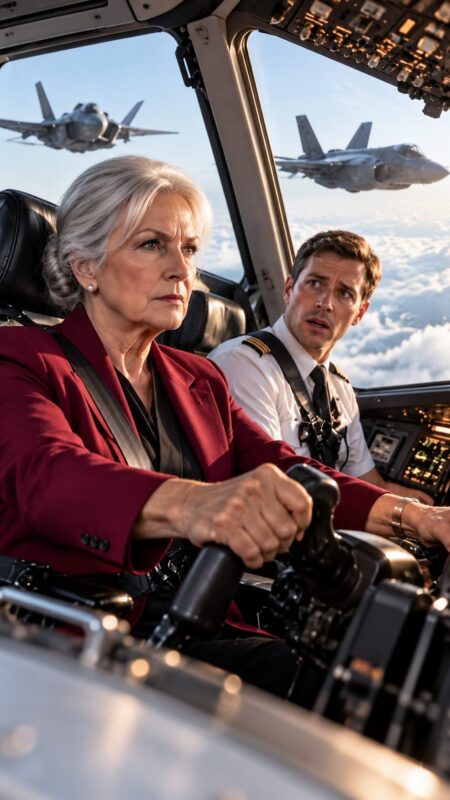
Everyone saw an elderly woman in a red jacket. The young first officer saw a passenger who didn’t know her place.
Then one engine began to fail, the captain collapsed, and two F-35s appeared off the wings.
Only then did he discover who had been sitting in seat 14A.
Pauline Sanders noticed the vibration almost immediately.
It traveled through the floor beneath her shoes—not strong enough to alarm the other passengers, but too uneven to be ordinary turbulence.
She stopped reading and listened.
Years had passed since she had sat behind the controls of an aircraft, but some instincts never disappeared.
Another vibration came through the cabin.
Pauline turned toward the window.
Left side.
Engine.
Something was wrong.
A flight attendant hurried toward the front of the aircraft. Seconds later, another followed.
Neither returned.
Pauline unfastened her seat belt.
As she approached the cockpit, First Officer Mark Jensen appeared in the doorway.
He looked young, tense, and irritated.
“Ma’am, you need to sit down.”
“Your left engine is unstable.”
Mark stared at her.
“Please return to your seat.”
“And you’ve lost the autopilot.”
His expression changed.
Pauline continued.
“Something happened to your captain too.”
Mark stepped into the aisle, blocking her path.
“How could you possibly know any of that?”
“I know what an airplane feels like when it stops behaving properly.”
He looked her up and down.
Gray hair.
Red jacket.
Wrinkled hands.
Then his attention settled on the faded silver aviation pin attached to her lapel.
He pointed at it.
“That supposed to mean something?”
Pauline said nothing.
Mark gave a nervous half-smile.
“What did you do, get it out of a cereal box?”
The aircraft suddenly rolled left.
Hard.
A luggage compartment popped open. Passengers screamed as Mark grabbed the doorway for balance.
Pauline barely moved.
When the aircraft leveled again, she looked directly at him.
“If we survive this, you can spend the rest of the day telling me how ridiculous I am.”
She nodded toward the cockpit.
“Until then, you need another pilot.”
A warning alarm sounded behind him.
Mark looked back.
The captain was unconscious.
The engine indications were worsening.
Whatever pride remained on Mark’s face disappeared.
“Can you actually fly this?”
Pauline stepped past him.
“Move.”
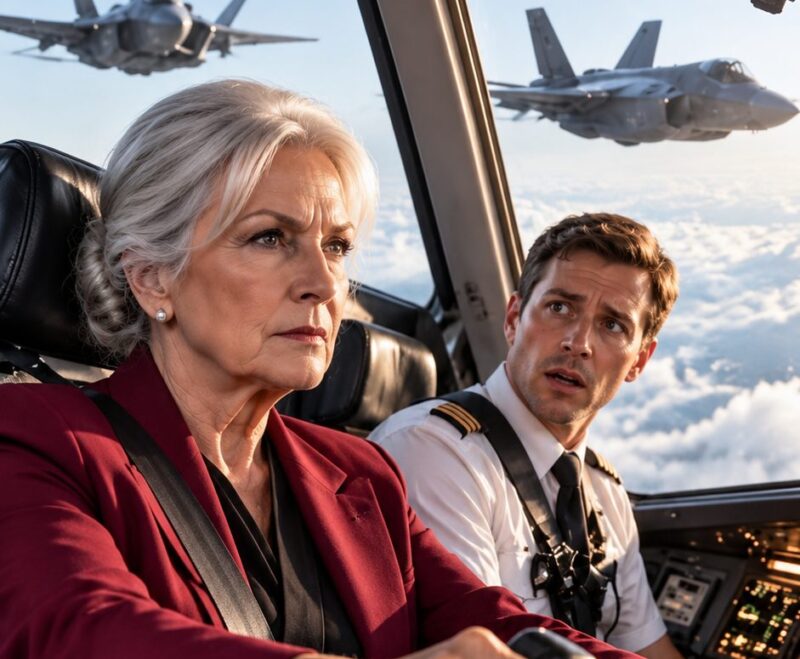
She slid into the captain’s seat.
The change was immediate.
Her shoulders straightened. Her hands found the controls without hesitation, and her eyes moved rapidly from one instrument to the next.
For the first time since the emergency began, the aircraft stopped fighting them.
Mark stared.
“Who are you?”
“Questions later.”
She adjusted the aircraft’s attitude.
“Declare an emergency.”
Mark reached for the radio.
“And tell them we need Nellis.”
He turned toward her.
“Nellis Air Force Base?”
“It has the runway and emergency response we need.”
Mark transmitted the request.
Pauline kept working.
Minutes later, two fast-moving shapes appeared against the Nevada sky.
Mark saw them first.
“Fighters.”
Two F-35s approached and settled into escort positions, one on either side of the damaged airliner.
The radio came alive.
“Civilian aircraft, Havoc One. Confirm your condition.”
Mark responded.
Then another question came.
“Identify the person currently at the controls.”
Pauline held out her hand for the radio.
“This is Sanders.”
“Sanders, provide your flight qualifications.”
Pauline watched the instruments.
“Enough.”
The fighter pilot didn’t respond.
She sighed.
“T-38s. Test programs. Experimental platforms.”
Then she added, “YF-23.”
Mark’s head snapped toward her.
Pauline paused before giving the last piece.
“Call sign Widow Six.”
Silence filled the frequency.
Mark looked from the radio to Pauline.
Then the fighter pilot returned.
His voice was suddenly far more formal.
“Confirm. Widow Six?”
“That’s correct.”
Another brief silence.
“Colonel Sanders, Nellis has been notified. We’ll escort you all the way in.”
Mark’s face went pale.
“Colonel?”
Pauline kept her attention on the aircraft.
“You can be impressed after we land.”
A warning light appeared.
The damaged engine was fading rapidly.
Mark leaned toward the instruments.
“We’re losing almost all thrust on the left.”
Pauline nodded once.
“Then we stop expecting it to help us.”
“How are we supposed to land like this?”
“With the airplane we still have.”
The runway appeared in the distance.
Pauline began configuring for the approach.
“Gear.”
Mark lowered it.
“Down. Three green.”
“Flaps.”
“Set.”
The aircraft drifted.
Pauline corrected with careful inputs.
The failing engine shuddered again.
Mark swallowed.
“Pauline…”
“I see it.”
The runway grew larger.
“Don’t chase the instruments,” she told him. “Stay ahead of the airplane.”
He nodded.
For the first time since meeting her, Mark stopped questioning anything she said.
The aircraft crossed the threshold.
The landing was hard.
The tires struck the runway, bounced once, then came down again.
Pauline held the centerline while emergency vehicles raced alongside them.
The aircraft slowed.
Finally, it stopped.
Nobody in the cockpit spoke.
Then applause thundered through the cabin.
Mark leaned back in his seat and exhaled.
Pauline simply closed her eyes for a moment.
When she eventually stepped onto the tarmac, she expected paramedics and emergency crews.
She didn’t expect the line of uniformed officers waiting beyond them.
One senior officer walked forward.
He stopped several feet from her.
Then he raised his hand in salute.
Pauline stared at him.
Mark, standing behind her, finally understood that he had mocked someone whose history he knew nothing about.
Pauline Sanders had once belonged to a world of experimental aircraft, classified test programs, and missions hidden from public records.
Her name had disappeared decades earlier.
Not because she had been insignificant.
Because much of what she had done had never officially existed.
Mark approached her.
“Colonel Sanders?”
She glanced at him.
“I suppose that cereal-box pin looks a little different now.”
He lowered his eyes.
“I deserved that.”
“Yes, you did.”
“I’m sorry.”
Pauline studied him for a moment.
Then she nodded toward the airliner.
“You made a bad judgment about me.”
“I know.”
“But when your assumptions stopped matching reality, you changed course and listened. That helped bring those people home.”
Mark looked at the aircraft.
“You brought them home.”
“We both did our jobs.”
Before he could respond, another officer approached.
He carried a sealed folder.
“Colonel, we need you to come with us.”
Pauline frowned.
“For what?”
The officer handed her the folder.
Inside was a photograph.
Pauline’s expression changed instantly.
An angular black aircraft sat on a desert runway.
She knew every line of it.
Nightshade X-11.
Her hands tightened around the photograph.
“Where did you get this?”
“Project Nightshade is no longer buried.”
Pauline looked up.
“That program was destroyed.”
“No, ma’am.”
The officer paused.
“It was hidden.”
She was escorted deep into a secure section of the base.
An elevator carried them underground.
At the end of a long corridor, massive hangar doors opened.
Something enormous rested beneath a gray cover.
Pauline didn’t need to see the aircraft itself.
She recognized the silhouette.
Nightshade.
The experimental machine that had ended her career and nearly destroyed her reputation.
Someone removed the cover.
Pauline stared.
The X-11 had been restored.
But before she could approach it, she heard a familiar voice.
“You still make people wait, Sanders.”
Pauline stopped breathing.
A wheelchair emerged from behind the aircraft.
The elderly man sitting in it smiled.
Her lips parted.
“Artie?”
Arthur Pendelton.
Her flight partner.
Her friend.
The man she had mourned for decades.
Pauline had been told Arthur died after ejecting during their final Nightshade test.
Arthur had been told Pauline had died too.
They stared at each other across the hangar.
“You’re alive,” Pauline whispered.
Arthur smiled sadly.
“So are you.”
The cover-up had been larger than either of them knew.
After the Nightshade accident, officials had protected the classified program by burying records, separating witnesses, and allowing Pauline to carry the blame.
Arthur survived his injuries.
And he preserved something the program’s leaders had failed to destroy.
The original telemetry.
Data proving that the accident had resulted from a system failure—not pilot error.
“You kept it all these years?” Pauline asked.
Arthur nodded.
“Somebody had to remember what actually happened.”
She walked toward him.
Arthur opened his arms.
“You’re about forty years late for the debrief.”
Pauline laughed through her tears and embraced him.
Behind them, the restored Nightshade gleamed beneath the hangar lights.
New lettering had been painted below the canopy:
COL. PAULINE “WIDOW 6” SANDERS
The base commander stepped forward.
“Project Nightshade has been declassified. Your official record is being corrected, Colonel. Your test history, commendations, and honors will be restored.”
Pauline touched the aircraft’s fuselage.
For decades, she had lived knowing that the public version of her career ended in failure.
Now the truth was finally catching up.
Mark had followed the officers into the hangar.
He stood near the entrance, visibly uncomfortable.
Pauline noticed him.
“Come here, Jensen.”
He approached.
“I’ve been thinking about what happened,” he said.
“That’s usually useful.”
His mouth twitched into a nervous smile.
“I looked at you and decided I already knew what you were capable of.”
“Yes.”
“I won’t make that mistake again.”
Pauline studied him.
Then Mark asked quietly, “Do you think someone who makes a mistake like that can still become a good captain?”
“A mistake doesn’t decide what kind of pilot you become.”
“What does?”
“What you learn after making it.”
She glanced toward the airliner outside.
“Training can teach you procedures. Experience teaches judgment. But neither matters much if your ego prevents you from listening.”
Mark nodded.
Later that evening, Pauline and Arthur appeared briefly before reporters.
Pauline found the situation almost absurd.
That morning, she had boarded a routine passenger flight to visit family.
By sunset, she had helped land a crippled aircraft, reunited with a man she believed had been dead for decades, and watched a classified chapter of her life return from history.
As the reporters began leaving, one of the F-35 pilots approached.
“Colonel?”
Pauline turned.
“My grandfather flew chase for some of the Nightshade tests.”
Pauline searched his face.
“What was his name?”
The pilot told her.
Recognition softened her expression.
“I remember him.”
“He remembered you too.”
The pilot hesitated.
“He died a few years ago. But he once told me that if I ever met Widow Six, I had to give her a message.”
Pauline waited.
The young pilot looked toward the fading Nevada sunset.
Then back at her.
“He said to tell you your sky was never broken.”
For once, Pauline had no reply.
She touched the old silver pin on her lapel.
The same pin Mark had mocked only hours earlier.
Then she looked toward the horizon.
For decades, files had been sealed.
Records had vanished.
People had been ordered to remain silent.
History had nearly erased Widow Six.
But history and the sky were not the same thing.
One could be rewritten.
The other remembered every flight.