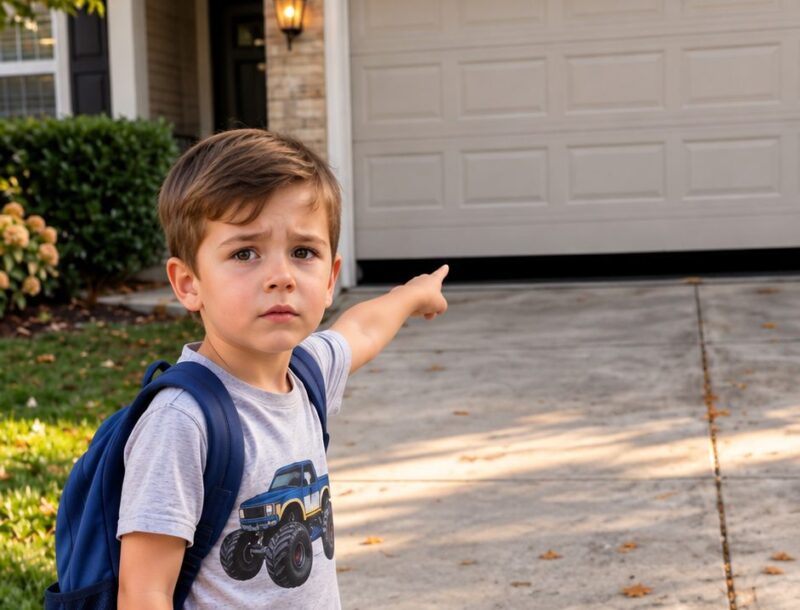
My five-year-old grandson leaned between the front seats and spoke in the serious whisper children use when they believe they’re sharing classified information.
“Grandma, Mom and Dad are hiding something. They said even the police can’t find out.”
I nearly laughed.
Twice a week, I collected Noah from kindergarten, and his “important news” usually concerned dinosaurs, arguments over playground swings, or whose dessert had disappeared at lunch. Whatever secret Emma and her husband were keeping, I assumed it was innocent.
Then Noah added, “They’re hiding it in the garage.”
I glanced at him in the mirror.
“Hiding what?”
He pressed his lips together.
“I promised not to tell. Dad said nobody can see it until everything is ready.”
I still wasn’t particularly concerned.
Then, a few blocks later, Noah mentioned something else.
“Mom asked Dad what they’d do if she found out.”
A cold feeling crept through me.
“Who did she mean?”
Noah silently pointed at the back of my seat.
Me.
I drove past the turn that would have taken us home and headed directly to Emma’s house.
As soon as we pulled into the driveway, I noticed an unusual reddish light glowing behind the garage windows.
Emma met us at the door.
Before she could say anything, Noah announced proudly, “I told Grandma about the garage!”
The look on my daughter’s face made my heart beat faster.
I stepped around her and opened the garage door.
Strings of deep red lights had been hung along the wall. Beneath them was a collection of old photographs—dozens of them, carefully arranged like an exhibition.
At first, they meant nothing to me.
Then one face became familiar.
Mine.
Not the face I saw in the mirror every morning, but the face I had worn four decades earlier.
There I was at twenty-five, laughing on a blanket in the grass.
In another photograph, I was sitting beneath a tree.
Others showed people whose names I hadn’t spoken in years.
A strange mixture of nostalgia and confusion washed over me.
Then I noticed what was sitting on the workbench.
An old camera.
My camera.
The one I had supposedly lost forty years earlier.
I turned toward Emma.
“Where did you get that?”
She explained that she had stumbled across it at a flea market. The man selling it mentioned that an unfinished roll of film was still inside. Emma thought it would be fun to have the film developed and surprise me with whatever photographs were on it.
Then her voice became hesitant.
“There’s something else.”
“What?”
“I invited the seller to dinner.”
Before I could ask why, the doorbell rang.
Emma went to answer it.
A moment later, I heard a man’s voice from the hallway.
I knew that voice before I saw his face.
When he appeared in the doorway, I stopped breathing for a second.
His hair was silver now. Time had changed the shape of his face and drawn lines around his eyes.
But those eyes were unmistakable.
“Stephen?”
He stared at me with equal disbelief.
“Alana.”
Suddenly, I was twenty-five again.
Stephen had been my first great love—the man I once imagined growing old beside.
Instead, I had disappeared from his life after becoming convinced that he had betrayed me.
Stephen walked toward the photographs and stopped in front of one particular image.
My chest tightened.
I remembered it perfectly.
Stephen was leaning toward my friend Selena. Their faces were so close that the photograph made it appear as though they were kissing.
“That’s the one,” I said.
Stephen nodded.
“I thought it might be.”
“That photograph told me everything I needed to know.”
“No,” he replied quietly. “It told you one second of the story.”
He pointed to the photograph beside it.
I looked closer.
Selena was laughing with her boyfriend, Carl.
The next photograph showed Stephen standing beside both of them.
Another captured Selena leaning comfortably against Carl while Stephen stretched across the picnic blanket to grab something from a plate.
I moved from picture to picture.
The story I had believed for forty years began falling apart in front of me.
There had been no secret romance.
No betrayal.
No affair.
Just friends at a picnic—and one photograph taken at exactly the wrong moment.
“I tried to tell you,” Stephen said.
I remembered that too.
“You told me never to come near you again,” he continued.
“I was angry.”
“I know.”
“You could have tried again.”
“I did. By then, you were gone.”
His next words hurt more than an accusation would have.
“At some point, I had to respect what you told me. I couldn’t spend my life pretending your ‘no’ meant I should keep chasing you.”
I looked away.
At twenty-five, I had mistaken confidence for certainty and pride for strength.
And I had never allowed him to explain.
We eventually moved to the dining room, although no one seemed interested in eating.
Emma tried to break the tension.
“So, when exactly did you two know each other?”
Stephen looked at her.
Something about his expression changed.
“How old are you, Emma?”
“Forty.”
He froze.
Slowly, he turned toward me.
“Alana…”
I already knew what he was calculating.
“We ended things forty years ago.”
“Yes.”
He swallowed.
For the first time since arriving, Stephen seemed frightened.
“I don’t want to jump to conclusions,” he said carefully. “But is it possible that Emma is my daughter?”
Silence filled the room.
Emma looked at Stephen.
Then she looked at me.
There was no way to hide anymore.
“I learned I was pregnant a few weeks after I left,” I said.
Stephen’s face went pale.
“And you never told me?”
I struggled to meet his eyes.
“I believed you had betrayed me. I was hurt and angry, and I convinced myself you wouldn’t want anything to do with us.”
His voice was barely above a whisper.
“But you never asked me.”
“No.”
Emma pushed her chair back slightly.
“Wait. You knew he could be my father?”
I turned toward her.
“I knew it was possible.”
Her disappointment was harder to face than Stephen’s anger.
“For forty years?”
“Yes.”
“And you decided I didn’t need to know?”
I opened my mouth, but every explanation sounded like another excuse.
So I closed it again.
Emma shook her head.
“You made a choice that belonged to both of us.”
She was right.
I had spent decades telling myself I had protected my daughter.
That night, I finally understood that protection without truth could become another form of control.
Stephen didn’t demand anything from Emma.
He simply said, “You don’t owe me a relationship. You don’t have to call me anything. I’m not here to replace anyone or pretend the last forty years didn’t happen. I’d just like the chance to know you—if that’s something you eventually want too.”
Emma watched him quietly.
Then she pulled out the empty chair across from her.
“You can stay for dinner.”
Stephen hesitated.
Emma raised one finger.
“But I ask the questions.”
For the first time that evening, he smiled.
“Deal.”
We sat together around a table full of food that had gone nearly untouched.
I listened as Emma began asking about Stephen’s life, his family, the years that had passed, and the things she had never been given the opportunity to know.
For most of my life, I had believed that loving someone meant protecting them from painful choices.
But sometimes love means giving people the truth and allowing them to choose for themselves.
It had taken me forty years to understand the difference.
So when Emma finally turned toward me, I didn’t explain, interrupt, or tell her what I thought she should do.
I simply asked the question I should have asked a lifetime ago.
“Where do you want to start?”