Fifteen Seconds
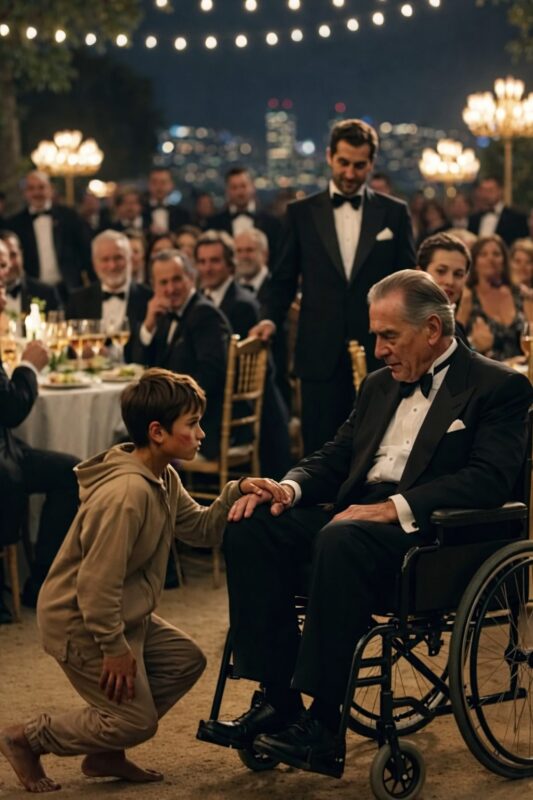
The patio went still.
Not the gentle kind of silence—the kind that presses against your ribs.
A barefoot boy stood on the cold stone, his hand hovering just above the man’s knee, exactly where an obscure medical report had once suggested something had been missed.
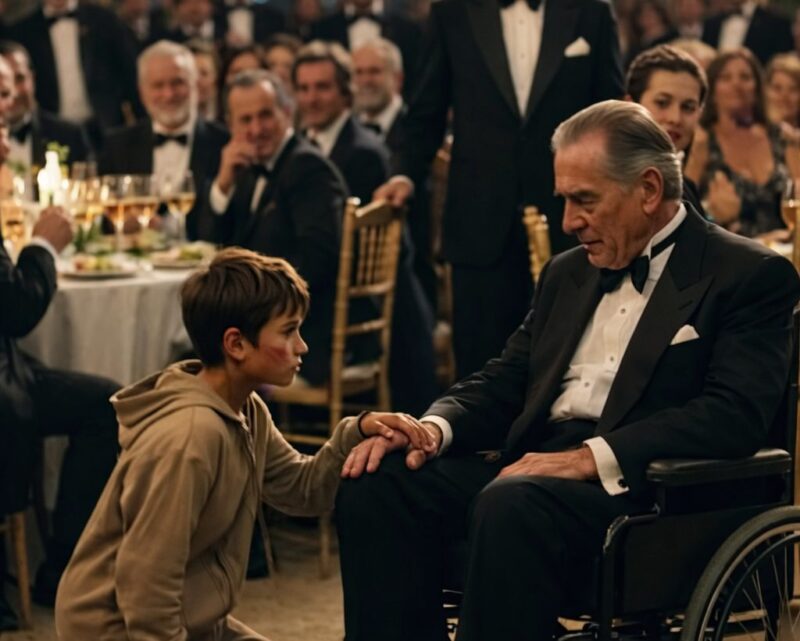
The man in the wheelchair gave a thin smile.
“Fifteen seconds,” he said loudly. “Then I’m calling the police.”
Phones lifted. Someone whispered that this would spread online within minutes.
The boy closed his eyes.
Then he pressed.
A sharp cry tore through the night.
“Don’t touch me!”
Then—silence again.
The man stiffened. His breath caught, color draining from his face.
Something changed. Not movement. Not pain.
Feeling.
A sensation he had been without for eleven years.
“That can’t be real,” he muttered.
The boy stepped back slightly.
“Try.”
A few people laughed.
Then stopped.
Because the man’s fingers were shaking.
Chapter Two: The Version They Told
Eleven years earlier, Marcus Hale had been told his condition was permanent.
A violent accident. Severe spinal trauma. A final verdict delivered in a sterile office by specialists who would never live with the consequences.
What he was never told was that his case had been labeled *“unlikely to improve,”* not impossible.
But “unlikely” doesn’t close cases cleanly.
And “never” keeps things quiet.
Chapter Three: Memory in the Body
Marcus tightened his grip on the wheelchair.
“I can’t.”
The boy met his eyes without emotion.
“You can.”
Marcus pushed upward.
His legs trembled—fragile, uncertain.
But they responded.
Slowly, he rose.
Unsteady. Weak.
But standing.
The check slipped from his hand.
No one applauded.
The crowd stepped back instead.
Chapter Four: When Fear Changes Direction
Police arrived—not for the boy, but because too many questions had surfaced too quickly.
Doctors’ names were mentioned. Documents requested. Files reopened.
An officer crouched down.
“What’s your name?”
The boy hesitated. Names leave evidence.
“No,” Marcus said suddenly. “He stays with me.”
“You’re protecting him?” the officer asked.
Marcus swallowed.
“No… I’m afraid of losing him.”
Chapter Five: A Different Truth
That night, Marcus learned the truth about the boy.
No miracle. No mystery.
An extraordinary memory. A rare mind.
A mother who had died during a clinical trial that vanished without explanation.
The same company Marcus had invested in.
The same system that built his fortune.
And the same system that erased the boy.
For years, Marcus had believed he was the one wronged.
But standing in his penthouse, watching the boy absorb complex medical texts with ease, he understood—
He hadn’t been the victim.
He had benefited from it.
Chapter Six: What Money Couldn’t Buy
“I’ll give you anything,” Marcus said. “Money. A home. A name.”
The boy looked at him quietly.
“I don’t want your money.”
“Then what do you want?”
A faint smile.
“The truth.”
Epilogue: What They Didn’t Expect
The fallout came quietly.
Investigations. Lawsuits. Careers ending without public noise.
Years later, a journalist asked the boy—now grown—
“Why did you do it?”
He answered simply.
“They laughed,” he said. “They thought money made them untouchable.”
A brief pause.
“It didn’t.”