He Opened His Home to His Sick Father—A Year Later, One Unexpected Gift Changed Everything
The day my father was discharged from the hospital, he looked nothing like the man I had known all my life.
This was the same man who once hauled a refrigerator up a flight of porch steps because he refused to pay a delivery fee. The same man who fixed leaking roofs, rebuilt engines, and never asked anyone for help.
But as he stepped through my front door that afternoon, something about him seemed diminished.
Not broken.
Not helpless.
Just worn down by life in a way I had never seen before.
My wife, Sarah, had spent hours preparing soup before leaving for work. The scent of chicken broth mixed with coffee, medication, and the menthol ointment the doctors had prescribed for Dad’s aching joints.
My brothers, Michael and Daniel, arrived shortly after I did.
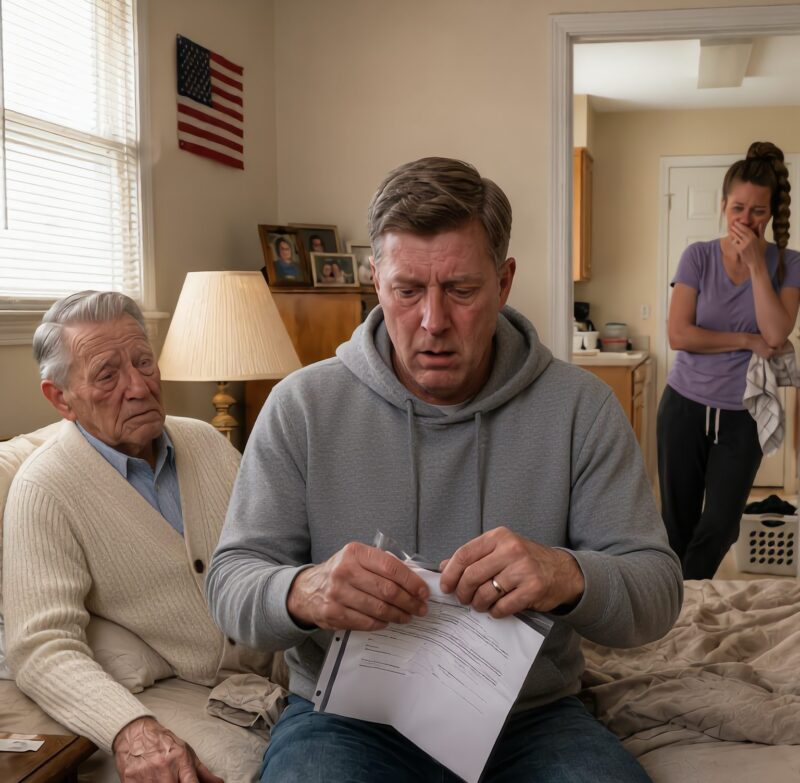
Dad sat carefully at the kitchen table and placed a large envelope in front of us.
“There’s something you need to know,” he said.
Inside was a debt statement.
The total was staggering.
**$2,160,000.**
Nobody spoke.
The number seemed unreal.
Michael finally broke the silence.
“How did this happen?”
Dad stared at the table.
“I trusted the wrong people,” he replied quietly. “One signature led to another. Before I understood what was happening, it was too late.”
Daniel shook his head.
“Can anything be done?”
Dad didn’t answer.
He didn’t have to.
The silence told us everything.
Michael was the first to retreat.
“I can’t take responsibility for something like this.”
Daniel looked equally defeated.
“My business is hanging by a thread already.”
Then their eyes turned toward me.
Sarah and I weren’t wealthy. We had bills, a mortgage, an aging truck, and two growing children.
Taking on that burden felt impossible.
But when I looked across the table, I didn’t see a debt.
I saw my father sitting there, ashamed.
That hurt far more than any number printed on a piece of paper.
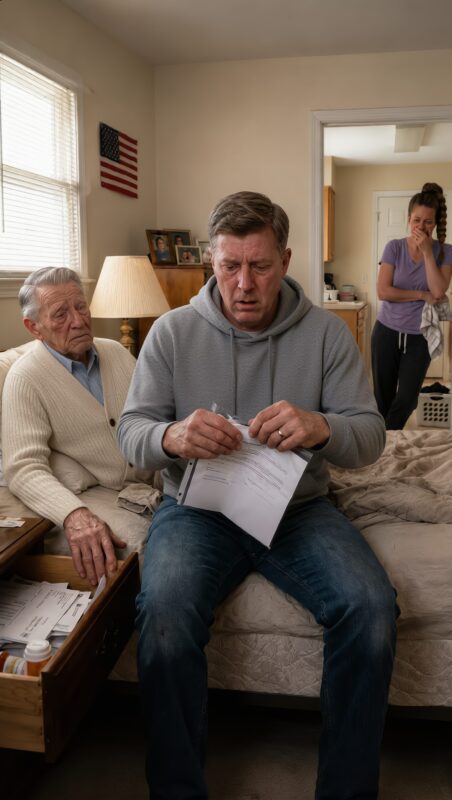
He had spent his entire life helping others carry their burdens.
Now he had no one willing to help carry his.
I picked up the pen.
Beneath the table, Sarah gently squeezed my hand.
She was nervous.
So was I.
But she didn’t let go.
That evening, I signed the paperwork.
Two days later, Dad moved into our home.
Life changed almost immediately.
Sarah organized his medications and medical records. A thick binder filled with payment schedules appeared on our kitchen counter and rarely left.
To make ends meet, I accepted every overtime shift available.
We sold my motorcycle.
Canceled vacations.
Put off home repairs.
The children quietly learned to stop asking for unnecessary things.
Kids understand more than adults realize.
The sacrifices were real.
Yet something remarkable began happening.
Dad slowly started finding himself again.
At first, he spent hours staring through the living-room window.
Then one afternoon my daughter asked for help with a spelling assignment.
Soon they were spending every evening together.
She sat on the rug with her notebook.
He sat in his favorite chair.
They laughed over difficult words and celebrated small victories.
Not long after that, my son wheeled a broken bicycle into the house.
Dad examined it carefully.
His hands trembled slightly, but his eyes lit up.
“Patience solves problems that force never can,” he told him.
The lesson wasn’t really about bicycles.
It never had been.
One evening Sarah carried him dinner and tucked a blanket around his legs.
Dad watched her for a moment.
“You’ve done more for me than I deserve.”
Sarah smiled.
“That’s what families do.”
He looked away quickly.
I could tell those words meant something to him.
After that, he started writing.
Every day.
Yellow notepads, loose papers, envelopes—anything he could find.
I assumed he was keeping track of debts and expenses.
I was wrong.
Nearly a year later, Dad called me into his room.
From a drawer, he removed a sealed plastic folder.
I expected another financial document.
Instead, I found a property deed.
My name and Sarah’s name were listed as the owners.
For a moment, I couldn’t breathe.
Near the bottom of the page, beneath the official seal, Dad had written a note in his own handwriting:
**For the child who returned when everyone else walked away.**
Before I could speak, he handed me another envelope.
Inside was a journal.
Not a financial record.
A record of people.
Every visit.
Every promise.
Every missed call.
Every ride to a doctor’s appointment.
Every meal Sarah prepared.
Every overtime shift I worked.
Every act of kindness.
He had written it all down.
Not to punish anyone.
Not to create guilt.
Simply to preserve the truth.
When Michael and Daniel learned about the property, they came immediately.
Their frustration disappeared when Dad opened the journal.
Page after page revealed the reality of the past year.
Dates.
Names.
Actions.
Or the absence of them.
Sarah’s name appeared constantly.
Mine did too.
Theirs rarely did.
When they complained about fairness, Dad simply closed the journal.
“This isn’t about rewarding people,” he said calmly. “It’s about recognizing who stayed when staying became difficult.”
No one argued after that.
There was nothing left to say.
The conversation changed something, though.
Daniel started stopping by with groceries.
Michael began visiting more often.
The healing was slow and awkward, but it was real.
Over time, old wounds began to mend.
Dad remained with us.
He helped with homework.
Taught the grandchildren how to repair things.
Shared stories from decades past.
And he continued writing in his journal.
Only now the entries looked different.
Mia mastered a difficult spelling test today.
Noah repaired his bicycle on his own.
Sarah laughed so hard at dinner she cried.
Months later, Dad and I sat on the porch watching the sunset.
“Do you regret helping me?” he asked.
I thought about the extra shifts.
The sacrifices.
The fear.
The uncertainty.
Then I thought about the memories we’d gained.
The time we never would have shared otherwise.
The family we had rebuilt.
“No,” I said.
“Not for a second.”
The debt eventually became just another number in a stack of paperwork.
What remained was something far more valuable.
A father who felt loved.
A family that found its way back together.
And a handwritten sentence that reminded me what truly matters:
For the child who returned when everyone else walked away.