For nearly an entire season, Elena followed the same unusual routine.
Just after sunrise, the elderly widow carried a ladder outside, climbed onto her roof, and attached another row of sharpened wooden pieces to it.
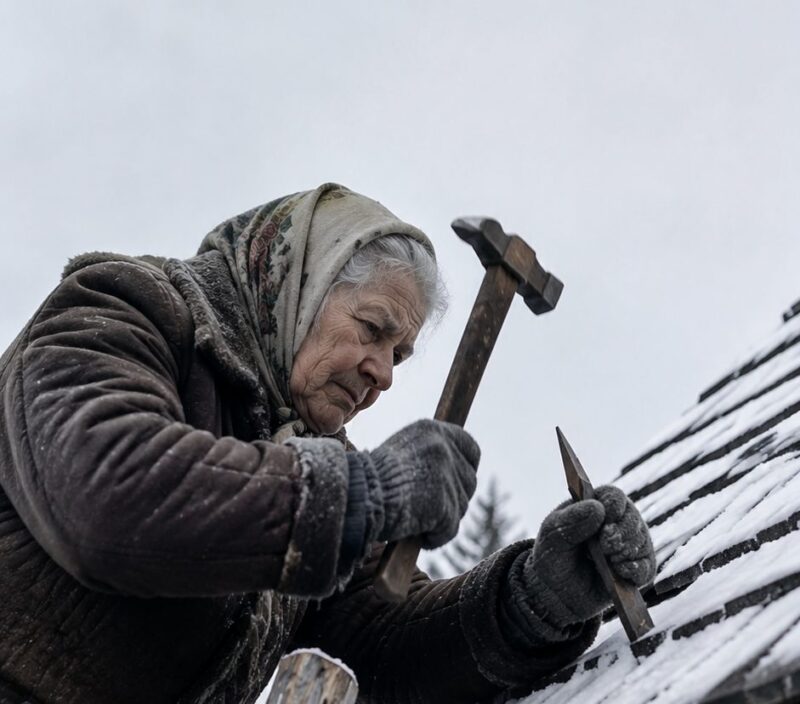
Day after day, the number grew.
At first, her neighbors barely noticed. Soon, however, Elena’s house became impossible to ignore. Dozens of pointed wooden stakes covered the roof, making it look more like an ancient barricade than a peaceful mountain home.
The village quickly invented explanations.
Some said grief had changed Elena after Antonio’s death. Others whispered that loneliness had made her superstitious. A few joked that perhaps she expected monsters to descend from the mountains.
Elena responded to none of it.
She worked slowly and precisely.
Every piece of wood had to be dry and strong. Every point was shaped by hand. Every stake was positioned at a deliberate angle before being secured.
Eventually, Tomás, who lived nearby, could no longer contain his curiosity.
“What are those things supposed to do?” he asked.
Elena tested one of the stakes with both hands.
“Keep me safe.”
Tomás glanced toward the empty sky.
“Safe from what?”
Elena gave him a faint smile.
“I’ll know when it arrives.”
Her answer became another village joke.
But the laughter ended sooner than anyone expected.
Winter arrived early that year.
One afternoon, clouds swallowed the mountain peaks, and powerful winds descended into the valley. Trees bent beneath the gusts. Fences toppled. Tiles disappeared from rooftops. By nightfall, several families were placing buckets beneath leaks while others tried desperately to cover damaged sections of their homes.
Elena stayed inside.
Above her, the roof creaked and trembled.
But it remained intact.
When the villagers emerged the next morning, they found branches and debris scattered everywhere.
Then someone pointed toward Elena’s house.
Nothing significant had happened to it.
The strange wooden structures everyone had mocked had altered the way the strongest gusts moved across the roof, reducing the direct pressure on its most exposed areas.
Suddenly, Elena’s strange project didn’t seem so ridiculous.
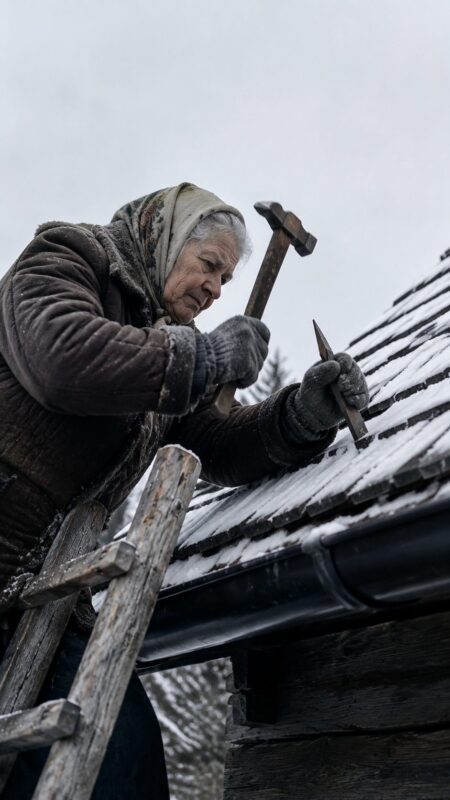
She finally told them where the idea had come from.
The previous winter, a violent storm had almost destroyed the house. Antonio had been alive then, and the experience had convinced him that they needed to prepare differently.
For years, he had observed the winds that traveled through the valley. He studied where they accelerated, how they struck different buildings, and which roof designs suffered the greatest damage.
Before his death, Antonio had taught Elena a method he believed could make their home more resistant to the mountain winds.
She had simply finished the work he could not.
Tomás thought that explained everything.
He was wrong.
While the village celebrated surviving the storm, Elena continued studying the mountains.
One evening, Tomás found her standing outside.
“You proved everyone wrong,” he said.
Elena shook her head.
“This wasn’t the one Antonio feared.”
According to his observations, storms arriving unusually early sometimes preceded far more dangerous weather.
Elena wasn’t willing to gamble on Antonio being wrong.
The next morning, she appeared at Tomás’s house carrying a small bag of tools.
“I’m checking your roof.”
This time, he didn’t laugh.
They found several loose sections and a weakened support beam.
Then Elena moved to another house.
And another.
Soon, the project expanded across the village.
People who had once mocked her were now holding ladders while she inspected their roofs. Carpenters volunteered their tools. Younger residents carried timber. Families replaced damaged tiles and reinforced vulnerable beams.
Within days, the village had become a construction site.
Then came the radio warning.
A major winter system was approaching the valley.
Forecasters predicted heavy snowfall, destructive winds, and possible road closures.
People had only a short time to prepare.
Nobody laughed now.
That night, the storm descended with terrifying force.
Power lines failed.
Roads vanished beneath rapidly accumulating snow.
The village became completely isolated.
Hours after darkness fell, someone hammered on Elena’s door.
Tomás stood outside.
“Marta’s house is failing.”
Elena immediately followed him.
They struggled through the storm until they reached Marta’s home, where she and her three children were waiting in fear.
Elena quickly examined the building.
The reinforced main structure was holding.
But there was a problem.
An old extension behind the house had never been strengthened.
Its roof was beginning to shift.
Elena didn’t waste time attempting a repair.
“We leave now.”
She sent Marta and the children toward Tomás’s basement, where the structure was safer.
They had barely reached shelter when a violent gust tore part of the old extension away.
Nobody needed an explanation after that.
By sunrise, the storm had left its mark everywhere.
Trees were down. Fences were shattered. Pieces of roofing lay scattered across the snow.
Yet most of the homes they had reinforced remained standing.
Marta found Elena and embraced her.
“My children could have been inside when that roof came down. You saved us.”
Elena looked toward her own house in the distance.
“Antonio did.”
Later, she gathered several neighbors around her kitchen table and placed an old notebook in front of them.
It had belonged to her husband.
The pages were crowded with diagrams, measurements, dates, arrows showing wind direction, and notes about previous storms.
Near the back, Antonio had drawn a detailed map of the village.
Several homes were circled.
Tomás leaned closer.
“That’s my house.”
Marta recognized hers as well.
“Why these houses?”
Elena ran her fingers across the faded markings.
“Antonio believed they were the most exposed.”
Only then did everyone understand.
Antonio’s work had never been intended solely for Elena.
He had been studying how to protect the entire community.
Before his death, he had entrusted the notebook to his wife and left her with one final piece of advice:
“Don’t waste your strength fighting the storm after it arrives. Prepare before it comes. And when you’re ready, help someone else prepare too.”
Those words changed the village.
When spring finally melted the snow, people didn’t forget what had happened.
They created teams to inspect houses before each winter. Younger residents helped repair the homes of people who couldn’t safely climb ladders. Marta organized a shared emergency supply room. Families began storing food, blankets, lamps, batteries, and other necessities together.
Antonio’s notebook became a community guide.
His knowledge no longer belonged to one household.
It belonged to everyone.
The following autumn, Elena walked outside carrying several freshly cut pieces of wood.
She stopped halfway to her ladder.
Tomás was standing beside it.
Behind him were Marta and several other neighbors.
They had brought tools, timber, ropes, and ladders of their own.
Elena stared at them.
Tomás smiled.
“You taught us to prepare together. So that’s what we’re doing.”
For a moment, Elena couldn’t speak.
Then tears gathered in her eyes.
She had spent months believing she was completing Antonio’s unfinished work alone.
Now she understood that his work had never truly ended.
It continued every time someone repaired a neighbor’s roof.
Every time a family prepared before winter.
Every time people chose cooperation over ridicule.
Elena opened Antonio’s weathered notebook one more time.
At the bottom of its final page was a short message.
She read it aloud:
“People can laugh before the storm. The wind won’t remember their laughter. It will only test whether they were ready.”
That winter, nobody stared strangely at Elena’s roof.
Other houses had begun to change too.
The wooden stakes that had once made Elena the village joke had become symbols of something much larger.
They were proof that preparation can look foolish until the day it becomes necessary.
And they carried the final gift of a man who had understood that protecting the people you love sometimes means preparing them for a future you may never live to see.