My husband was so embarrassed by my inexpensive dress that he spent most of his company’s gala pretending I was part of the hotel staff.
A few hours later, the billionaire who owned his company noticed the old silver pendant around my neck—and uncovered a truth that had been missing from my life for three decades.
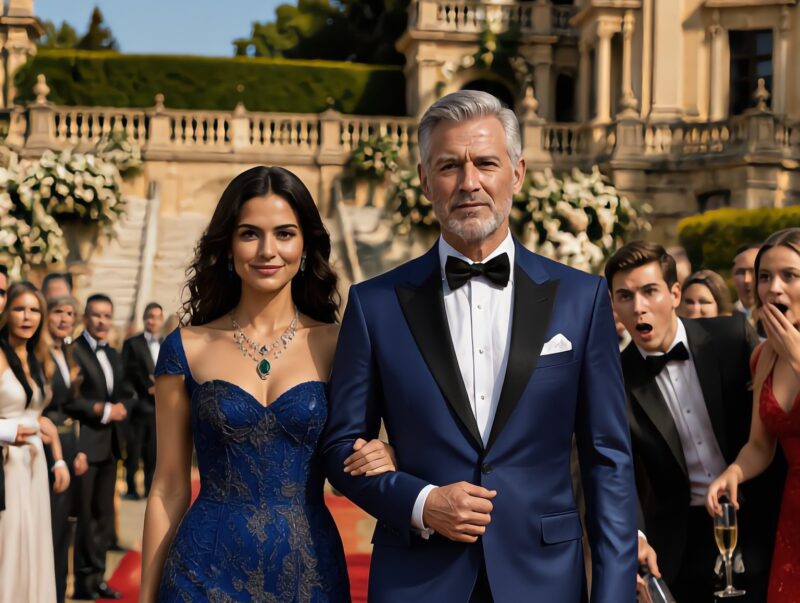
That evening, I chose a modest dark-blue dress from my closet. It had no designer label and certainly hadn’t cost a fortune. There was even a tiny repair near the bottom where I had once stitched the fabric by hand.
To me, none of that mattered.
The dress was special because Rosa Bennett had always loved it.
Rosa was the only mother I remembered.
She hadn’t given birth to me. She had taken me in when I was a young child after I was found alone following a devastating accident. No one could determine exactly where I had come from, and there was almost nothing that could identify me.
Almost nothing.
I had a small scar and a silver necklace shaped like one half of a rising sun.
Rosa protected that necklace for years. Before she passed away, she returned it to me.
“Whatever happened before you came to me,” she said, “this belongs to that part of your story.”
From then on, I rarely took it off.
Julian had always hated it.
He hated my dress even more.
The moment we stepped out of the car in front of the elegant Dallas hotel, he studied me with obvious disappointment.
“That’s what you’re wearing?”
“Yes.”
He exhaled sharply.
“This is the biggest event of the year. The board will be here. Investors will be here. Kensington himself will be here.”
“I know. I came because I wanted to support you.”
Julian looked at my dress again.
“You look like you should be serving the guests.”
The comment hurt, but what happened inside was worse.
The ballroom glittered with chandeliers, crystal glasses, tailored tuxedos, and gowns that probably cost more than my monthly salary.
Julian pulled me aside before we reached his colleagues.
“Stay near the service area tonight.”
I thought I had misunderstood him.
“Excuse me?”
“And don’t tell people you’re my wife.”
I stared at him.
“What am I supposed to tell them?”
“Say you’re helping the hotel staff.”
There was no humor in his face.
He meant it.
After years of marriage, Julian would rather pretend I was a stranger than risk having his wealthy colleagues see him beside a woman in an inexpensive dress.
So I stood near the edge of the ballroom and watched my husband introduce himself to everyone who might advance his career.
Then Richard Kensington arrived.
He was the billionaire founder of the company and the most powerful person in the room.
His sister, Eleanor, accompanied him.
Eventually, Richard reached Julian and exchanged a few polite words with him.
Then he asked a simple question.
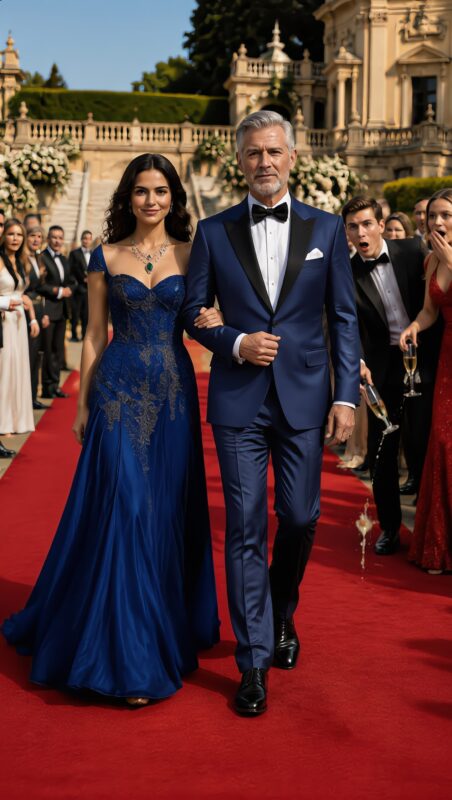
“Didn’t you tell me your wife was coming tonight?”
Julian’s expression tightened.
His eyes moved toward me.
He had no choice now.
He motioned for me to join them.
When I approached, he didn’t introduce me as his wife.
“This is Elena,” he said. “She’s helping out tonight.”
Richard seemed not to hear the rest.
His attention had shifted to my chest.
More precisely, to the silver pendant resting against my dress.
His expression vanished.
Eleanor saw it too.
She suddenly gripped Richard’s arm.
Julian noticed their reaction and laughed awkwardly.
“Don’t mind the necklace. She has a strange attachment to old things. I’ve told her it looks cheap.”
He reached toward it.
Richard’s voice stopped him.
“Don’t touch that necklace.”
The authority in his tone silenced everyone nearby.
Richard moved closer.
“Please,” he said to me. “Tell me where you got it.”
“The woman who raised me gave it to me.”
“Raised you?”
I nodded.
“She wasn’t my biological mother. I was found after an accident when I was little. Nobody knew who my family was.”
Eleanor’s eyes immediately filled with tears.
“The necklace,” she whispered. “Was it with you when they found you?”
“Yes.”
Her hands began trembling.
She reached beneath her blouse and removed a thin silver chain from around her neck.
Something hung from it.
The other half of a sun.
For several seconds, I forgot how to breathe.
Eleanor brought her pendant toward mine.
The edges joined perfectly.
Together, the two pieces formed a complete silver sun.
Across the back ran a tiny inscription that could only be read when both halves were connected.
Richard looked from the necklace to my face.
His eyes filled with tears.
“Elizabeth?”
I had never heard anyone call me that.
Yet something about the way he said it made the entire ballroom disappear.
Richard explained that thirty years earlier, his young daughter, Elizabeth, had vanished after a terrible accident.
His family had been told there were no survivors.
He had never completely believed it.
For years, he had hired private investigators, contacted hospitals, reviewed records, and followed every possible lead.
Nothing had brought his daughter home.
Eventually, the trail had gone cold.
But Richard had never forgotten the necklace.
The matching silver pendants had belonged to his family.
Then, in front of a ballroom filled with employees, executives, and investors, Richard Kensington lowered himself to his knees.
“I think you’re my daughter.”
I couldn’t speak.
Neither could Julian.
But his shock didn’t last long.
The moment he understood what Richard was saying, his entire personality seemed to change.
He stepped toward me with a smile.
“Elena, sweetheart, this is unbelievable.”
I moved away.
He reached for my hand.
“I always knew you were special.”
That sentence broke whatever remained of my marriage.
“Don’t touch me.”
Julian froze.
“Elena, you’re emotional.”
“No. I’m finally seeing you clearly.”
People had begun watching us.
For once, Julian couldn’t control the situation.
“You were ashamed to call me your wife less than an hour ago,” I said. “You told me to hide near the service area because my clothes weren’t expensive enough.”
“That’s not what I meant.”
“You’ve mocked my childhood. You’ve mocked Rosa. You’ve mocked this necklace.”
His face reddened.
“Can we discuss this privately?”
I almost laughed.
“You wanted me invisible when you thought I had no status. Now you think I might be a billionaire’s daughter, and suddenly you want everyone to know I’m your wife.”
Julian looked around nervously.
“Please don’t make a scene.”
That was when I understood what had always mattered most to him.
Appearance.
Connections.
Money.
Status.
Not me.
“You didn’t love who I was,” I told him. “You loved whatever you thought I could add to your image.”
Richard had been listening silently.
Now he turned toward Julian.
“You won’t need to worry about your image at this company anymore.”
Julian stared at him.
“What?”
“Your employment ends tonight.”
The color drained from Julian’s face.
“Mr. Kensington, please. This is a personal disagreement.”
Richard’s expression remained cold.
“No. It’s a demonstration of character.”
That ended the conversation.
I left the gala through the hotel’s grand front entrance.
Richard walked on one side of me.
Eleanor walked on the other.
For the first time that night, I didn’t feel like someone who needed to disappear.
The necklace wasn’t enough to prove everything, of course.
Over the following months, DNA tests were conducted and old records were examined.
The results confirmed it.
I was Elizabeth Kensington, Richard’s daughter.
Investigators eventually reconstructed enough of the past to understand what had happened. Rosa had rescued and raised a missing child without ever realizing that the girl’s biological family had enormous wealth.
That knowledge didn’t diminish Rosa’s place in my life.
It made her even more extraordinary.
She hadn’t rescued the daughter of a billionaire.
She had rescued a frightened little girl.
That was all she needed to know.
My divorce from Julian followed soon afterward.
I never tried to punish him.
There was no need.
The reputation he had spent years carefully constructing had collapsed because people had finally seen the person behind it.
Six months after the gala, Richard accompanied me to Rosa’s grave.
I wore the same dark-blue dress.
This time, nobody made me feel ashamed of it.
Richard placed white roses beside Rosa’s headstone.
For a long moment, he said nothing.
Then he touched the stone gently.
“You gave my daughter a home when I couldn’t,” he whispered. “Thank you.”
I looked down at the necklace around my neck.
The sun was whole now.
But so was something inside me.
In the years that followed, I used part of my new resources to establish the Rosa Bennett Foundation, an organization dedicated to supporting women experiencing financial control and emotional abuse.
At the opening event, people expected me to arrive covered in expensive jewelry.
Instead, I wore only one piece.
An old silver sun.
When I stood before the audience, I told them something I wished I had understood much earlier.
“For years, I allowed another person to measure my value by my clothes, my background, and the amount of money attached to my name. But human worth doesn’t come from a designer label or a bank account. And no one has the right to make you feel smaller simply because they refuse to recognize your value.”
Afterward, a woman approached me.
She told me quietly that she had spent years being made to feel worthless in her own relationship.
Then she said my story had convinced her that she deserved something different.
I watched her leave and realized that this was the part of my story that mattered most.
Yes, I had found my biological father.
Yes, I had discovered a family and a history I thought were gone forever.
And yes, the broken silver sun had finally become whole.
But wealth wasn’t what transformed my life.
My value hadn’t suddenly appeared when Richard Kensington recognized me.
I had been worthy when Rosa raised me with almost nothing.
I had been worthy in my repaired navy dress.
I had been worthy when Julian tried to hide me at the edge of the ballroom.
The necklace didn’t make me valuable.
It simply revealed a truth I should have understood long before that night:
No one becomes worthy because a powerful person finally recognizes them.
They were worthy all along.