My father had spent years looking down on my husband because Daniel repaired cars for a living.
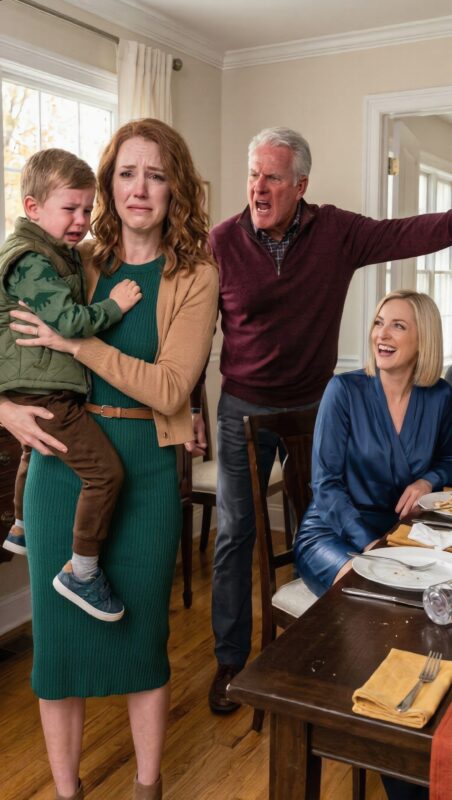
One Sunday, he finally went too far. He called Daniel poor in front of our five-year-old son and ordered us out of his house.

What Dad didn’t know was that while he had been judging our old cars and modest lifestyle, Daniel and I had quietly built something worth far more than appearances.
That Sunday, Daniel wasn’t with me at my parents’ house outside Columbus. An emergency repair had kept him at the shop, so Noah and I went to dinner alone.
We had barely begun eating when my sister Vanessa started talking about her new SUV.
“Eric surprised me yesterday,” she announced. “Can you believe it cost seventy-two thousand dollars?”
Dad looked delighted.
He raised his glass toward Vanessa and her husband.
“That’s what you get when you marry an ambitious man.”
Then he turned toward me.
His expression changed.
“Your sister chose wisely. You married someone who’ll always be poor.”
Vanessa laughed under her breath.
Mom said nothing.
I set down my fork.
“Daniel is a co-owner of Miller Automotive.”
Dad smirked.
“Half of a little repair shop? That’s hardly an accomplishment.”
I had heard similar comments before.
Usually, I ignored them.
This time, Noah was listening.
He looked up at me with genuine confusion.
“Mommy, is Daddy poor?”
That question changed everything.
My father wasn’t simply insulting Daniel anymore.
He was teaching my son that a man’s value could be calculated by the price of his car, the title on his business card, or the number in his bank account.
I looked at Noah.
“No, sweetheart. And someone’s worth should never be measured by money.”
Dad immediately became defensive.
“Don’t use my dinner table to lecture me.”
“Then don’t insult my husband in front of my child.”
Dad pointed toward the hallway.
“If you don’t like what I say in my house, leave.”
I stood.
Then he added, “And don’t come back for Thanksgiving. We’ll have a better holiday without all this drama.”
I helped Noah into his coat.
Before walking out, I turned toward my father.
“You may wish you hadn’t said that.”
He dismissed me with a wave.
He thought he understood our life.
He didn’t.
Daniel hadn’t grown up with money or connections.
He hadn’t inherited a company.
He hadn’t gone to an elite university.
He started with a toolbox, a mechanic’s uniform, and the willingness to work harder than almost anyone I knew.
Years earlier, when the owner of Miller Automotive announced his retirement, he offered Daniel and another longtime mechanic the chance to buy the shop.
Daniel came home terrified and excited.
We reviewed the numbers for weeks.
Then we invested nearly everything we had.
The early years were exhausting.
Daniel regularly worked twelve-hour shifts. After Noah fell asleep, I handled invoices, payroll, taxes, and bookkeeping from our kitchen table.
Every dollar mattered.
We kept our old vehicles.
We took inexpensive vacations or skipped them entirely.
We lived in the same modest house.
Whenever the business made extra money, we invested it back into equipment, employees, and expansion.
Dad saw our lifestyle and assumed we had nothing.
In reality, we were building ownership.
Eventually, Daniel purchased his partner’s share.
By the time Dad insulted him at Sunday dinner, Daniel wasn’t half-owner of Miller Automotive anymore.
He owned the entire company.
And that wasn’t our biggest news.
When Noah and I arrived home that evening, Daniel was waiting for us with a letter from the bank.
Our financing had been approved.
After months of negotiations, we could finally purchase a second automotive service center in Westerville.
The property included fourteen service bays, modern equipment, office space, commercial contracts, and the building itself.
Three weeks later, we closed the deal.
Then Thanksgiving approached.
Mom called several days before the holiday.
“Your father wants you to come after all.”
“Why?”
“He thinks the family should be together.”
That didn’t sound like Dad.
Then Mom reluctantly explained.
Eric had lost his corporate position.
The son-in-law Dad had praised for years was suddenly unemployed.
I understood immediately.
Dad’s definition of success had changed the moment Eric lost the title that impressed him.
“We already have plans,” I said.
And we did.
Thanksgiving at our house wasn’t elegant.
Daniel’s mother joined us, along with several employees who didn’t have family nearby.
Our dining table wasn’t large enough, so we borrowed chairs from different rooms.
Someone spilled a drink.
Noah dropped a dinner roll.
People laughed so loudly that we could barely hear the television.
It was imperfect.
And it felt wonderful.
Nobody cared what anyone drove.
Nobody asked about salaries.
Nobody had to prove they deserved a seat.
Halfway through dinner, Vanessa called.
She sounded close to tears.
“Dad won’t leave Eric alone.”
“What happened?”
“He keeps asking when he’s getting another job. He told Eric that an unemployed man has no business relaxing at Thanksgiving.”
I wasn’t surprised.
Then Vanessa became quiet.
“I owe you an apology.”
“For what?”
“For laughing at Daniel. For letting Dad treat you both like you were less successful than us.”
I let the silence sit for a moment.
Then I asked, “Where are you?”
“Still at Mom and Dad’s.”
“Come here. Bring Eric and your daughter.”
They arrived less than half an hour later.
Daniel opened the door.
Eric looked embarrassed.
Daniel didn’t ask questions.
He simply shook his hand.
“Come in. We’ve got plenty.”
We found three more chairs.
For the first time that day, Eric smiled.
Twenty minutes later, the doorbell rang again.
Mom and Dad were standing outside.
Dad looked beyond me and saw Vanessa’s family sitting around our crowded table.
“I’ve come to take everyone home.”
Daniel stepped beside me.
“They’re already home.”
Dad’s eyes narrowed.
Then came the familiar insult.
“You’re still just a mechanic.”
Daniel looked at me.
I nodded.
There was no reason to keep letting Dad believe the story he had invented about us.
“Yes,” Daniel replied. “I’m a mechanic. I’m also the owner of Miller Automotive.”
Dad scoffed.
“Co-owner.”
“Sole owner.”
Dad’s expression shifted.
Daniel explained that he had bought his partner out months earlier.
Then he told him about the Westerville property.
Fourteen bays.
Commercial clients.
New equipment.
Employees.
Real estate.
A second location we owned rather than rented.
Dad stopped talking.
For years, he had believed expensive purchases were evidence of wealth.
Daniel and I had done the opposite.
Instead of trying to look successful, we had spent years buying assets that could produce something.
Property.
Equipment.
Equity.
A business.
A future.
Then Eric stood.
“Daniel offered me a job.”
Dad stared at him.
“At an auto shop?”
“Managing commercial accounts for the new location.”
“You had a corporate career.”
Eric’s face tightened.
“I had a corporate job. Then it disappeared.”
He looked directly at Dad.
“Daniel offered me an opportunity when I needed one. You offered me humiliation.”
Dad opened his mouth.
Nobody defended him.
Not even Mom.
She stepped inside and removed her coat.
“I’m staying here for dinner.”
Dad looked stunned.
Mom’s voice remained calm.
“I’ve spent years watching you turn family gatherings into competitions. You compare our daughters, their husbands, their houses, and their incomes. Then you call it motivation.”
She shook her head.
“I’m done pretending it’s acceptable.”
Dad drove home alone.
Mom stayed for pie.
In the months that followed, the family slowly rearranged itself around healthier boundaries.
Eric accepted Daniel’s offer.
His corporate experience made him surprisingly effective at handling commercial clients, and he helped the Westerville location grow faster than we had projected.
Vanessa eventually sold the SUV.
But the bigger change wasn’t financial.
She apologized again—properly this time.
She admitted that agreeing with Dad had been her way of avoiding his criticism.
Dad needed longer.
Four months later, he appeared at our door for Noah’s birthday.
I didn’t immediately let him enter.
“If you want a relationship with Noah, there are conditions.”
Dad listened.
“No insults about Daniel. No comments about people’s income around Noah. No comparisons between families.”
“And if I forget?”
“You leave.”
He nodded.
“I understand.”
It wasn’t forgiveness.
But it was a beginning.
Several months later, Dad finally visited Miller Automotive’s Westerville location.
Daniel walked him through the building.
Dad saw the fourteen service bays filled with vehicles.
He met employees.
He saw the equipment, offices, and commercial operation.
For once, he had very little to say.
Before leaving, he stopped beside Daniel.
“I was wrong about you.”
Daniel nodded.
“Yes, you were.”
Dad seemed surprised by the answer.
Then he said, “You’ve built an impressive business.”
Daniel glanced toward me.
“We built an impressive business.”
That evening, Noah found me in the kitchen.
“Mom?”
“Yes?”
“Was Daddy ever poor?”
Daniel was sitting nearby in an old T-shirt, reviewing invoices at the table.
I smiled.
“Your dad didn’t have much money when he started.”
“So Grandpa was right?”
“No.”
I crouched beside him.
“Grandpa thought having expensive things made someone important. Your dad understood that working hard, treating people well, and building something that lasts matters more.”
Noah thought about that.
Then he ran over to Daniel and climbed into his lap.
The following Thanksgiving, everyone came to our house again.
Mom arrived early.
Vanessa brought bread.
Eric brought wine.
Daniel’s mother brought dessert.
Dad arrived last.
When I opened the door, he remained on the porch.
For the first time, he didn’t walk in as though every room automatically belonged to him.
He looked past me toward the table.
“Do you still have a seat?”
One chair remained empty.
“Yes.”
I stepped aside.
“But everyone who sits at our table gets treated with respect.”
Dad nodded.
“I know.”
That Thanksgiving was quieter than the previous one.
Nobody compared salaries.
Nobody discussed the price of anyone’s car.
Nobody ranked careers.
Nobody laughed at another person’s struggles.
We simply shared a meal.
Our family still had scars.
One dinner couldn’t erase years of resentment, and one apology couldn’t repair everything Dad had damaged.
But we had finally stopped allowing money to determine the hierarchy of our family.
Dad had spent most of his life believing success was something other people needed to see.
Daniel had taught us a different lesson.
A luxury car can disappear.
A prestigious job can end without warning.
An impressive title can be taken away.
What lasts is what you build when nobody is applauding—the work, the character, the relationships, and the way you treat people when they have nothing to offer you.
Daniel had never needed to look rich.
He had been too busy building something real.