He Gave Up His Inheritance for Four Homeless Siblings—And Built a Life His Fortune Could Never Buy
The rifle in Josefina Salgado’s hands trembled from cold, not fear.
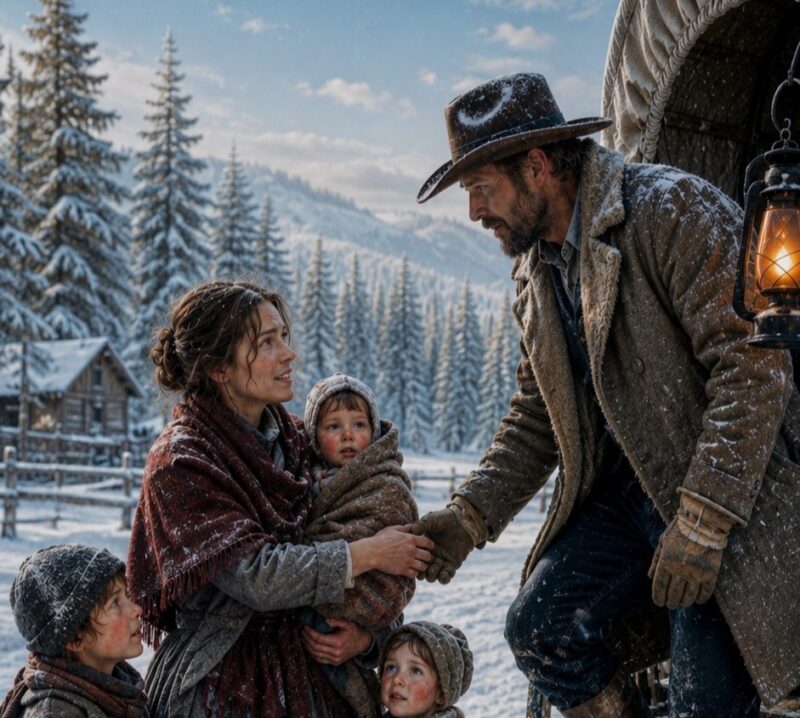
Snow swept across the road that December morning in 1887, nearly erasing the tracks behind her. Her three younger siblings stood close together at her back. Fourteen-year-old Benjamín tried to look brave. Eleven-year-old Rosa clutched their only blanket. Six-year-old Daniel could barely stand.
A lone horseman approached through the storm.
Josefina raised the weapon.
“Stop right there!”
The stranger obeyed.
“I mean you no harm,” he said. “I’m Sebastián Villalobos.”
The name struck harder than the winter wind.
Villalobos.
Only days earlier, Sebastián’s father, Don Baltasar, had taken possession of the Salgado ranch after Josefina’s father died. Josefina had buried one parent and lost her home almost at the same time.
Now she was twenty-four years old, responsible for three children and carrying everything her family still owned in a single bag.
“Turn around,” she ordered. “Your family has done enough.”
Sebastián was about to answer when he noticed Daniel.
The little boy’s face was pale, his breathing weak.
“How long has he been sick?”
Josefina said nothing.
“He needs medical attention.”
“And you expect me to trust a Villalobos?”
“No,” Sebastián replied. “But I’m asking you not to let your hatred for my father decide what happens to your brother.”
Josefina tightened her grip on the rifle.
Then Sebastián told her why he had recognized the danger so quickly.
Not long before, he had lost his wife and their unborn child.
“I know what it feels like to stand beside someone you love and realize you may not be able to save them,” he said quietly. “Please don’t make that choice because of my name.”
For several seconds, Josefina remained motionless.
Then the barrel of the rifle dropped toward the ground.
That decision saved Daniel’s life.
Sebastián took them through the storm to Dr. Mei Chen, who worked for hours to bring the boy’s fever under control.
Josefina refused to leave the doorway.
Finally, the doctor came to her.
“He’s going to recover.”
Josefina closed her eyes.
For the first time in days, she allowed herself to breathe.
But Daniel’s recovery did not give them a home.
Sebastián did.
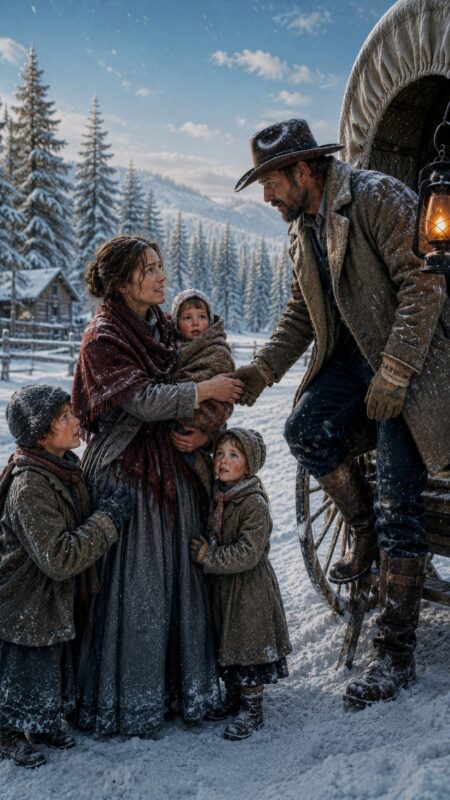
Without telling his father, he placed the Salgados in an unused cabin at the far end of the Villalobos estate.
It was small, cold, and badly neglected.
To Josefina, it felt like a palace.
“You can stay here until we find something better,” Sebastián told her.
“And when your father discovers us?”
Sebastián looked directly at her.
“Then he can deal with me.”
It took Don Baltasar only three days to become suspicious.
He confronted his son and demanded to know whom he was sheltering.
Sebastián refused to tell him.
But afterward, he understood that hiding the family was only postponing the inevitable.
If Baltasar wanted them gone, Sebastián needed something stronger than a locked door.
He needed the law.
Sebastián petitioned the court for temporary guardianship of Benjamín, Rosa, and Daniel, seeking legal protection that would make it harder for his father to separate the siblings or force them onto the road again.
Baltasar arrived at the hearing furious.
He claimed Josefina had deliberately attached herself to his grieving son in hopes of gaining access to the Villalobos fortune.
Josefina stood before the court.
“I would rather earn one peso with my own hands than beg your family for a hundred,” she said. “I want food for these children, a roof above them, and the right to live without owing you for every breath.”
Sebastián rose from his chair.
Everyone turned toward him.
“If my inheritance is the reason you believe she is here,” he said, “then remove it from the argument.”
Baltasar frowned.
“What are you saying?”
Sebastián faced the judge.
“I surrender my claim to my father’s estate.”
No one spoke.
Baltasar’s face hardened.
“If you walk out of this courtroom with them, you are no longer my son.”
Sebastián did not hesitate.
“Then I suppose you have made your decision too.”
That afternoon, the richest heir in the district walked away with almost nothing.
The court granted temporary protection to the Salgado family but required them to demonstrate within six months that they could provide a stable home.
So they worked.
Sebastián, who had grown up surrounded by servants, became a hired laborer.
Benjamín worked with cattle. Josefina earned money sewing and mending clothes, while Rosa helped with smaller jobs. Daniel regained his strength little by little.
They recorded every coin.
They wasted nothing.
And for the first time since losing their ranch, the Salgados began believing that their future might belong to them again.
Baltasar had other plans.
He supported a new measure that would make it easier to remove indebted households from contested land when no adult man legally headed the family.
The Salgados were obvious targets.
But they were not the only ones.
Widows, abandoned families, and struggling mothers throughout the district could also lose their homes.
At the meeting where the proposal was debated, Rosa walked into the crowded room carrying an old journal.
It had belonged to her father.
For months, nobody had understood why he had hidden it.
Now they did.
Its pages contained dates, payments, property valuations, names of officials, and records involving seventeen families whose land had eventually passed into Baltasar’s control.
Josefina began reading.
The room grew quiet.
The records indicated that officials had been bribed, debts had been manipulated, and properties had been deliberately undervalued before being seized.
Then an elderly farmer rose from the crowd.
“What she is reading happened to me.”
A widow stood next.
“And to my husband.”
Another voice followed.
Then another.
Fear had protected Baltasar’s reputation for years.
That afternoon, fear finally lost its power.
The proposed evictions were suspended, and an investigation was ordered into Baltasar’s land dealings.
Outside the meeting hall, Baltasar confronted Sebastián.
“Look at what you’ve done,” he said bitterly. “You threw away your family for people who share none of your blood.”
Sebastián glanced toward Josefina and the children.
“You taught me that blood was something people could use to demand obedience,” he replied. “They taught me that family is something you earn by showing up.”
Baltasar had no answer.
The six-month deadline approached quickly.
By working almost every day, the family managed to save 530 pesos.
It was enough to purchase sixteen hectares near the Conchos River.
The land was far from perfect.
That was precisely why they could afford it.
They built their future anyway.
Corn appeared first, followed by beans and squash. Sebastián and Benjamín carved irrigation channels through stubborn earth. Josefina transformed the little house into a home. Rosa kept careful records of everything they planted, bought, and sold.
Sebastián never described himself as the man who had saved them.
By then, Josefina understood why.
They had saved him too.
One evening, after the summer heat had faded, Sebastián sat beside her overlooking the fields.
“When I first brought Daniel to the doctor, I thought helping your family might quiet something inside me,” he admitted. “I was still trying to survive what happened to my wife and child.”
Josefina listened without interrupting.
“But somewhere along the way, this stopped being about what I had lost.”
He looked toward the house, where her siblings were laughing.
“I realized I was looking at what I could still build.”
Then he asked her whether there might someday be room for him in her future.
There was no pressure.
No debt to repay.
No reminder of what he had sacrificed.
Josefina gave him the only answer she could give honestly.
“Maybe one day.”
She smiled.
“But if that day comes, Sebastián, it will be because I choose you—not because I owe you.”
“That is the only answer I would accept.”
A year later, Josefina chose him.
Their wedding took place outside the modest house near the river.
There were no marble halls or expensive decorations.
Yet Sebastián had never felt richer.
Baltasar attended as well.
He did not ask to be forgiven.
Instead, he acknowledged what years of pride had cost him.
“I spent my life collecting land,” he told Sebastián. “You built something I never learned how to build.”
“What?”
“A home people actually want to return to.”
Reconciliation took years.
Apologies were not enough. Baltasar had to return property where possible, compensate families he had harmed, and prove through his actions that he had changed.
Only then did the distance between father and son slowly begin to narrow.
The small farm beside the Conchos River grew with the years.
So did its purpose.
Travelers without shelter were given beds. Displaced families found temporary refuge there. Children without parents found adults willing to protect them.
Benjamín eventually took responsibility for managing the farm.
Rosa devoted herself to recording the histories of families whose property had been unjustly taken.
Daniel—the feverish six-year-old who had once seemed unlikely to survive a winter night—grew up and became a teacher.
Josefina never forgot how it had all begun.
Whenever the first snow arrived, she remembered the empty road, her freezing hands, and the stranger approaching on horseback.
She had pointed a rifle at Sebastián Villalobos because his surname represented everything her family had lost.
She did not know then whether he deserved her trust.
So she gave him something smaller.
A chance.
Sebastián spent the rest of his life proving what he would do with it.
He could have returned to comfort.
He could have chosen his inheritance.
He could have walked away when staying became difficult.
Instead, he remained.
And perhaps that was the lesson their strange family eventually understood best:
Blood can give you relatives.
Money can give you security.
A name can give you status.
But sometimes a true family begins with something much simpler—
someone who has every opportunity to leave, yet chooses to stay.