He Promised a Fortune—The Boy Asked for a Meal… and It Changed Everything
Victor Hale prided himself on control. Timing, precision, results—nothing in his world was left to chance.

But that morning, everything slipped.
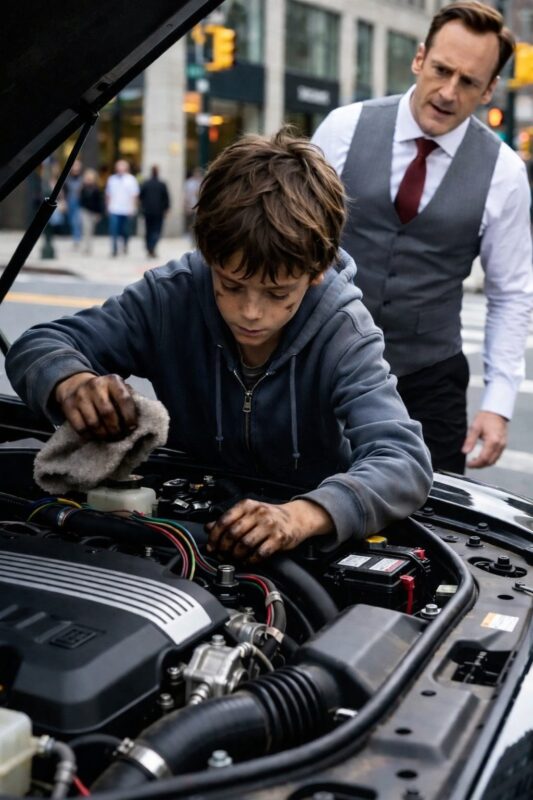
He stood on a busy downtown street beside his silent luxury sedan, irritation tightening his jaw as he checked his watch yet again. Forty minutes until the most crucial investor meeting of his career—and his car wouldn’t even start.
“Unbelievable,” he muttered, turning the key once more. Still nothing.
He shut the door with force. A passing courier glanced over, then quickly looked away after catching Victor’s expression.
No answer from his assistant. The towing service needed nearly an hour. For a man who solved problems with a swipe of his card, this situation felt like a direct insult.
“I can fix it.”
Victor turned slowly.
A thin boy stood nearby, no older than fourteen. His clothes hung loosely, worn and patched. His shoes were barely holding together. Yet his eyes were steady—sharp, observant.
“I can repair your car,” the boy said again. “But I need something to eat.”
Victor frowned. “You’re asking me to feed you?”
“Yes.”
Victor let out a quiet breath. “This isn’t the moment.”
“I know what’s wrong with it,” the boy continued, gesturing toward the hood. “Sounds like the battery connection. Maybe corrosion.”
Victor raised an eyebrow. “You figured that out from over there?”
“I heard it.”
There was a pause. Victor glanced at his watch, then back at the boy.
“Alright,” he said finally. “Fix it, and I’ll feed you. I might even hand you a million dollars.”
His tone carried irony.
The boy didn’t react. “Open the hood.”
His name was Eli Turner.
He hadn’t learned engines from books, but from experience—hours spent in his father’s small garage, listening carefully to every explanation.
“Machines speak,” his father used to say. “You just have to pay attention.”
Tom Turner had been known as a man people trusted. Skilled, fair, dependable. Until one winter morning, his heart gave out without warning.
Eli was eleven.
His mother, Rachel, fought to hold their lives together. But illness came, and with it, mounting debt. Soon, they lost their home. Shelters were full.
For nearly a week, Eli had been sleeping near a transit station.
Food had become uncertain.
Now, standing over Victor’s car, Eli worked with quiet certainty.
It didn’t take long. A loose terminal. Corrosion cutting the connection.
“Do you have tools?” he asked.
Victor pointed to the trunk.
Within minutes, Eli cleaned the contact, tightened it, and secured everything back in place.
“Try it now.”
Victor turned the key.
The engine came to life instantly—smooth, effortless.
For a moment, Victor said nothing.
Then he stepped out, studying the boy.
“How old are you?”
“Fourteen.”
“And you learned this from your father?”
A nod.
Victor pulled out several bills and held them out.
Eli didn’t move.
“You promised food.”
They sat in a modest restaurant.
Eli ordered a simple burger—nothing more.
Victor watched as he ate, slowly but with focus.
“Your mother?” Victor asked.
“She’s in the hospital,” Eli replied, placing a worn bracelet on the table.
Victor’s gaze lingered on it.
Something shifted inside him.
One call became several.
By evening, Rachel had access to proper care—real treatment, real hope.
Later, Victor said, “I can give you anything.”
Eli shook his head.
“I don’t need money.”
“Then what do you need?”
Eli looked at him steadily.
“Honesty.”
That night, Victor faced something he had avoided for years.
He hadn’t simply succeeded in life.
He had benefited from a system that left others behind.
Time passed.
Rachel recovered. Eli returned to school.
And Victor began to change.
Six months later, he found himself back in his father’s old workshop, hands dirty, tools in place—remembering who he used to be.
Two months after that, he launched something new.
A program offering housing, education, and skilled training—a path forward for children like Eli.
He named it:
The Turner Initiative.
Because sometimes…
Fixing a machine is the smallest part of what truly gets repaired.