He Took a Wife to Win a Bet—She Made His Ruined Hacienda Worth a Fortune
The bell at Hacienda El Manantial had not sounded so loudly in years.
On a dry morning in 1893, its three heavy chimes drew laborers from the fields, women from nearby houses, and curious villagers through the gates.
They had been told there was something worth seeing.
Magdalena Reyes soon discovered that something was her.
She crossed the courtyard with a cloth bundle containing her few possessions and two chickens she hoped would help her start a new life.
People began snickering as she passed.
On the veranda stood Evaristo Luján, her husband of less than twenty-four hours.
He wasn’t laughing anymore.
Magdalena stopped when she heard the truth.
The previous day, Evaristo had been drinking with Don Severo Cárdenas when the wealthy landowner proposed a cruel game. Evaristo was to marry the first unmarried woman who appeared at El Manantial seeking employment.
Magdalena had arrived before sunset.
She thought she had found a husband willing to offer her security.
Instead, she had unknowingly become the prize in a drunken wager.
The courtyard erupted in laughter.
Magdalena placed her bundle on the ground.
Then she looked at Evaristo.
“Enjoy their laughter while you can,” she said quietly. “There may come a day when everything you have depends on the woman you chose to humiliate.”
The laughter continued.
Magdalena simply turned away.
It didn’t take her long to understand that Evaristo had little worth envying.
El Manantial was dying.
Sections of fencing had collapsed. The sheep were thin and neglected. Water dripped through holes in the barn roof whenever it rained, and the estate’s old well was nearly useless.
The hacienda was also buried beneath a debt owed to Don Severo.
If Evaristo failed to pay, El Manantial would become his.
That afternoon, Magdalena noticed a ewe dragging one leg.
She knelt beside the animal.
“Who takes care of the flock?”

Several ranch hands exchanged amused glances.
“We do.”
“Then why has no one treated this?”
One man laughed.
“Treated what?”
Magdalena pointed to the swollen leg.
“The infection.”
They stopped smiling when she correctly identified similar problems in several other animals.
“Heat water,” she ordered. “Bring clean cloths, salt, and alcohol.”
The men ignored her.
An elderly ranch hand named Jacobo did not.
He brought everything she requested.
As Magdalena worked, Jacobo finally asked, “Where did you learn this?”
“From my grandmother. She raised sheep in Durango. By the time I was old enough to read, I already knew how to shear one.”
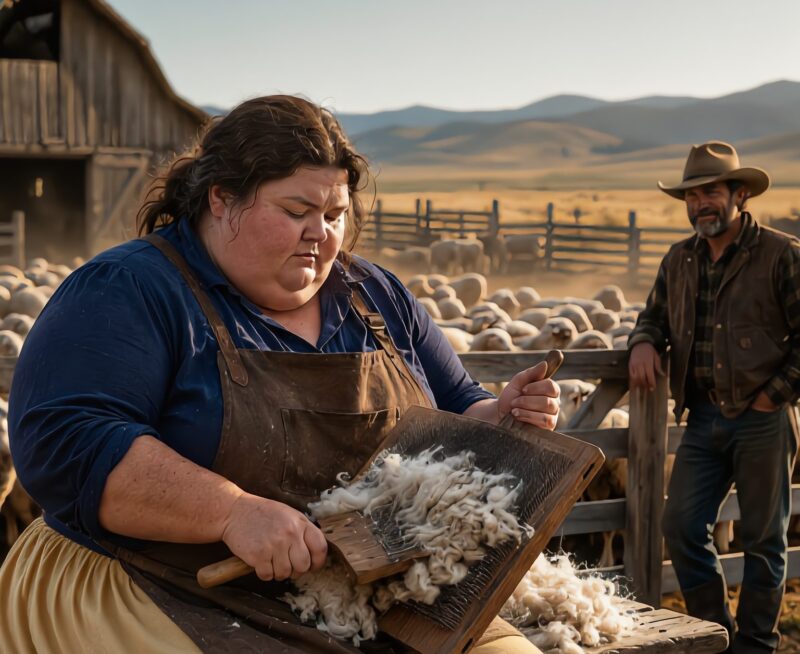
That night, Magdalena noticed piles of dirty wool that had been discarded as worthless.
She carried some inside.
For hours, she cleaned, separated, and carded the fibers beneath an oil lamp.
By midnight, a soft bundle of usable wool lay on the table.
Jacobo touched it in disbelief.
“We’ve been throwing this away for years.”
“Then you’ve been throwing away money.”
That sentence changed El Manantial.
Magdalena began with the flock.
Sick animals were treated. Pens were cleaned regularly. Feeding practices improved, and usable wool was no longer discarded.
Then she turned her attention to what could be made from it.
A local seamstress named Remedios came to see her.
Remedios knew how to turn ordinary material into beautiful clothing, but few people had ever taken her talent seriously.
Magdalena did.
The two women began working together.
Their first pieces were simple blankets and shawls.
A merchant passing through the region bought three.
Several weeks later, he returned.
This time, he wanted twenty.
Magdalena needed more hands.
Women from neighboring families began arriving at El Manantial. Some were widows. Others had husbands whose wages barely fed their children. A few had skills nobody had ever considered valuable.
Magdalena gave them work.
More importantly, she paid them fairly.
The abandoned barn became a workshop filled with looms, wool, conversation, and activity.
And slowly, money returned to El Manantial.
Evaristo watched the transformation with increasing discomfort.
The woman he had brought home as a joke was saving everything his family had spent generations building.
One morning, Magdalena saw him repairing a fence.
A few days later, he was helping Jacobo clear the well.
Then he began working beside the ranch hands instead of ordering them around.
Eventually, Evaristo found the courage to speak to her.
“What I did to you was shameful.”
Magdalena continued sorting wool.
“I know.”
“I wish I could take that day back.”
She finally looked at him.
“You can’t.”
Evaristo swallowed.
“Then what can I do?”
“Make sure the man who laughed at me that morning isn’t the man standing here a year from now.”
It wasn’t forgiveness.
But it was a path toward it.
Don Severo noticed El Manantial’s recovery too.
And he hated it.
For years, he had expected the hacienda to collapse under its debts. Once it did, he intended to take possession of the property.
The reason was simple.
A permanent stream crossed El Manantial’s land.
In a region where water could determine whether a ranch prospered or disappeared, the stream was worth more than the buildings surrounding it.
Magdalena had disrupted his plans.
Rumors soon appeared in neighboring towns claiming that El Manantial used diseased wool.
Then cheap imitations of Magdalena’s products appeared in markets under her name.
Neither scheme worked.
So Don Severo delivered an ultimatum.
Thirty days.
That was how long Evaristo had to repay everything Don Severo claimed he owed.
Magdalena spent nights studying old contracts, receipts, and property records.
One name kept appearing.
Ignacio Luján.
Evaristo’s older brother.
“What happened to him?”
Evaristo’s expression hardened.
“We haven’t spoken in years.”
“Why?”
“Pride.”
Magdalena placed the document before him.
“Then pride is about to cost you half this ranch. Ignacio still owns it.”
They found him several days beyond the mountains, earning his living as a blacksmith.
When Evaristo entered the forge, neither brother spoke for a long moment.
Magdalena expected an argument.
Instead, Evaristo said, “I was wrong.”
Ignacio stared at him.
“I didn’t come to ask you to surrender your inheritance,” Evaristo continued. “I came because I should have said those words years ago.”
Something changed in Ignacio’s expression.
He agreed to return.
But as they approached El Manantial days later, they saw an orange glow against the night sky.
Magdalena’s workshop was on fire.
Everyone ran.
Workers passed buckets from the well while flames tore through the roof.
Jacobo was still inside.
Evaristo and Ignacio went after him and brought the old man out before part of the structure collapsed.
By morning, the workshop was a blackened shell.
Finished orders were gone.
Tools had been destroyed.
Months of labor had vanished overnight.
Magdalena stood among the ruins without speaking.
Then Ignacio found something near the rear of the building.
Evidence suggested the fire had not been accidental.
The trail pointed toward men connected to Don Severo.
But Ignacio possessed something even more dangerous to him.
From among his belongings, he produced a document he had protected for seventeen years.
It was a receipt bearing their father’s signature.
The debt Don Severo claimed was destroying El Manantial had already been settled long ago.
The truth unraveled quickly after that.
Payments had been concealed.
Interest had been invented.
Records had been altered.
Don Severo had constructed a false debt and used it as a weapon to take property that did not belong to him.
Once the evidence became public, his scheme collapsed.
His claim against El Manantial disappeared, and property obtained through his fraudulent dealings was taken from him.
For the first time in years, the Luján family owned their land without Don Severo’s shadow hanging over it.
Magdalena faced another choice.
She could leave.
She had already proven everyone wrong.
Instead, she looked at the burned workshop and decided to build again.
This time, they built bigger.
Customers sent money in advance for future orders. Merchants who trusted Magdalena placed new contracts. Women from surrounding communities arrived asking for work.
Before long, the name **Tejidos El Manantial** could be found in markets from Zacatecas to Durango and Guadalajara.
What had begun with discarded wool became a prosperous enterprise supporting dozens of households.
Magdalena became a legal owner of the hacienda she had once entered with almost nothing.
Years passed.
One evening, she found Evaristo waiting beneath the veranda where the village had once gathered to mock her.
He lowered himself onto one knee.
Magdalena raised an eyebrow.
“What are you doing?”
“Trying to correct something I can never undo.”
He looked up at her.
“The first time I married you, you weren’t given a choice. So I’m asking now.”
He took her hand.
“Magdalena Reyes, will you choose me this time?”
She remained silent for several seconds.
“I don’t need another ceremony to show those people that I won.”
“This isn’t about winning,” Evaristo replied. “And it isn’t about them.”
“Then what is it about?”
“Giving you the choice I should have given you from the beginning.”
Magdalena looked at the ranch surrounding them.
The broken fences were gone.
The well was full.
Healthy sheep grazed beyond the courtyard, and light spilled from the windows of the rebuilt workshop.
Then she looked back at the man who had once laughed at her—and who had spent years becoming someone different.
This time, Magdalena made the decision herself.
“Yes.”
Many years later, a plaque was placed beside the entrance to El Manantial.
Its message was simple:
**“Worth is not determined by what a person arrives with, but by what they create without destroying the dignity of others.”**
Magdalena had arrived carrying a bundle of clothes and two chickens.
To the villagers, that had looked like poverty.
What they couldn’t see was everything she carried within her.
Knowledge.
Discipline.
Courage.
And the ability to recognize value where everyone else saw waste.
She transformed discarded wool into a business.
She transformed a failing hacienda into a prosperous estate.
She transformed opportunity into livelihoods for families who had once been overlooked.
But there was one thing Magdalena refused to do.
She never allowed Evaristo to believe that saying “I’m sorry” had erased what happened.
Because second chances are not purchased with words.
They are earned through what comes next—
one decision, one act of respect, and one day at a time.