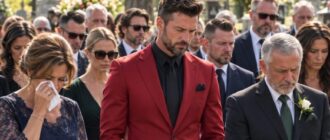
My Husband’s Funeral Hadn’t Even Ended When My Mother-in-Law Tried To Erase Me—Then His Final Video Played, and Her Entire World Fell Apart
PART 1

“Take your things and leave. You never belonged in this family.”
The cruel command sliced through the silence inside the Church of San Agustín before the priest had even completed the final blessing over my husband’s coffin.
I stood frozen beside Julián Mendoza’s casket, one hand trembling against my swollen eight-month belly while the other held the silver rosary he’d placed in my palm on the day we married. Only four days had passed since the accident near Valle de Bravo. Four unbearable days since a police officer appeared at our home in Las Lomas and quietly informed me that Julián’s vehicle had crashed into a ravine.
Since that moment, nothing around me had felt real.
To the public, Julián was untouchable—a brilliant entrepreneur whose technology empire stretched across Mexico. His interviews filled business magazines. Investors chased his approval. Hospitals and banks competed for contracts with his company.
But behind closed doors, he was simply my husband.
The man who wandered barefoot into the kitchen late at night searching for pastries. The man who rested his head against my stomach and spoke to our unborn son as though the baby were already listening.
And now I was standing beside his coffin while his family watched me like a stranger trespassing at a private event.
Doña Teresa had hated me from the beginning.
To her, I was nothing more than “the schoolteacher from Iztapalapa” who had somehow climbed above her station. Her daughter Fernanda followed the same pattern. Every family dinner became an elegant form of humiliation. My clothes were “too modest.” My voice sounded “too provincial.” They openly joked that they hoped my child would inherit “real Mendoza features.”
But while Julián was alive, their cruelty remained hidden beneath fake smiles.
Now that he was gone, they no longer bothered pretending.
Doña Teresa approached me slowly, holding a mustard-colored envelope between perfectly manicured fingers. The sharp rhythm of her heels echoed across the marble floor until the entire church fell silent.
“It’s time everyone discovered the truth,” she announced.
She pulled several documents from the envelope and raised them for the mourners to see.
“A DNA report,” she declared coldly. “The child she’s carrying is not my son’s.”
A wave of whispers swept through the church instantly.
Executives. Politicians. Family friends. Reporters near the back. Every face turned toward me with sudden suspicion.
My throat tightened.
“That’s impossible,” I whispered.
Doña Teresa’s lips curved into a satisfied smile.
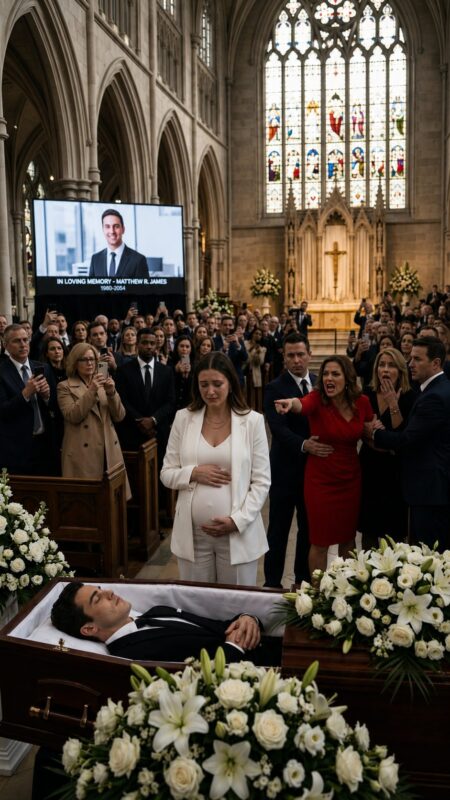
“My son may have loved blindly, but he wasn’t stupid. We knew exactly what you were from the beginning—a woman desperate to secure wealth with another man’s child.”
Before I could respond, Fernanda grabbed my wrist.
Her nails cut into my skin as she yanked my left hand upward.
“And this belongs to the Mendoza family too.”
She ripped the wedding ring from my finger with such force that pain shot through my hand. The ring dropped into her palm, and she held it up like a trophy.
“Look carefully,” Fernanda said mockingly. “A penniless widow carrying a child with no real father.”
The humiliation burned hotter than grief.
My knees nearly gave out beneath me.
Inside my womb, my son moved suddenly, as if he could sense every poisonous word spoken around us.
Then Doña Teresa placed the fake DNA papers directly on top of Julián’s coffin.
“You’ll be removed from the house today,” she said quietly. “The accounts have already been frozen. The cars, the properties, the company shares—everything returns to the rightful family.”
Rightful family.
I stared at the coffin, struggling to breathe.
Then Julián’s final words replayed inside my head.
“Whatever happens,” he had told me before leaving that morning, “trust Arturo. I already prepared for this.”
Arturo Salcedo.
His attorney.
But Arturo had not appeared at the funeral.
Doña Teresa lifted one hand toward the security guards stationed near the entrance.
“Get her out of here,” she ordered. “I’m tired of this performance.”
The guards moved toward me—
—and suddenly the massive church doors exploded open.
The sound echoed through the sanctuary like thunder.
Every conversation stopped instantly.

A tall man in a charcoal-gray suit walked down the aisle with calm, deliberate steps.
Arturo Salcedo.
Two assistants followed behind him carrying black cases and a portable projection screen.
His expression was cold enough to silence the room before he even spoke.
“Under the direct orders of Mr. Julián Mendoza,” Arturo announced, “the funeral proceedings are suspended until this video recording is played in full.”
Doña Teresa smiled faintly, convinced the message would honor her son.
Then the screen flickered on.
Julián’s face appeared.
And the moment he spoke his first sentence, my mother-in-law’s expression collapsed completely.
The blood drained from her face.
For the first time since the funeral began—
Doña Teresa looked terrified.
PART 2
Julián appeared seated behind the desk in his private office.
This was not the kind of farewell message families usually played at funerals.
There was no music.
No childhood photos.
No emotional montage.
Only Julián, staring directly into the camera with exhausted eyes and a face marked by sleepless nights. He wore the same navy-blue shirt he’d worn two days before the crash.
“If this recording is being shown,” he began calmly, “then I did not survive long enough to attend my own funeral.”
The church fell into a suffocating silence.
My hand covered my mouth instantly.
Hearing his voice again felt like reopening a wound that had never stopped bleeding.
Julián inhaled slowly.
“First, I need to speak to my wife.”
For the first time, his expression softened.

“Mariana… forgive me for hiding this from you. I never wanted you to live in fear. But weeks ago, I realized something was very wrong.”
Nobody moved.
Even the priest stood motionless beside the altar.
Julián leaned slightly closer to the camera.
And then he spoke the sentence that changed everything.
“If anything happens to me… it was not an accident.”
Doña Teresa’s jaw tightened, and the last trace of confidence vanished from Fernanda’s face.
“That child is my son,” Julián said with unwavering certainty. “I ordered three independent DNA tests from licensed laboratories. Every result was notarized and legally registered.”
The giant screen illuminated with official documents — signatures, stamps, dates, and legal certifications.
The paper Doña Teresa had dramatically thrown onto the coffin was instantly revealed as nothing more than a forgery.
A restless wave of whispers rolled through the church.
Doña Teresa lifted her voice in desperation.
“Those records could have been falsified! This is all fabricated!”
Arturo stood motionless.
“The message is not over.”
Julián fixed his eyes on the camera, his expression harder than before.
“My son will inherit my surname, my company shares, and every asset I built with my own hands. Everything has already been transferred into an irrevocable trust under Mariana’s and the baby’s names. No one will be able to touch it. Not my mother. Not my sister. Not any attorney or business partner they tried to influence.”
Fernanda released my wedding ring as though it had scorched her fingers. The ring struck the marble floor with a tiny metallic sound, but inside the suffocating silence of the church, it echoed like an explosion.
I wanted to bend down and retrieve it, but my body refused to obey me.
Then Julián spoke again, and the atmosphere inside the church shifted completely.
“But inheritance is not why I recorded this.”
The footage changed.
Wire transfers appeared across the screen. Printed conversations. Secret photographs taken inside a casino in Monterrey. Contracts signed with counterfeit signatures.
“Mother. Fernanda. For two years, you stole funds from the foundation I created for children fighting cancer. Thirty-eight million pesos disappeared into gambling losses, luxury vacations, expensive jewelry, and political bribes.”
The church erupted into stunned murmurs. One woman covered her mouth while crossing herself. A businessman hurriedly reached for his phone. Somewhere in the crowd, someone muttered,
“This is horrifying.”
Doña Teresa stumbled backward.
“That is a lie! My son had psychological problems!”
But Julián’s tone never changed.
“No, Mother. I was never the unstable one. I was simply blind to how far you were willing to go.”
An icy chill spread through my body.
Arturo raised one hand, and one of the men beside him silently locked the church doors.
Doña Teresa noticed immediately.
“Why are they locking the exits? What is happening here?”
Nobody answered.
The screen switched once more.
This time, security footage from the garage of our home in Las Lomas appeared. The timestamp showed it had been recorded three nights before the crash.
The black-and-white recording was grainy but unmistakable.
A woman wearing gloves and a dark coat entered the garage carrying a large bag. Without hesitation, she approached Julián’s vehicle.
My pulse began hammering violently.
The woman crouched beside the car.
Fernanda suddenly covered her mouth as tears filled her eyes.
“No…” she whispered shakily.
Doña Teresa turned toward her sharply.
“Be quiet!”
But it no longer mattered.
The woman unknowingly lifted her face toward a hidden camera.
It was Doña Teresa.
Julián reappeared on the screen.
“I ordered an inspection after finding fluid beneath the brake pedal. At first, I believed it was a mechanical failure. Then I discovered someone had tampered with the braking system. That same night, I installed additional surveillance cameras.”
The world around me seemed to collapse.
My husband had never died by chance.
In the video, Julián paused before speaking again.
“If I die, it will not be because of the road. It will be because someone decided my life was worth less than money.”
Doña Teresa screamed hysterically.
“Turn that off right now!”
But Arturo raised his hand firmly.
“There is still one final recording.”
The screen brightened again, and Julián delivered the sentence that forced even the priest to lower his gaze.
“Now everyone will hear the phone call in which my own mother ordered my murder.”
PART 3
The recording began with the faint metallic sound of a phone being placed on a table.
Then Doña Teresa’s voice echoed throughout the church.
“It has to look accidental. No mistakes. My son changed his will, and that woman cannot keep what belongs to our family.”
The church fell into absolute silence.
A man’s voice answered moments later.
“If it happens on the highway, nobody will investigate deeply. But the price will be higher.”
Doña Teresa replied immediately, without hesitation.
“Pay whatever they ask. Once Julián is gone, everything comes back to me.”
My knees nearly buckled beneath me. Arturo caught me before I hit the floor.
Part of me wanted to scream in agony.
Another part wanted to run to Julián’s coffin and beg forgiveness for never realizing how terrified he had been.
Doña Teresa shook her head wildly.
“That is not my voice! The recording was altered!”
At that exact moment, the two men standing beside Arturo revealed official badges.
“Teresa Robles de Mendoza,” one of them announced coldly, “you are under arrest for aggravated homicide, fraud, criminal conspiracy, and embezzlement.”
The sharp click of the handcuffs echoed through the church with brutal finality.
Fernanda collapsed to her knees, sobbing uncontrollably.
“My mother pressured me!” she cried. “I only signed documents. I didn’t know she planned to kill Julián!”
Doña Teresa glared at her daughter with venomous hatred.
“Pathetic,” she spat. “You were always weak.”
That final sentence broke whatever remained of the image she had spent years carefully constructing. The woman who had once labeled me a gold digger, an intruder, and a disgrace to her family stood there now as officers led her away in handcuffs, right in front of the very people she had always tried to impress.
As she passed, she couldn’t resist one last spiteful remark.
“That child will never get a single cent. Do you hear me? Not a penny!”
I exhaled slowly, bent down with care, and picked up my wedding ring from the stone floor of the church. Sliding it back onto my injured finger burned sharply, but I held steady.
“My son will grow up knowing his father’s love,” I said quietly. “And he will also know the truth about his grandmother.”
For the first time, Doña Teresa had nothing to say.
Months later, on a stormy morning in Mexico City, my son was born. I named him Julián, after his father. When they placed him in my arms, I broke down in tears unlike anything I had ever experienced—even at the funeral. It wasn’t just sorrow.
It was release.
It was the anger finally draining out of me.
It was the deep certainty that my husband’s love had not ended with his death.
Eventually, Doña Teresa was found guilty. Fernanda testified against her in exchange for a reduced sentence, but she lost everything—her wealth, her influence, her connections, and the family name she once used as a weapon. The same society that once welcomed her turned its back without hesitation.
I didn’t stay with the company out of ambition or desire for power. I stayed because Julián had built it with intention. With Arturo’s help, I helped clean the finances, restore the foundation’s funds, and launch a program for children in public hospitals. Every decision, every signature, carried one quiet promise: their greed would never decide how this story ended.
Five years later, I brought my son to his father’s grave. He held my hand tightly, carrying a small bouquet of white flowers.
“Was Dad brave?” he asked.
I looked at the stone and smiled through tears.
“Yes,” I said softly. “Very brave. But more importantly, he loved you deeply.”
My son placed the flowers down and rested his palm against the marble.
“Thank you for protecting us, Dad,” he whispered.
A light wind moved through the trees, almost like a response.
And in that moment, I understood something no inheritance could ever replace: some people destroy for gain, but certain kinds of love continue protecting long after everything else is gone.
And if life taught me anything, it was this—never mistake a pregnant woman standing alone for weakness, because sometimes her silence holds the kind of truth that can dismantle an entire family.