I almost gave my life to save my ten-year-old sister from a house consumed by flames. Nineteen years later, I rolled into her wedding in a wheelchair, only to hear her quietly say, “Could you please sit in the back? You’re ruining the photos.” Within moments, the groom’s mother revealed a secret that brought the entire ceremony to an abrupt stop.
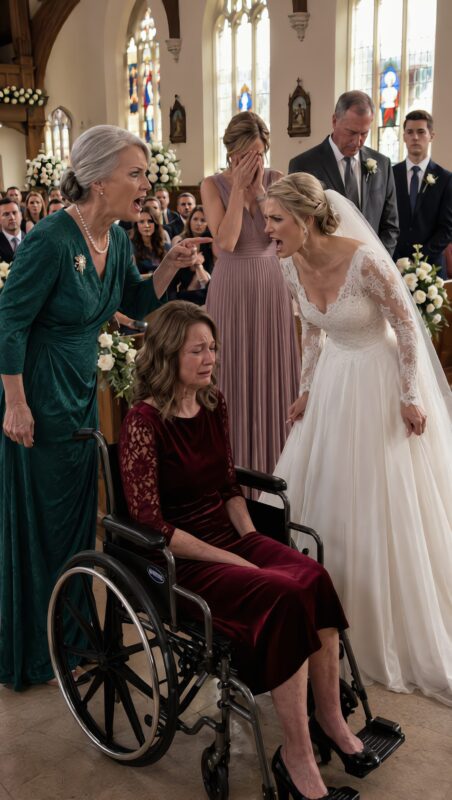
The historic chapel in Charleston glowed beneath rows of candles and overflowing white roses. I sat quietly in the second pew, my wheelchair tucked beside me. Long lace sleeves covered the scars that stretched across my arms, while soft gloves concealed my injured hands. The scars on my face and neck, however, had never been something I could hide. Guests glanced in my direction before quickly pretending they hadn’t.
At twenty-nine, I no longer cared about strangers staring.
What hurt was seeing that same look in the eyes of the sister I had once carried out of a burning house.
Emily had been only ten when the fire trapped her upstairs. While neighbors watched in horror, I ran back through the smoke without thinking twice. Shielding her with my own body, I carried her through collapsing beams and walls of fire. She escaped with nothing more than a small scar. I spent months in hospitals, surviving burns that covered most of my body.
As Emily approached the altar in her elegant wedding gown, she leaned toward me without losing her smile for the photographer.
“Please move to the back,” she whispered. “I don’t want you in the wedding pictures.”
For a moment, I couldn’t breathe.
My parents had heard every word.
My mother busied herself with the floral arrangements. My father kept his eyes fixed ahead, pretending nothing had happened.
I lowered my gaze and reached for my wheelchair, prepared—as always—to quietly remove myself.
Then someone stood.
Margaret Callahan, the groom’s mother, stepped into the aisle.
“She saved your life, Emily.”
Her voice wasn’t loud, but it carried through the chapel with remarkable clarity.
Every conversation fell silent.
Margaret explained that nearly two decades earlier she had worked as an emergency room nurse. She still remembered the teenage girl who had arrived with devastating burns over nearly her entire body. Before surgeons rushed her into the operating room, that frightened seventeen-year-old had asked only one thing.
“Is my sister alive?”
Daniel slowly turned toward his bride.
“Emily… is that true?”
Emily tried to laugh it off, insisting everyone had misunderstood. The silence that followed made it clear no one believed her.
Daniel then looked at me.
“Did she really ask you to hide?”
For years, I had protected my family by saying nothing.
This time, I didn’t.
“Yes.”
One word was enough.
Emily burst into tears. Between sobs, she admitted she had spent years feeling invisible beside my story. Everywhere we went, people praised my bravery, while she felt remembered only as the little girl who had been rescued. Eventually, admiration became something she resented.
Daniel stared at her in disbelief.
“You always said your sister avoided attention,” he said quietly. “You never admitted you were embarrassed to be seen with her.”
Only then did my father rise.
Instead of defending me, he called it “a private family disagreement” and suggested everyone move on.
Something inside me finally refused.
“I wasn’t a burden when I ran into that fire,” I said calmly. “I wasn’t a burden through endless surgeries, painful skin grafts, and years of recovery. I only became one when I hoped my own family would love me without shame.”
The chapel remained silent.
I confessed that I had worn gloves because Emily once told me my scarred hands made photographs look unsettling. I had chosen my dress in her wedding colors, smiled through every insult, and asked for nothing except the chance to celebrate one of the happiest days of her life.
Even that had been too much.
Without another word, Daniel removed the boutonniere from his lapel.
“I can’t build a future with someone who mistakes gratitude for humiliation,” he said.
The wedding ended before the vows ever began.
As I made my way out of the chapel, the guests stepped aside. Their expressions had changed. The pity I had grown used to was gone, replaced by quiet admiration.
Outside, Margaret gently squeezed my shoulder.
“Today, everyone finally saw what courage really looks like.”
A few months later, the wedding was officially canceled. Emily sought professional help and, over time, apologized—not only for what she had said that day, but for years of bitterness she had hidden behind silence. I accepted her apology, though forgiveness didn’t erase every wound.
Instead of hiding, I started living.
The gloves disappeared. So did my fear of being seen. I began speaking with burn survivors, nursing students, and families, sharing what recovery truly means—not just physically, but emotionally.
The fire forever changed my appearance.
My family’s silence nearly changed who I believed I was.
But the day a single sentence stopped a wedding was the day I finally reclaimed my dignity, my voice, and my future.