My 22-Year-Old Daughter Married a 56-Year-Old Man — I Thought She Chose Money Until I Learned What Really Happened
The photograph arrived on a Tuesday evening.

My twenty-two-year-old daughter, Chloe, was standing beside a silver-haired man in a tailored coat. He looked calm, wealthy, and old enough to be her father.
Before I even knew his name, I had already judged her.
My name is Elena, and I raised Chloe alone.
For most of her childhood, money was something we stretched, counted, and worried about. I cleaned houses before sunrise, picked up extra shifts whenever I could, bought secondhand clothes, and learned how to make one bag of groceries last longer than it should have.
I did all of it for one reason.
I wanted Chloe to have choices.
So when she was accepted into a nursing program in London, I emptied nearly everything I had saved to help her go.
At first, she called every night.
She told me about lectures, hospital placements, the rain, the crowded buses, and how strange it felt to be so far from home.
Then something changed.
Her calls became shorter.
Sometimes she sounded distracted.
Sometimes she did not call at all.
A few months later, she told me she was coming home.
Then came the photograph.
Before I could decide what to think, my phone rang.
“Mom,” she said, “please hear me out before you get angry.”
My heart started pounding.
“What happened?”
A long silence followed.
Then she said, “I got married.”
I looked again at the man beside her.
“To him?”
“Yes.”
“What’s his name?”
“Arthur.”
“How old is he?”
She hesitated.
“Fifty-six.”
I reacted exactly the way she had feared.
I accused her of throwing away her future.
I asked what he had promised her.
Money?
A house?
A life of comfort?
I told her she was too young to understand what she was doing and that a man more than twice her age could not possibly want the same things she did.
Chloe let me finish.
Then she said quietly, “Please wait until I get home.”
That only made me more suspicious.
For the next week, I imagined every ugly possibility.
I pictured expensive jewelry, luxury hotels, private cars, and a daughter who had decided money mattered more than everything I had taught her.
But when Chloe walked out of the airport, none of that was there.
She wore plain jeans, worn sneakers, and a sweater I recognized from years earlier.
No diamonds.
No designer bag.
No sign of wealth.
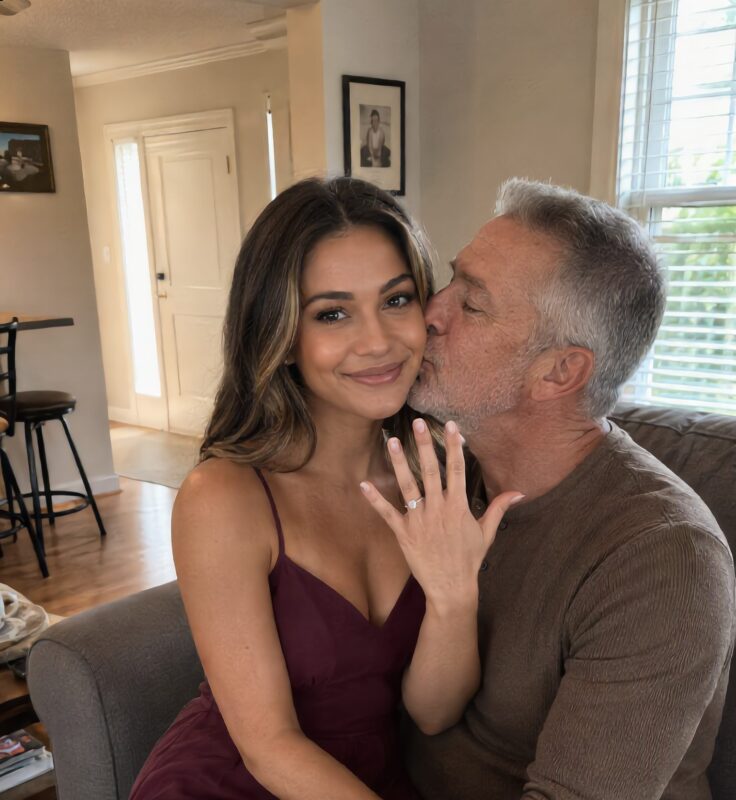
She looked tired.
Not glamorous.
Not triumphant.
Just tired.
That night, we sat at the kitchen table.
I could not hold back any longer.
“Did you marry him for his money?”
Chloe looked at me for several seconds.
Then she reached into her bag and placed an old hospital receipt on the table.
The logo stopped me cold.
It came from the hospital where I had been treated for cancer ten years earlier.
I picked it up.
At the bottom were words I remembered seeing long ago:
**Balance Paid in Full — Anonymous Donor**
I looked at Chloe.
“What does this have to do with Arthur?”
“Turn it over.”
There was a signature on the back.
It meant nothing to me.
But Chloe recognized it.
“I saw that signature during my placement,” she said. “Arthur signed a hospital document in front of me.”
I stared at her.
She continued.
“Years ago, he funded a private assistance program. It quietly paid medical bills for patients who couldn’t afford treatment.”
My throat tightened.
“You mean…”
“You were one of them.”
I could barely speak.
For ten years, I had believed some anonymous act of kindness had saved me from a debt that would have destroyed our lives.
Now that kindness had a name.
Arthur.
“He paid for my treatment?”
“Yes.”
I covered my mouth.
Then Chloe said, “But that’s not why I married him.”
That was when she told me the rest.
Arthur had advanced heart failure.
His condition was serious, and everyone around him knew his time was limited.
He had three adult children.
All successful.
All financially comfortable.
And all increasingly interested in what would happen to his estate after his death.
According to Chloe, they challenged his medical decisions, argued over property, questioned his spending, and discussed inheritance while he was sitting in the same room.
Eventually, they began taking legal steps to have him declared mentally incompetent.
Their goal was simple.
Take control of his finances.
Control his treatment.
Move him into a care facility he had repeatedly said he did not want.
Arthur’s body was failing.
His mind was not.
Chloe had met him during one of her hospital rotations.
At first, she treated him like any other patient.
She brought his medication.
Adjusted his pillows.
Sat with him when he could not sleep.
Listened when he wanted to talk.
One night, she noticed his signature on a form.
Something about it felt familiar.
Later, she checked through old documents I had kept from my treatment.
That was when she found the same signature.
She confronted Arthur gently.
He did not deny it.
Instead, he asked one question.
“Did your mother make it?”
Chloe said yes.
Arthur closed his eyes.
For a moment, he said nothing.
Then he whispered, “I’m glad.”
That was all.
As Arthur grew weaker, the conflict with his children became worse.
His solicitor warned him that they were preparing to challenge his decision-making capacity.
Doctors had repeatedly found him mentally competent, but legal battles could become complicated if his health deteriorated further.
Arthur wanted someone he trusted to have clear authority to defend his wishes.
That person was Chloe.
He asked her to marry him.
She refused at first.
Then he explained exactly what he wanted.
Not romance.
Not an heir.
Not someone to inherit everything.
He wanted one person legally empowered to say:
No, he does not want that treatment.
No, he does not want to be moved.
No, he is still capable of making his own decisions.
Independent doctors evaluated him before the marriage.
His solicitor documented everything.
Arthur understood exactly what he was doing.
After they married, he gave Chloe power of attorney.
I sat in silence after she finished.
Finally, I asked, “You married him so his children couldn’t take away his rights?”
Chloe’s eyes filled with tears.
“I married him because he deserved to spend his final months as a person, not as an estate waiting to be divided.”
Every accusation I had thrown at her came back to me.
I had called her selfish.
Greedy.
Naive.
I had never once considered that she might be protecting someone.
A week later, I flew to London.
Arthur was sitting near a large window when we met.
He looked much frailer than he had in the photograph.
I walked toward him with tears already in my eyes.
I had rehearsed a speech on the plane.
I wanted to thank him for paying my bills.
For giving me another chance.
For giving Chloe more years with her mother.
But the words would not come.
Arthur saw me struggling and smiled.
“You don’t owe me anything.”
“I owe you my life.”
He shook his head and looked toward Chloe.
“You already repaid me.”
I frowned.
“How?”
“You raised someone who stayed.”
That sentence broke me.
For the next three weeks, I watched their marriage up close.
It was nothing like the version I had imagined.
There were no expensive vacations.
No luxury shopping.
No dramatic romance.
There were pill organizers.
Medical appointments.
Nights when Arthur could not breathe comfortably.
Days when he was too weak to finish a meal.
Chloe spoke to doctors, handled paperwork, monitored his medication, and stayed beside him when pain made sleep impossible.
Sometimes they talked for hours.
Sometimes they watched old movies.
Sometimes they sat in complete silence.
What they had was difficult to define.
It was not the love story I had expected.
But it was still love.
Built from trust.
Gratitude.
Loyalty.
Respect.
And the refusal to abandon someone when staying became difficult.
Then Arthur’s children took the case to court.
They claimed Chloe had manipulated a wealthy, vulnerable man.
Their lawyers described her as an ambitious young woman who had targeted him for financial gain.
The accusations sounded disturbingly similar to the ones I had made myself.
But Chloe was ready.
She arrived with independent medical assessments showing Arthur was competent.
There were recorded statements explaining his decisions.
Letters from his solicitor.
Hospital records.
Testimony from nurses and physicians.
Documentation showing that the marriage had been discussed, evaluated, and entered into knowingly.
The evidence was overwhelming.
Eventually, Arthur was permitted to address the judge.
He looked toward his children.
“My children speak about my death as though it has already happened,” he said.
The courtroom became still.
“They discuss property. Accounts. Houses. Investments.”
Then he looked at Chloe.
“She asks whether I am comfortable.”
He paused to catch his breath.
“I know I am dying.”
Another pause.
“But dying does not mean confused.”
The judge rejected the petition.
Arthur retained control over his finances and medical treatment.
He stayed in his own home.
Exactly where he wanted to be.
Four months later, he died there.
Peacefully.
Chloe sat on one side of the bed.
I sat on the other.
Near the end, Arthur opened his eyes and looked at me.
“You were worth saving,” he whispered.
Then he turned to Chloe.
“Promise me you won’t let cruel people turn you cruel.”
She squeezed his hand.
“I promise.”
He died shortly afterward.
After the funeral, Chloe and I sat together in Arthur’s quiet living room.
There was one question I still needed to ask.
“Did you love him?”
She did not hesitate.
“Yes.”
I looked at her.
“What kind of love?”
She thought for a moment.
Then she said, “The kind that means you stay when someone has nothing left to offer you except who they are.”
I took her hand.
“I was awful to you.”
“You were worried.”
“No,” I said. “I was wrong.”
That distinction mattered.
I had looked at my twenty-two-year-old daughter beside a fifty-six-year-old man and built an entire story from a single photograph.
I saw greed.
I saw manipulation.
I saw money.
I never saw the frightened, dying man behind the expensive coat.
And I never saw the courage it took for my daughter to stand beside him.
Chloe did not marry Arthur because she wanted his fortune.
She married him because he was losing control of everything except his mind, and she refused to let anyone take that away too.
For years, I believed my greatest achievement was giving Chloe the chance to become a nurse.
I was wrong about that too.
Her greatest gift was not what she learned in a hospital.
It was the kind of person she chose to become.
Someone willing to become family to a man whose own family had already begun treating him like property.