My Daughter and Her Newborn Were Left to Die in a Locked Car—But One Hidden Camera Recorded Everything
I knew something was wrong the moment I saw Rachel’s car.
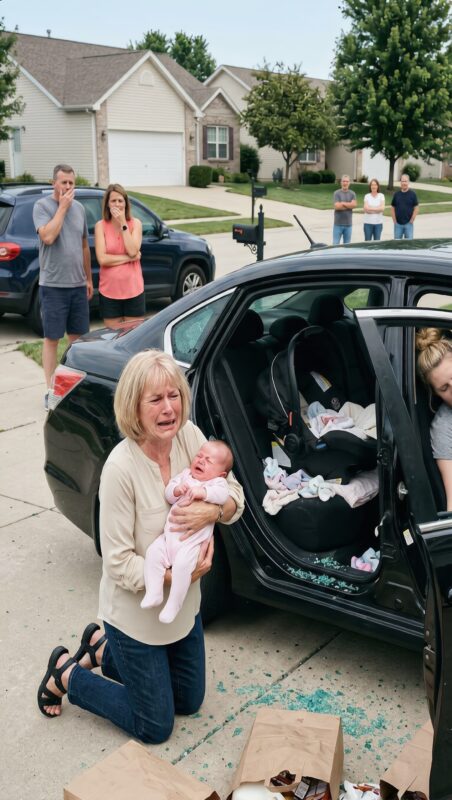
It was parked diagonally across my driveway, one wheel nearly touching the flower bed. The engine was silent, the doors were closed, and every window was sealed.
I had just returned from the pharmacy and assumed she had gone inside in a hurry.
Then something moved behind the glass.
A tiny hand rose weakly from the back seat.
I dropped the bags and ran toward the car.
Rachel was folded over the steering wheel, barely conscious. Her face was flushed, her hair was plastered to her skin, and her blouse was soaked through with sweat.
Behind her, my three-week-old granddaughter, Lily, was strapped into her carrier. Her cheeks were crimson. She no longer had the strength to cry properly. Only thin, broken sounds escaped her.
I yanked at the handle.
Locked.
I shouted Rachel’s name and struck the window with my palm.
Her eyelids fluttered. She tried to lift one arm toward the controls, but it collapsed against the console.
I stopped thinking.
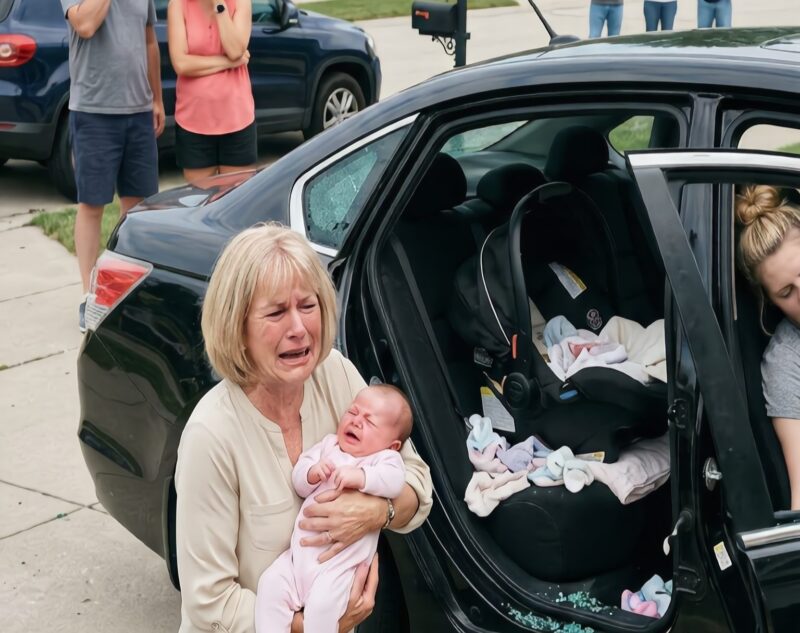
My late husband had kept an emergency glass hammer in the garage. I grabbed it, rushed back, and shattered the rear window on the side farthest from Lily.
After clearing the glass, I reached inside, unlocked the vehicle, and pulled Lily out first.
Her body felt frighteningly hot.
Then I opened the driver’s door and helped Rachel onto the driveway.
She could barely speak.
“Who did this?” I asked.
Her lips trembled.
“Tyler… Vanessa…”
Then she went limp in my arms.
The ambulance arrived minutes later.
As the paramedics carried Rachel and Lily away, Tyler’s SUV turned into the driveway.
He climbed out with Vanessa beside him.
Neither of them rushed toward the ambulance.
Tyler looked irritated rather than terrified.
“What happened this time?” he asked.
I stared at him.
“Your wife and your daughter were trapped in that car. They almost died.”
His expression shifted briefly, but he recovered quickly.
He told the police that Rachel had been behaving irrationally since giving birth. He claimed she must have locked herself inside during some kind of episode.
His explanation might have sounded believable if the scene had not contradicted nearly every word.
Rachel’s phone was missing.
Her key fob was gone.
The diaper bag had been placed on the rear floor, beyond her reach.
The driver’s seat had been pushed backward so far that she could barely reach the dashboard.
An empty electrolyte bottle stood in the cup holder.
My neighbor, Mrs. Alvarez, gave the officers another problem with Tyler’s story.
She had seen his SUV outside my house earlier.
Vanessa had been standing next to Rachel’s car while another person leaned through the open driver’s door.
At the hospital, the doctors told me that Lily had been dangerously close to serious heat injury.
Rachel was severely dehydrated, confused, and drifting in and out of consciousness.
When a nurse prepared to take blood, Tyler tried to stop her.
“There’s no reason for that,” he said. “She’s exhausted. Let her sleep.”
I stepped between him and the bed.
“You are not making decisions for her anymore.”
His face darkened.
He leaned closer and spoke quietly enough that the nurses could not hear.
“Rachel has no job, no house of her own, and no money. Without me, she’ll lose everything—including Lily.”
The threat did not intimidate me.
It reminded me of my husband.
Years earlier, after several burglaries in our neighborhood, he had installed a second security camera inside the exterior garage light.
The visible doorbell camera was easy to spot.
The one hidden in the light fixture was not.
Tyler had removed the doorbell camera.
He had missed the other one.
That evening, Detective Chen joined me at the house.
We opened the archived footage.
Rachel’s car arrived first.
Several minutes later, Tyler’s SUV appeared behind it.
Tyler walked to the driver’s door, leaned inside, and placed something in the cup holder.
Vanessa got out next.
Then someone else stepped from the rear passenger seat.
When she turned toward the camera, I recognized her immediately.
Evelyn.
Tyler’s mother.
The footage showed Evelyn removing Rachel’s phone from the passenger seat. Then she took the key fob and locked the car from the outside.
Tyler glanced through the rear window.
“The baby is still inside,” he said.
Evelyn barely looked at Lily.
“That makes the story stronger,” she replied. “No one questions a breakdown when a child is involved.”
Vanessa shifted uneasily.
Even Tyler seemed uncertain.
But Evelyn reminded him that Rachel had to be frightened and disoriented before she would sign anything.
Then the three of them drove away.
The detectives soon uncovered the rest.
Two days before the incident, Evelyn had arranged for an attorney to prepare an emergency custody petition. The document accused Rachel of being mentally unstable and dangerous to her child.
It requested that Lily be placed temporarily in Evelyn’s care.
The petition had already been signed that morning.
Then the hospital contacted Detective Chen.
Rachel’s blood test revealed a prescription sedative.
The amount was dangerous on its own. Combined with the heat and dehydration, it could easily have killed her.
Police searched Evelyn and found Rachel’s phone inside her handbag.
The missing key fob was in her coat pocket.
Tyler’s composure shattered.
“You said it would only relax her,” he shouted at Evelyn. “You said we’d come back before anything happened.”
That sentence destroyed the last part of their defense.
When Rachel was well enough to give a statement, she explained what had led to the attack.
For weeks, Tyler had pressured her to transfer a lake house into his name. The property had belonged to my husband and had passed to Rachel after his death.
She refused.
On the day she nearly died, Tyler handed her an electrolyte drink and insisted she needed it because she looked tired.
After several sips, she began to feel dizzy.
Her thoughts became slow and disconnected.
Her limbs felt too heavy to control.
The last clear image she remembered was Evelyn taking the keys while Vanessa stood near the open door.
Laboratory tests confirmed that the drug in Rachel’s blood was the same medication prescribed to Evelyn.
Pharmacy records showed when she had collected it.
Investigators recovered deleted messages discussing the lake house, the custody petition, and their plan to make Rachel appear incapable of caring for Lily.
Vanessa eventually agreed to testify.
She admitted that Tyler had promised they would live together once Rachel lost custody and the property was transferred.
The motives were simple.
Tyler wanted the house.
Evelyn wanted Lily.
Vanessa wanted the life Tyler had promised her.
At trial, the jury watched the entire security recording.
They saw Evelyn lock the doors.
They heard her say the baby would make the story more convincing.
Doctors explained how close Rachel and Lily had come to permanent injury—or death.
Evelyn was convicted of the most serious charges against her.
Tyler was convicted as well, and the court placed severe restrictions on his parental rights.
Rachel received sole custody of Lily.
Evelyn was legally barred from contacting either of them.
A few months later, Rachel and Lily moved in with me.
One afternoon, Lily stood beside the porch steps, holding tightly to the railing.
Then she released it.
She took one step.
Then another.
She crossed the same driveway where I had once found her trapped inside a burning-hot car.
Rachel lifted her into her arms and began to cry.
“I thought they had taken our whole future,” she whispered.
I held them both.
“They didn’t take it,” I said. “They only lost the right to be part of it.”
The place where they tried to end our family became the place where Lily first learned to walk.
Sometimes justice begins with broken glass.
And sometimes the truth survives because someone arrogant enough to remove one camera never thinks to search for another.