My Father Made Me Walk Down the Aisle Alone—Until the Chapel Doors Opened Again
PART ONE: THE WEDDING
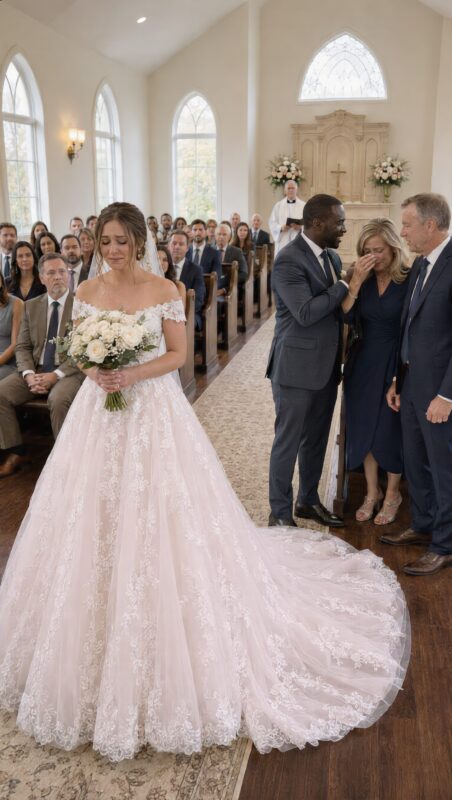
My father did not hesitate when I asked him to escort me to the altar.
He laughed.
“You embarrassed this family by choosing him,” Richard Whitmore said. “Do not expect me to celebrate it.”
Then he added, with a smile meant to wound me, “Walk alone.”
On my wedding day, he sat in the back row beside my mother as though he were an ordinary guest.
I waited outside the chapel with my bouquet pressed against my chest. Through the open doorway, I could see Ethan standing at the altar.
Ethan Cole was a public defender. He did not own an expensive home, belong to a private club, or have powerful friends. He spent his days representing people everyone else had already judged.
To my father, that made him insignificant.
The music began.
I stepped into the chapel without anyone beside me.
Every face turned in my direction. Some guests looked uncomfortable. Others quickly lowered their eyes.
My father watched openly.
He wanted the empty space beside me to feel like a public punishment.
I had nearly reached the center of the aisle when the chapel doors opened behind me.
Footsteps echoed across the stone floor.
Thirty strangers entered, all wearing gray suits. They separated into two lines, standing quietly along both sides of the aisle.
A broad-shouldered man with silver hair walked toward the back row.
He stopped in front of my father.
“I am Marcus Bell,” he said. “I work with the Innocence Review Network.”
Dad leaned back in his seat. “And why are you interrupting my daughter’s wedding?”
Marcus glanced toward Ethan.
“Because the man she is marrying proved that my son was innocent after everyone else had given up on him.”
A murmur spread through the chapel.
“My son was facing twenty-five years in prison,” Marcus continued. “Ethan found evidence no one else bothered to examine.”
He gestured toward the people in gray.
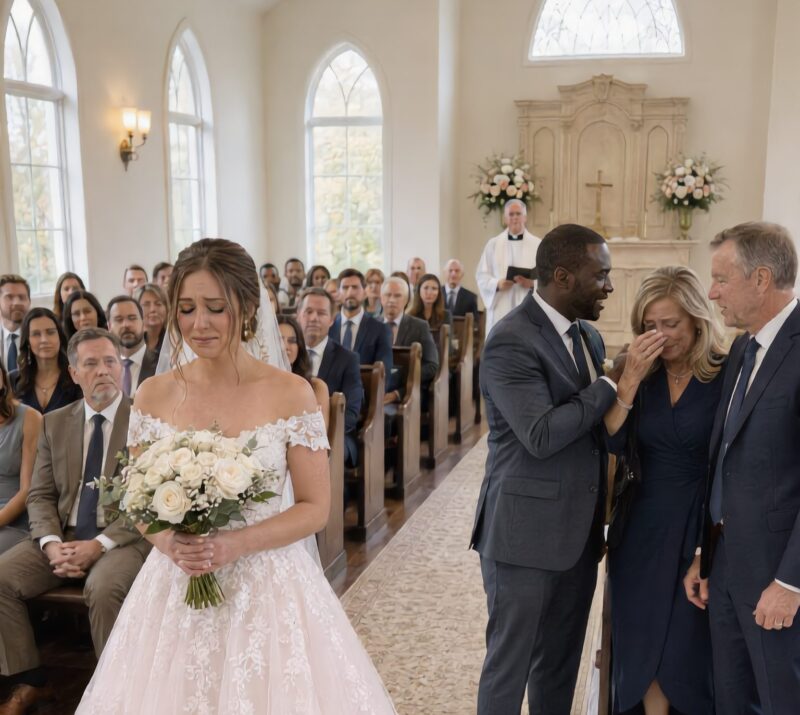
“Every person standing here has a similar story. Ethan helped our families when we had no money, no influence, and almost no hope.”
My father’s expression hardened.
“You described him as a nobody,” Marcus said. “To us, he is the reason someone we love came home.”
Then he removed a document envelope from inside his jacket.
“There is another reason we are here.”
My father’s eyes dropped to the envelope.
Marcus continued, “During a recent investigation, Ethan discovered financial irregularities connected to the Whitmore Hope Fund.”
The color slowly drained from Dad’s face.
“The attorney general’s office has been reviewing those records.”
Two investigators entered the chapel.
PART TWO: THE FALL
My father gave a short, humorless laugh.
“This is absurd,” he said. “Maya, tell your fiancé to end this performance.”
I looked at Ethan.
“What records?”
His face tightened with regret.
He explained that my father had threatened to destroy his legal career if he continued seeing me. Ethan believed the threat might be connected to one of his cases, so he began examining publicly available documents involving the Whitmore Foundation.
What he discovered was far worse than intimidation.
Scholarship money had been issued to students who did not exist.
Some listed addresses belonged to empty buildings. Others led to abandoned land, companies controlled by my father, or properties owned by his associates.
A woman near the entrance raised her badge.
“Denise Walker, Office of the Attorney General,” she announced. “We have authorization to collect electronic devices and records connected to suspected wire fraud, charitable fraud, obstruction, and evidence tampering.”
My mother stood so quickly that her chair scraped against the floor.
“Richard,” she said, “tell me they are mistaken.”
Dad turned toward her.
“Sit down, Helen.”
She had obeyed him for most of their marriage.
That day, she did not move.
The investigators took my father’s phone and escorted him outside for questioning. He was not handcuffed, but the man who left the chapel was not the same man who had entered it.
His power had depended on everyone being afraid of him.
Now no one was.
Ethan approached me slowly.
He stopped before reaching for my hand.
“I am sorry,” he whispered. “I never wanted you to learn about any of this during our wedding.”
“You should have told me.”
“I know.”
He looked toward the chapel doors.
“We can postpone everything. We can leave. Whatever you decide, I will follow your choice.”
That was the difference between Ethan and my father.
One demanded obedience.
The other gave me room to decide.
I looked at the strangers lining the aisle. They had come because Ethan had once stood beside them during the worst moments of their lives.
I turned back toward the altar.
“We are not leaving,” I said.
The thirty visitors remained in place as I continued walking.
The space beside me was still empty, but I no longer felt abandoned.
At the altar, Ethan apologized again for hiding the investigation.
“You thought my father would force me to choose,” I said.
“Yes.”
I glanced toward the doors through which Dad had disappeared.
“He did force me to choose,” I replied. “He just assumed I would choose him.”
During his vows, Ethan promised that he would never confuse love with ownership. He promised to tell me difficult truths, respect my decisions, and never ask me to become quieter so he could feel more important.
When it was my turn, I folded the page containing my prepared vows.
“This morning, someone wanted me to walk alone so I would feel rejected,” I said. “But loneliness is not measured by who stands beside you in a ceremony. It is measured by whether the person you love makes you feel heard, protected, and free.”
I looked into Ethan’s eyes.
“You have never made me feel alone.”
We were married that afternoon.
My mother began applauding first.
My brother Caleb followed.
Soon, the entire chapel was on its feet.
Outside, my father heard the celebration. He looked back toward the building, but no one went after him.
PART THREE: WHAT REMAINED
Most of my father’s wealthy associates disappeared before the reception.
The people in gray stayed.
They filled the tables, danced with their families, and told me stories about Ethan.
Marcus explained that Ethan had once spent three nights reviewing grainy bus-station footage frame by frame. That footage proved Marcus’s son could not have committed the crime for which he had been charged.
“Ethan does not care whether anyone notices what he does,” Marcus said. “He sees someone in trouble, and he stays until the work is finished.”
My mother later admitted that she had known my father was moving money through the foundation, although she claimed she never understood the full extent of it.
She agreed to cooperate with prosecutors and filed for divorce.
Caleb confessed that the charity had paid the deposit on his apartment. He surrendered bank statements, emails, and financial records.
Fourteen months after the wedding, my father pleaded guilty.
The investigation uncovered fake scholarship recipients, shell companies, fabricated invoices, altered accounting files, and messages instructing employees to destroy evidence.
He received a forty-one-month prison sentence and was ordered to repay the stolen money.
The verdict did not repair everything.
Ethan and I attended counseling because his secrecy had hurt me, even though he believed he was protecting me. He learned that keeping someone safe does not mean keeping them uninformed.
I learned that I had spent years taking responsibility for my father’s anger. Whenever he hurt me, I searched for something I had done to deserve it.
Slowly, I stopped apologizing for wounds I had not created.
On our first anniversary, we invited the thirty families to our home. We ate dinner beneath strings of lights in the backyard.
Before dessert, Ethan stood and raised his glass.
“One year ago, Maya entered a chapel believing she had been left to walk alone,” he said. “But she chose courage over approval, and that choice gave everyone else permission to be brave too.”
Later, after the guests had gone, he asked whether I still missed my father.
“At times,” I admitted.
“The person he was?”
I shook my head.
“I miss the father I imagined he might someday become.”
My father had refused to escort me because he wanted the empty space beside me to look like proof that I was unworthy.
Instead, the chapel doors opened.
Thirty strangers entered, and the truth followed them inside.
That day, I discovered that being rejected by someone who only loves through control is not always a loss.
Sometimes, it is the first step toward freedom.