My Husband Returned From His Fishing Trip With a Strange Mark on His Ring Finger. I Thought He Was Cheating—Until a Terrifying Phone Call Exposed His Secret.
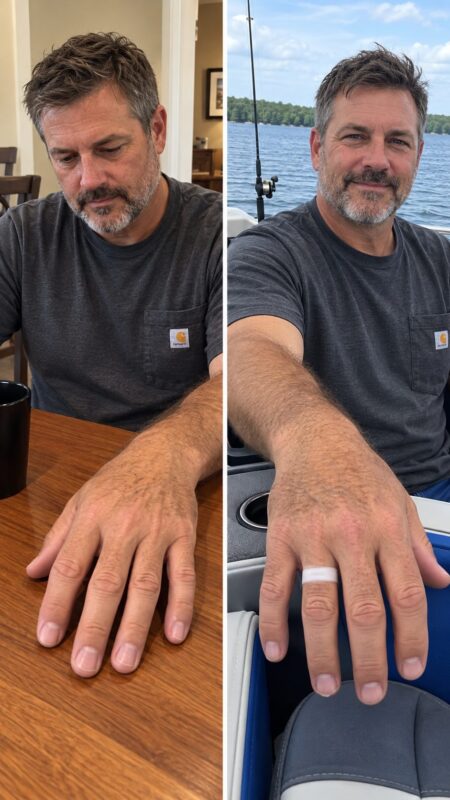
My husband came home from a weekend fishing trip with a pale, unmistakable circle around his left ring finger.
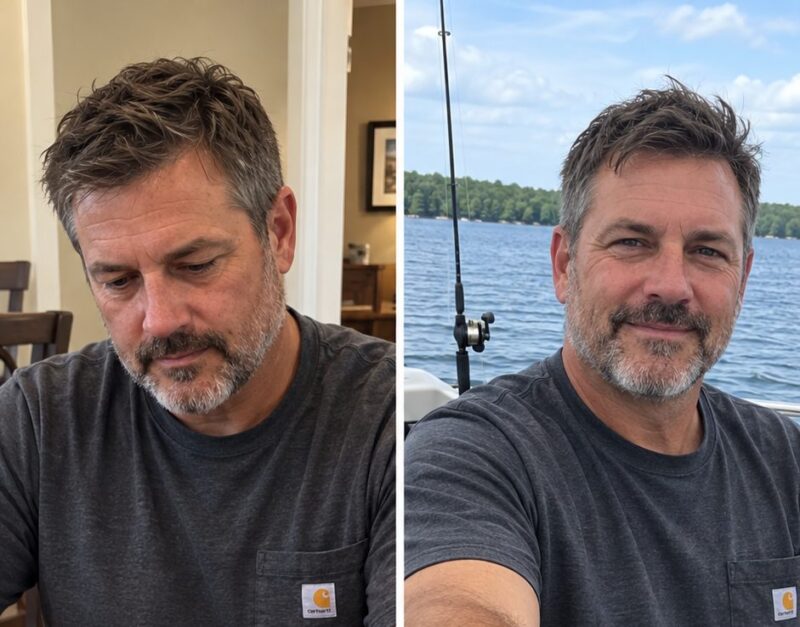
It was the kind of mark left behind by a wedding band.
But my husband, Mark, hadn’t worn his wedding ring in twelve years.
When I questioned him, he shrugged and claimed the fishing rod must have caused it.
I wanted to believe him.
Then I discovered a hotel key and a jewelry receipt worth more than $2,000 hidden inside his suitcase.
The key belonged to Room 12 at Lakeview Inn.
The very room where we’d spent our honeymoon twenty-six years earlier.
I was convinced Mark had taken another woman to the place where our marriage began.
But I couldn’t have been more wrong.
The truth emerged when my phone rang the following afternoon.
“Lee?” Mark whispered.
His voice sounded unfamiliar, almost childlike with fear.
“Please help me. I don’t know where I am.”
My husband, Mark Ellison, had enjoyed an annual fishing weekend at Loon Lake with his three closest friends for nearly a decade.
He usually returned with photographs, ridiculous stories, and enough fish to fill our freezer.
This year, however, he came home unusually withdrawn.
He barely touched his dinner. Twice, he stopped speaking halfway through a sentence, as though he’d forgotten what he wanted to say.
Then I spotted the white circle on his finger.
Years earlier, an accident at work had damaged his knuckle, making his original wedding band uncomfortable to wear. He’d placed it in a wooden keepsake box and never put it on again.
“Have you been wearing a ring?” I asked.
Mark immediately curled his hand into a fist.
“No. Why?”
“There’s a mark on your finger.”
“Oh, that.” He glanced away. “Probably from holding my fishing rod.”
Something about his reaction bothered me more than the mark itself.
The next morning, I checked the wooden box.
His old wedding ring was still there.
Later, I examined the photographs his friends had uploaded from their trip.
Mark appeared in only two pictures. In both, his left hand was hidden.
Another photograph showed his friends sitting around a table at Gull’s Nest Café.
Four breakfast plates were visible.
Only three men were seated.
Where was my husband?
I called the restaurant.
“Hello, I’m trying to reach someone who might remember a customer named Mark Ellison.”
The waitress paused.
“Are you his wife?”
“Yes.”
Her voice softened.
“Oh, dear. I thought someone would have told you.”
“Told me what?”
Another uncomfortable silence followed.
“I’m sorry. I really shouldn’t say anything.”
She ended the call before I could ask another question.
By then, I was certain something was terribly wrong.
That night, I searched Mark’s luggage.
Beneath his clothes, I discovered a hotel key card.
LAKEVIEW INN — ROOM 12.
My chest tightened.
Twenty-six years earlier, we’d spent our honeymoon in that room. We’d been young, nearly broke, and deliriously happy.
Mark had promised to bring me back someday.
Apparently, he’d returned without me.
Then I found a folded receipt from an exclusive jewelry store.
The total was $2,180.
A handwritten message appeared beneath the purchase details:
“Engraving completed. Congratulations, Mr. Ellison.”
I stared at those words until they blurred.
Was he buying an engagement ring?
Had he fallen in love with someone else?
I spent the night beside a man I suddenly felt I didn’t know.
The following morning, after Mark left the house, I opened his laptop.
Several password attempts failed.
Then I entered “Loon Lake.”
The screen unlocked.
A folder on his desktop immediately caught my attention. Its icon was a tiny gold wedding ring.
Inside were dozens of photographs, scanned documents, and video recordings.
One file carried a message that made my hands tremble.
“LEE, PLEASE WATCH THIS BEFORE ANYTHING ELSE.”
I clicked.
Mark appeared on the screen, sitting alone near a window.
He looked exhausted.
“Lee,” he began, “I’ve rehearsed this conversation a hundred times, but every time I see you, I lose my courage.”
He paused and rubbed his forehead.
“Three months ago, a neurologist told me I have early-onset Alzheimer’s disease.”
For a moment, I couldn’t move.
Mark continued speaking.
“I started forgetting appointments. Then I began losing track of conversations. Once, I drove to the grocery store and couldn’t remember how to get back.”
His eyes filled with tears.
“I kept telling myself I was tired. But deep down, I knew something wasn’t right.”
He explained the medical examinations, the diagnosis, and his growing fear.
“I wanted to tell you immediately. But how do you tell the person you love most that someday you might look at her and see a stranger?”
My tears began falling.
“I know I should’ve trusted you,” he whispered. “I was just terrified of becoming someone you’d have to take care of.”
He reached for a small box.
“I went back to Lakeview Inn because I wanted to remember the happiest beginning of my life.”
He opened the box.
Inside was a gold wedding band.
“I had this made because my old ring doesn’t fit anymore. I wanted us to renew our vows on our anniversary.”
Then he turned the band toward the camera.
Four words had been engraved inside.
“I’d choose you again.”
I covered my face and sobbed.
The ring mark hadn’t belonged to another woman’s gift.
Mark had been trying on his own new wedding band.
The mysterious hotel visit wasn’t an affair.
It was his attempt to preserve a precious memory while he still could.
His friends had accompanied him because they knew about his diagnosis and were worried about his increasing confusion.
The waitress had witnessed him struggling to remember where he’d left his belongings during breakfast.
She’d assumed I already knew.
I opened more files.
There were letters to our daughter, financial instructions, medical information, and videos for birthdays and anniversaries that hadn’t happened yet.
Mark was preparing for a future he couldn’t predict.
He’d recorded messages explaining how proud he was of our daughter, how grateful he was for our marriage, and how desperately he wanted us to remember the happy years rather than only the difficult ones.
Then my phone rang.
It was Mark.
“Lee?”
“I’m here, sweetheart.”
His breathing was uneven.
“I don’t know where I am.”
I sat upright.
“Are you driving?”
“No. I stopped somewhere. I don’t recognize anything.”
“Tell me what you can see.”
“A gas station. There’s a red sign across the road. Lee, I’m scared.”
I helped him identify the location and asked him to remain inside the station until I arrived.
Twenty minutes later, I found him sitting near the entrance.
He looked up when he heard my voice.
And immediately began to cry.
“I’m sorry,” he said.
I knelt beside him.
“For what?”
“For lying. For making you worry. For everything that’s coming.”
I held his hands.
“Mark, I know.”
He stared at me.
“You watched the video?”
I nodded.
His shoulders sagged.
“I didn’t want you to lose your freedom because of me.”
“You’re my husband, not a burden.”
“But what happens when I can’t remember you?”
“Then we’ll find new ways to know each other.”
“What if I forget our wedding?”
“I’ll show you the pictures.”
“What if I forget our daughter?”
“We’ll help you remember what we can, and she’ll still know you’re her dad.”
He lowered his head.
“And what if I forget that I love you?”
I brushed a tear from his cheek.
“Then you won’t have to prove anything to me.”
For the first time, Mark allowed himself to lean on me without apologizing.
In the weeks that followed, we met with his medical team, discussed support services, and made decisions about our future together.
Our daughter came home as soon as we told her.
She hugged Mark for a long time.
“Dad,” she said, “you’ve always been there for me. Now it’s my turn to be here for you.”
Life gradually settled into a new rhythm.
Some days, Mark seemed exactly like the man I’d known for decades.
He laughed at his own jokes, complained about the weather, and insisted nobody made better pancakes than he did.
Other days were more challenging.
He misplaced familiar objects, forgot conversations, or became overwhelmed in places he’d visited countless times.
We learned to make plans without allowing fear to control every moment.
On our twenty-seventh anniversary, I arranged a special trip.
When we reached Lakeview Inn, Mark looked around with curiosity.
I opened the door to Room 12.
He walked slowly toward the window overlooking Loon Lake.
“Have we been here before?” he asked.
“Yes. This is where we spent our honeymoon.”
He smiled faintly.
“I thought it looked familiar.”
We sat together watching the sunset.
After a while, Mark reached into his pocket and removed the gold ring.
He studied it carefully.
“Did I give you this?” he asked.
“You bought it for our anniversary.”
He turned it over, reading the inscription.
Then he looked at me with a tenderness that reminded me of the young man I’d married.
“Would you marry me again?”
I squeezed his hand.
“I’d say yes every time.”
He smiled.
“Good. Because you seem like someone I would want beside me.”
That evening, we promised to keep choosing one another, even when our lives looked different from what we’d imagined.
As the months passed, Mark’s memory became less dependable.
We began keeping photographs around the house, along with notes and familiar objects that helped him feel comfortable.
Every evening, if he wanted to, we sat together and talked about our life.
I told him about our first date, our daughter’s first steps, our disastrous attempt at camping, and the Christmas when he accidentally bought two identical gifts.
Sometimes he remembered the stories and laughed before I reached the ending.
Sometimes he listened as though everything was entirely new.
One evening, after looking through our wedding album, Mark became unusually quiet.
“Lee?”
“Yes?”
“I don’t remember much about that day.”
“That’s okay.”
He touched the photograph of us standing outside the church.
“You look happy.”
“I was.”
“Was I a good husband?”
The question broke my heart.
I took his hand.
“You’ve given me a life full of love, Mark.”
He smiled gently.
“I don’t remember all of it.”
“I know.”
“But I like being here with you.”
I leaned against his shoulder.
And somehow, those simple words meant more than any grand declaration.
Before his diagnosis, I’d imagined love as a lifetime of shared memories.
Now I understood that memories were only one part of our story.
There was also trust, patience, laughter, companionship, and the quiet comfort of being together.
I couldn’t promise Mark that every day would be easy.
I couldn’t stop time or restore everything his illness might take away.
But I could promise that he wouldn’t have to navigate those changes alone.
Perhaps one morning he’ll wake up and no longer recognize the woman sitting beside him.
Perhaps he’ll ask my name.
And if he does, I’ll smile and say:
“I’m Lee. It’s lovely to meet you.”
If he asks how we know each other, I’ll tell him about a young couple who fell in love, a little hotel overlooking Loon Lake, and the twenty-six wonderful years that followed.
I’ll show him a golden wedding band engraved with four words.
“I’d choose you again.”
And I’ll remind myself that our love story isn’t finished simply because he can no longer remember every chapter.
When I married Mark, I promised to stand beside him in sickness and in health.
I never said he had to remember our story for me to keep that promise.