The call came at 2:47 a.m.
I had been asleep for hours when my phone began vibrating on the bedside table. The moment I saw my fourteen-year-old grandson’s name on the screen, an uneasy feeling settled in my stomach.
“Grandma?” Noah whispered.
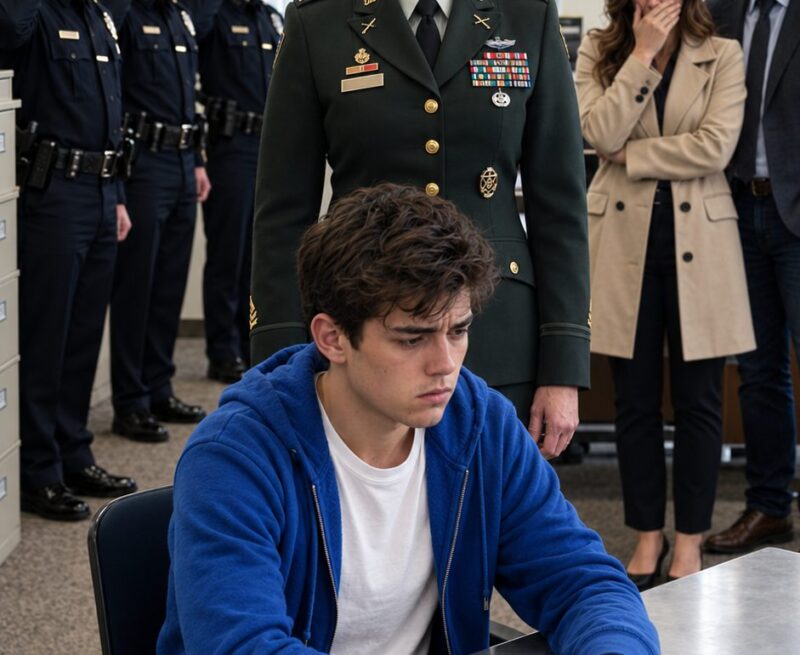
His voice sounded frightened.
“What’s wrong, sweetheart?”
“I’m at the police station. Lydia told them I hurt her. Dad believes her, and nobody will listen to me. Please, Grandma. I don’t know what to do.”
Twenty minutes later, I walked into the police station.
The officer at the reception desk glanced up, then abruptly rose from his chair.
“Commander Grant?”
His surprise attracted the attention of everyone nearby.
Across the waiting area, my daughter-in-law Lydia turned toward me. The confident smile she’d been wearing vanished.
She had spent months convincing my son that I was an interfering old woman who should stay out of their family business.
What she apparently hadn’t considered was that I had spent thirty-two years as a detective and police commander in Chicago.
I had questioned experienced criminals, investigated complicated cases, and learned to recognize when a story deserved closer examination.
And now my grandson was sitting in a police station, frightened and injured, while the people who should have protected him accused him of something he insisted he hadn’t done.
My name is Eleanor Grant.
I retired from the Chicago Police Department four years earlier, believing that the most stressful chapter of my life was behind me.
I was wrong.
The real trouble began after my grandson lost his mother.
My son, Mark, had been devastated by his wife’s death. For a long time, he struggled to balance grief, work, and raising a young boy who missed his mother terribly.
Then Lydia entered his life.
She was charming, attentive, and always seemed to know exactly what Mark needed to hear.
When they married, I hoped Noah would gain another adult who cared about him.
Instead, I watched my grandson slowly withdraw into himself.
At first, the changes were almost invisible.
He stopped calling as often. Weekend visits became rare. Whenever I asked to see him, Lydia had an explanation ready.
Noah was busy.
Noah had misbehaved.
Noah needed to learn responsibility.
Eventually, Mark began speaking about his son in ways I’d never heard before.
“He lies about everything, Mom.”
“He’s disrespectful to Lydia.”
“He keeps trying to cause problems between us.”
Whenever I asked whether he’d actually heard Noah’s side, Mark became defensive.
“Lydia lives with him every day. She knows what’s happening.”
I tried to explain that children sometimes become quiet when they feel unheard.
Mark accused me of undermining his marriage.
That was the last serious conversation we’d had before the phone call.
Now, standing inside the police station, I finally understood how dangerous that silence had become.
Noah sat alone on a bench near the wall.
A white bandage covered part of his forehead. His eyes were red, and he kept pulling at the sleeves of his sweatshirt.
When he noticed me, he stood so quickly that his backpack fell to the floor.
“Grandma!”
I crossed the room and embraced him.
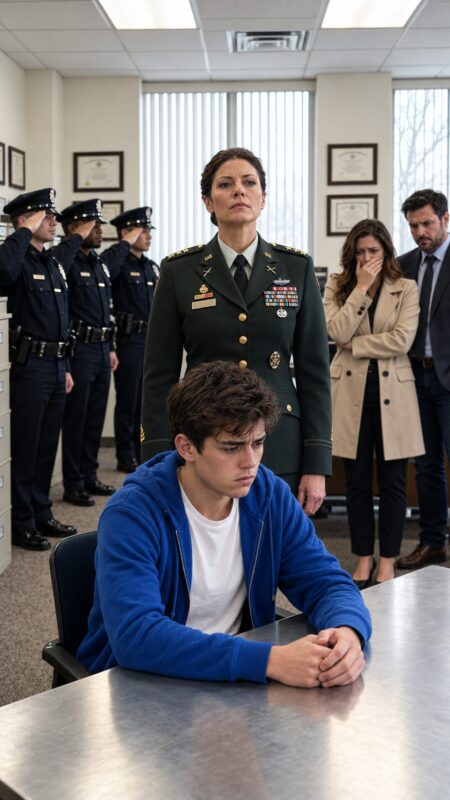
“I’m here, sweetheart.”
His shoulders shook as he held on to me.
Behind him, Mark cleared his throat.
“Mom, please don’t encourage this behavior.”
I turned slowly.
“What behavior?”
“He attacked Lydia. She’s been trying to help him, and this is how he repays her.”
Lydia stepped closer, wearing an expression of practiced disappointment.
“I never imagined Noah would do something like this. I’ve treated him like my own child.”
I looked from her to my grandson.
“Then I’m sure you won’t object to him explaining what happened.”
Lydia folded her arms.
“He’s already told enough lies.”
“I’m asking Noah,” I replied.
I sat beside him.
“Start at the beginning.”
He took a shaky breath.
“I asked Dad yesterday if I could spend the weekend with you.”
Mark frowned.
“You told me you wanted to stay home and finish your school project.”
“Because Lydia said I had to tell you that!”
“That’s not true,” Lydia interrupted.
I raised one hand.
“Let him finish.”
Noah continued.
“After Dad left for work, Lydia came into my room. She said I was trying to make her look bad. She told me if I kept asking to visit Grandma, she’d find a way to get me sent away.”
His voice grew softer.
“I told her I just missed you.”
I felt a familiar anger rising, but kept my expression calm.
“What happened next?”
“She started shouting. Then she picked up a candlestick from the hallway table. I got scared and backed away.”
He glanced at the floor.
“I tried to protect myself. Then she fell near the stairs and started screaming that I’d pushed her.”
Lydia gave a sharp laugh.
“Listen to him! He practically rehearsed that story.”
I turned toward her.
“You said Noah pushed you?”
“Yes.”
“How?”
“With both hands. He shoved me as hard as he could.”
I looked at Noah.
He touched the bandage.
“I had one hand against my forehead. I couldn’t have pushed her with both.”
Mark’s expression changed slightly.
Lydia noticed.
“Oh, Mark, don’t tell me you’re falling for this nonsense.”
Before he could answer, another officer approached.
He was tall, gray-haired, and immediately familiar.
“Eleanor?”
“Daniel Miller. It’s been a while.”
Captain Miller and I had worked together during some of the most demanding years of my career.
He greeted me briefly, then lowered his voice.
“We’re reviewing what happened at the residence. There’s an issue with the security cameras.”
I waited.
“They were switched off several hours before the incident. It doesn’t appear to have been an accidental outage.”
Lydia stiffened.
“That system is unreliable. I’ve complained about it before.”
Captain Miller nodded.
“We’ll check the service records.”
I noticed Noah suddenly glance toward his backpack.
His fingers tightened around one of the straps.
“Grandma,” he whispered, “there’s something I didn’t tell them.”
“What is it?”
“I have proof.”
Lydia turned sharply.
“What are you talking about?”
Noah reached into the bag.
She immediately stepped forward.
“Mark, stop him! He has no business taking that out!”
But Noah had already retrieved an old smartphone.
Its screen was cracked, and the protective case was peeling at the corners.
He held it carefully in both hands.
“I kept my old phone after Dad bought me a new one. Lydia didn’t know it still worked.”
His eyes met mine.
“I started recording when she came into my room because I was afraid nobody would believe me again.”
The room went quiet.
Lydia shook her head.
“He’s making this up.”
Noah tapped the screen.
A recording began playing.
At first, there was only the sound of footsteps and a door closing.
Then Lydia’s voice emerged, sharp and unmistakable.
“You need to understand something, Noah. This is my home now, and I’m tired of you acting like your grandmother has some kind of authority over me.”
“I only wanted to see her,” Noah replied.
“You always want something. More attention. More sympathy. You’re constantly trying to make your father feel guilty.”
“I’m not trying to do that.”
“Do you know what happens to boys who refuse to behave? Their parents find somewhere else for them to live.”
“Please don’t say that.”
“I can convince Mark you’re impossible to control. Who do you think he’ll believe? His wife or a boy who’s always causing trouble?”
There was a brief pause.
Then Noah’s voice sounded again.
“Why do you hate me?”
Lydia didn’t answer the question.
Instead, her voice rose.
“Stop making me the villain! You’re the one destroying this family!”
A sudden noise interrupted the conversation.
Noah cried out.
The phone seemed to move, and moments later the recording ended.
Nobody spoke.
Mark stared at the device as though he couldn’t understand what he’d just heard.
Finally, he turned toward Lydia.
“Tell me that wasn’t you.”
She blinked.
“Mark, sweetheart, you know how technology works. Recordings can be changed.”
“Was that your voice?”
“He provoked me!”
Mark stepped backward.
“You threatened to send my son away.”
“I was trying to discipline him!”
My son looked at Noah, then at the bandage on his forehead.
Something in his expression broke.
Captain Miller carefully took possession of the phone so the recording could be examined and preserved.
He explained that investigators would need to verify its authenticity and examine all the evidence before making conclusions.
But there was one thing nobody in that room could ignore.
Noah had been trying to tell his father something was wrong for a very long time.
And Mark hadn’t listened.
My grandson stood in front of him.
“Remember when I told you she called me worthless?”
Mark opened his mouth, but Noah continued.
“Remember when I said she wouldn’t let me call Grandma?”
“Noah, I…”
“You told me to stop making things up.”
His eyes filled with tears.
“I wasn’t making things up, Dad.”
Mark looked down.
“I know.”
“No. You didn’t know. Because you never wanted to hear it.”
Those words hurt my son more deeply than any accusation I could have made.
He lowered himself into a chair.
For the first time, Lydia had nothing useful to say.
By morning, the authorities had approved temporary arrangements for Noah to stay with me.
I took him home, made him breakfast, and prepared the spare bedroom he’d once used during his weekend visits.
The moment he stepped inside, he noticed something on the bookshelf.
His childhood collection of model cars.
“You kept them?” he asked.
“Of course I did.”
He picked up a little blue car.
“I thought you’d put everything away.”
I smiled gently.
“This has always been your room.”
That evening, I found him sitting on the bed, holding the same toy.
“Grandma?”
“Yes?”
“Can I stay here for a while?”
I sat beside him.
“We’ll make sure you have somewhere safe to stay, sweetheart.”
He nodded.
Then he asked the question I’d been dreading.
“Do you think Dad loves me?”
I took a moment before answering.
“I believe your father loves you, Noah. But love doesn’t excuse the times he failed to listen or protect you.”
He stared at the little car.
“I don’t want to go back there.”
“You don’t have to decide everything tonight.”
Over the following weeks, investigators uncovered more information.
Records connected Lydia’s tablet to the request to deactivate the security system. Noah’s school counselor also confirmed that he’d previously raised concerns about the atmosphere at home.
What had once been dismissed as teenage rebellion was finally being taken seriously.
Mark separated from Lydia, sought appropriate protective arrangements, and began counseling.
He called me frequently.
“How is Noah doing?”
“Better some days than others.”
“Does he ask about me?”
“Sometimes.”
“Can I see him?”
“When Noah is comfortable, and within the arrangements that are in place.”
I refused to make promises on my grandson’s behalf.
Mark needed to understand that trust wasn’t something he could demand simply because he was Noah’s father.
Nearly a month after the incident, he appeared at my front door carrying a battered cardboard box.
He looked exhausted.
“I found some of Noah’s belongings while I was packing,” he explained.
I invited him inside.
Noah was sitting at the dining table, drawing a picture of the garden.
When he noticed his father, he went still.
Mark placed the box near him.
“I brought a few things I thought you might miss.”
Inside were his sketchbooks, a navy-blue hoodie, several childhood keepsakes, and a photo album with a faded green cover.
Noah recognized it immediately.
“Mom’s pictures.”
He lifted the album with both hands.
On the first page was a photograph of his mother holding him as a baby.
Beneath it, she’d written a message.
*My darling Noah, wherever life takes you, never forget that you are loved more than words can express.*
He traced the letters with his finger.
I watched tears gather in his eyes.
Mark stayed by the doorway.
“Your mom made that album when you were little,” he said quietly. “She wanted you to have it when you got older.”
Noah turned another page.
Then another.
After several minutes, Mark spoke again.
“Son, there’s something I need to say.”
Noah didn’t look up.
“I failed you.”
Silence.
“I kept telling myself that Lydia knew what she was doing. Every time you tried to explain, I found a reason not to believe you.”
His voice began to break.
“I should have protected you. Instead, I made you feel alone in your own home.”
Noah closed the album.
“You were supposed to be on my side.”
“I know.”
“Mom always listened when I was upset.”
Mark nodded.
“She did.”
“And after she died, I thought at least I still had you.”
My son covered his face for a moment.
When he finally spoke, his words were barely audible.
“I’m so sorry.”
Noah studied him.
“I don’t know if I can trust you anymore.”
“I understand,” Mark replied. “I won’t ask you to pretend everything is fine. I just hope you’ll let me prove that I can change.”
Noah didn’t answer.
But when Mark left, he took the photo album to his bedroom and placed it beside his bed.
That evening, he asked me if people could really become different.
“Sometimes they can,” I said. “But it’s their actions over time that tell us whether they’ve changed.”
He thought about that.
“Then I guess we’ll see.”
And that was exactly what happened.
The months that followed weren’t simple.
There were setbacks, difficult conversations, and days when Noah didn’t want anything to do with his father.
Mark continued his counseling appointments and gradually learned to listen without defending himself.
He stopped making excuses for Lydia.
He stopped telling Noah how he should feel.
Most importantly, he began respecting his son’s boundaries.
Sometimes they met for breakfast.
Sometimes they walked through the park.
On other days, they simply exchanged messages about school, basketball, or a new drawing Noah was working on.
Small moments slowly replaced the awkward silence between them.
Meanwhile, Noah began rediscovering parts of himself that had nearly disappeared.
He joined an art club.
He made new friends.
He started laughing more often.
One afternoon, he came home carrying a certificate from a school drawing competition.
“Grandma, look!”
I examined it proudly.
“First place?”
He grinned.
“I didn’t think I’d win.”
“Well, I did.”
He laughed.
It was the carefree laugh I remembered from years earlier.
Almost a year after the night at the police station, Mark and Noah came to my house for Sunday dinner.
We ate roast chicken, potatoes, and the apple pie Noah had helped me prepare.
Conversation flowed easily.
Mark asked about Noah’s latest drawings, and Noah teased him about his terrible attempts at cooking.
After dinner, I began clearing the table.
“No, Grandma,” Noah said. “You’ve cooked all afternoon. I’ll do the dishes.”
I started to protest, but he was already carrying plates toward the kitchen.
A moment later, he looked at his father.
“Dad, want to help?”
Mark smiled.
“Absolutely.”
“You can dry. I don’t trust you with the washing.”
They both laughed.
I stood in the doorway watching them.
For anyone else, it would have looked like an ordinary family scene.
For me, it was something much more meaningful.
It was the sight of a father and son finding their way back to each other, one small act of trust at a time.
Later, Noah joined me on the porch.
The evening was cool, and the last light of the day was fading beyond the trees.
He sat beside me without speaking.
Then he leaned his head against my shoulder.
“Grandma?”
“Yes, darling?”
“Do you remember when I called you from the police station?”
“I remember.”
“I almost didn’t.”
I turned toward him.
“Why?”
He looked down.
“Because I’d gotten so used to adults not believing me. I thought maybe you’d be angry that I woke you up. Or maybe you’d think I was lying too.”
I took his hand.
“Noah, you never have to earn the right to ask for help.”
His eyes glistened.
“I know that now.”
We sat quietly for a moment.
Then he glanced through the window.
Mark was still in the kitchen, carefully putting away the clean dishes.
“Dad’s different,” Noah said.
“In what way?”
“He listens more. If I tell him I’m upset, he doesn’t automatically say I’m overreacting.”
“That sounds like progress.”
“Yeah.”
He hesitated.
“But sometimes I still get angry when I think about what happened.”
“Of course you do. Being hurt doesn’t mean those feelings disappear just because someone apologizes.”
“Do you think I’ll ever completely forgive him?”
“That’s something only you can decide. And there’s no deadline.”
He considered my words.
Then he smiled faintly.
“I think I want to try.”
A few minutes later, he stood and walked to the door.
“Dad?”
Mark looked up from the kitchen.
“What’s up?”
“Can we look at Mom’s photo album together?”
My son froze.
Then a warm smile slowly spread across his face.
“I’d love to.”
They sat on the living room sofa with the green album between them.
As Noah turned the pages, Mark began telling stories about his mother.
He reminded Noah how she used to dance while cooking breakfast, how she laughed at her own jokes, and how she insisted on taking dozens of photographs during every family holiday.
Soon they were both smiling.
At one point, Noah laughed so hard that he had to wipe his eyes.
I watched from the hallway without interrupting.
For decades, I had believed my greatest professional achievement was helping people find justice.
I had spent thirty-two years investigating crimes, uncovering secrets, and making sure that important truths weren’t buried beneath convenient lies.
But that year taught me something I had never fully understood while wearing a police uniform.
Exposing the truth is not always the end of a painful story.
Sometimes it is only the beginning of recovery.
Noah needed more than evidence to prove that he’d been telling the truth.
He needed a home where he could relax without fear.
He needed someone willing to listen without immediately questioning his honesty.
And he needed the freedom to rebuild his relationship with his father at his own pace.
Mark, in turn, had to learn that being a parent meant more than providing a roof and paying the bills.
It meant paying attention.
It meant recognizing when a child was struggling.
And it meant believing that a young person’s feelings deserved to be heard.
That night, as father and son sat together turning the pages of an old photo album, I quietly returned to the porch.
My phone was lying on the small table beside my chair.
I looked at it and remembered the call that had changed everything.
2:47 a.m.
One frightened boy.
One desperate plea.
One decision to answer.
For years, people had known me as Commander Grant, the woman who could walk into a difficult situation and demand answers.
But when Noah needed me most, none of those titles mattered.
I wasn’t there to impress anyone.
I wasn’t there to relive my career.
I was simply a grandmother who loved her grandson enough to show up, listen, and stand beside him.
And that was exactly what he needed.
**Because every child deserves at least one person who will hear their voice in the darkness, answer when they call, and remind them that they never have to face the world alone.**